Deadline extended second time for selecting operator of Nagdhunga-Sisnekhola tunnel road
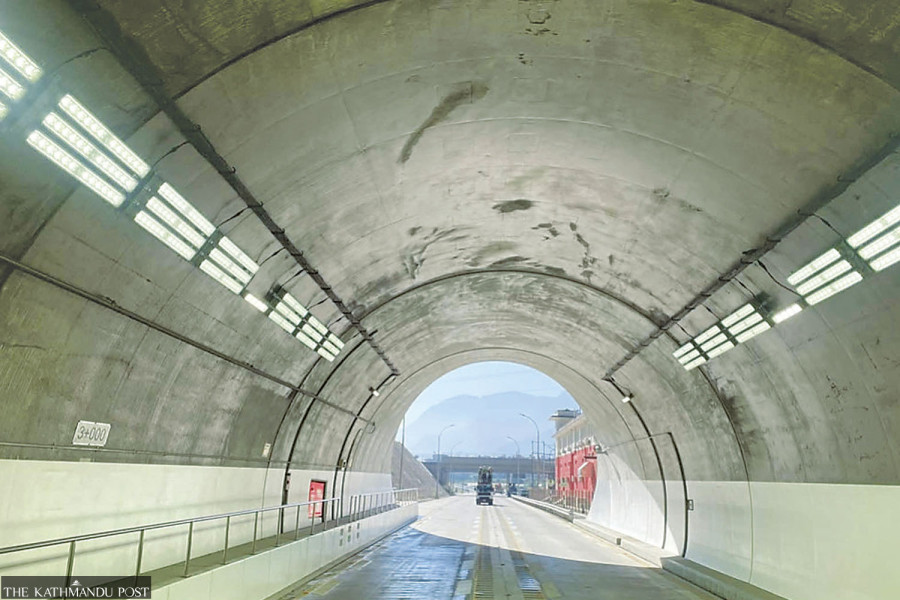
Project head says extension was granted after bidders sought clarification on several provisions in bidding documents. Construction of tunnel began on October 21, 2019, with a completion target of 42 months. Post file photo
The government has extended, for the second time, the deadline to select a service provider for the operation and management of the Nagdhunga-Sisnekhola tunnel road, a key infrastructure project aimed at easing traffic congestion at the western entry point to the Kathmandu valley.
The Nagdhunga Tunnel Construction Project had initially invited international bids on November 2 to appoint a service provider responsible for operating and maintaining the tunnel. The original deadline for bid submission was December 17. However, following requests from both international construction firms and domestic contractors, the deadline was first extended to December 31. It has now been further extended to January 14, 2026, according to the project office.
Project Director Saunjanya Nepal said that the extension was granted after bidders sought clarification on several provisions in the bidding documents. “Some of the clauses required further clarification, particularly related to insurance and operational responsibilities. Since these issues were raised formally, we had to revise certain sections in line with the Public Procurement Act,” said Nepal.
He said section 16 (3) of the Public Procurement Act 2007 allows the procuring agency to amend bid documents and extend deadlines if bidders seek clarification within the stipulated period. “We followed due process. The amendments were minor and mostly technical, but since they required approval from the Public Procurement Monitoring Office, the process took some time,” he added.
According to Nepal, confusion had mainly arisen regarding insurance requirements for manpower, machinery and operational risks during tunnel operation. “There was uncertainty among bidders about what kind of insurance coverage would be mandatory. We have now clearly specified the scope of insurance and the liabilities to be covered,” he said, adding that no major changes were made to the core terms of the contract.
The service provider to be selected through the international competitive bidding process will be responsible for operating and maintaining the 2,688-metre-long main tunnel and the 2,557-metre emergency tunnel for five years. The operator will also manage traffic, emergency response, toll collection and overall maintenance of the tunnel and the approach roads on both the Kathmandu and Dhading sides.
“This will be a 24-hour operation throughout the year. Around 150 personnel will be required, working in shifts. We have made it mandatory for the operator to deploy at least five experts with prior experience in tunnel operations,” Nepal said.
The project requires the service provider to submit a detailed staffing plan, including salary structures for different categories of workers. The cost of routine maintenance will be borne by the government, while the operator will be responsible for daily operations and safety management. Toll revenues collected from vehicles using the tunnel will be deposited daily into the Road Board Nepal’s account, which will also oversee monitoring and compliance.
Under the bidding conditions, foreign companies must form joint ventures with Nepali firms. This requirement, officials say, is aimed at enhancing domestic capacity in tunnel operation and management.
The Nagdhunga-Sisnekhola tunnel, a long-awaited project intended to ease chronic congestion along the Kathmandu-Naubise section of the Tribhuvan Highway, is now nearly complete, with physical progress reported at around 97 percent. However, delays in selecting an operator have pushed back the planned opening date.
Originally, the government had announced that the tunnel would come into operation by the beginning of 2026. Project officials now say operations are likely to begin by mid-April 2026, provided the service provider is selected on time.
“It took nearly one and a half years to prepare the operational guidelines because there was no clear procurement framework for tunnel operation in the country,” said Nepal. “We had to prepare a separate guideline, get it approved by the Cabinet, and then develop the standard bidding documents accordingly.”
The ‘Nagdhunga-Sisnekhola Tunnel Operation Directive’ was endorsed in April 2024. It bars pedestrians, motorcycles, three-wheelers and non-motorised vehicles from using the tunnel. Vehicles carrying highly flammable or explosive materials will also be prohibited.
Construction of the tunnel began on October 21, 2019, with a completion target of 42 months. However, the project suffered repeated delays due to the Covid-19 pandemic and frequent local obstructions, according to the Department of Roads. The construction contract was awarded to Japan’s Hazama Ando Corporation.
Work is currently ongoing on the Dhading-side toll plaza and slope stabilisation. The contractor’s deadline has been extended until April 25, 2026, mainly to complete landslide mitigation works.
Once operational, the tunnel is expected to reduce travel time for freight vehicles by 30 to 35 minutes and significantly ease traffic congestion at the Naubise-Nagdhunga section, one of the country’s busiest transport corridors.




 15.26°C Kathmandu