CCTV camera monitors critically endangered vultures in Kaski
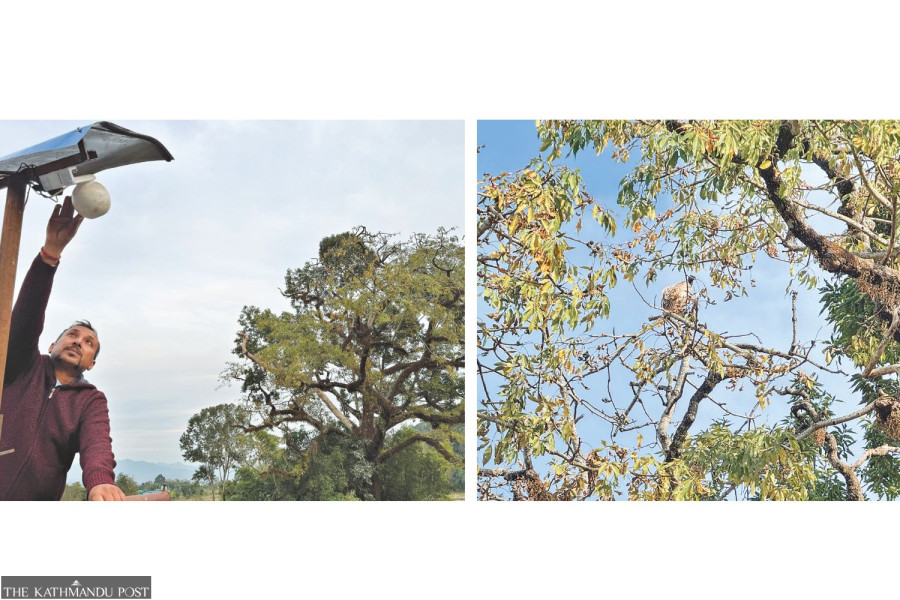
Researcher Hemanta Dhakal, who has tracked the nest for the past four years, says the camera helps him study the breeding of a slender-billed vulture pair. Conservationist Hemanta Dhakal shows the CCTV camera trained on a vulture nest in the simal tree at Thulodhunga in Pokhara Metropolitan City, in this recent photo. (Right) A slender-billed vulture is seen perching on the tree. POST PHOTO
In a quiet corner of Thuldhunga in ward 33 of Pokhara Metropolitan City, a towering red silk-cotton (Bombax ceiba) tree, known as simal in Nepali, spreads its branches like open palms against the sky. High up in its canopy lies one of the country's rarest natural treasures—the nest of the critically endangered slender-billed vulture, locally called Sano Khairo Gidda. To ensure its protection and to closely study the bird’s breeding behaviour, conservationists have installed a CCTV camera—marking the first such initiative in Nepal aimed at monitoring a vulture nest in real time.
The camera, fixed at a safe distance on a nearby house, allows continuous observation of the birds without disturbing them. Conservationist Hemanta Dhakal, who has been monitoring the nest for the past four years, says the system enables him to study the vultures’ daily activities from his mobile phone. Dhakal, secretary of the Pokhara Bird Society and a PhD researcher on vulture ecology and conservation, said this is the first time CCTV technology has been used in Nepal for long-term monitoring of a vulture nest.
“The aim is to understand how vultures breed, how they raise their chicks, what threats they face and what kind of conservation interventions are needed,” said Dhakal, adding, “Without knowing these details, it is impossible to design effective protection measures.”
The slender-billed vulture is listed as critically endangered bird species globally. According to conservation data, fewer than 75 individuals are believed to remain in Nepal. Dhakal has been monitoring vultures in Kaski and other districts for nearly 15 years. The nest in Thulodhunga is currently occupied by a single breeding pair.
Of the six known nesting sites of the species recorded in the country in recent years, only four remain active—two in Dang and one each in Shuklaphanta and Pokhara. A nest previously located in Gachhepani of Shuklagandaki Municipality in Tanahun was destroyed after the simal tree was felled during the expansion of the Abukhairani-Pokhara stretch of Prithvi Highway. Another nest at Dobilla in ward 7 of Pokhara Metropolis was abandoned by the birds after the area became densely settled. The birds then relocated to the Thulodhunga area.
Dhakal said installing the CCTV camera became possible only after extensive consultation with local residents, landowners and the household hosting the equipment. “We first had to explain why the vulture is important and why this nest matters. Only after building trust did the community agree to this.”
The Pokhara Bird Society organised an awareness programme in the area last week which was attended by local residents, women’s groups, community leaders and ward representatives. “The locals have pledged full cooperation for vulture conservation,” said Dhakal.
Landowner Taranath Lamichhane has committed to protecting the tree that hosts the nest. The CCTV camera was installed at the nearby house of Mantrilal Paudel. Expenses related to the camera, internet connection and maintenance have been covered by the UK-based Rufford Foundation and the Pokhara Bird Society.
According to Dhakal, the CCTV system is essential to study how vultures incubate eggs, feed their chicks and respond to threats. “We could have placed the camera closer, but that might have disturbed the birds. So we chose a safer distance with a high-resolution camera,” he said.
The slender-billed vulture lays only one egg per year, making its population recovery extremely slow. Mating usually occurs in November and December, and nest-building is completed by January. The female lays a single egg soon after and both parents take turns incubating it. The chick usually fledges by May or June. Males and females are nearly indistinguishable without genetic testing.
“If we don’t understand what risks they face during nesting—whether from poisoning, food scarcity or disturbance—we cannot design effective conservation strategies. Many vultures die after feeding on carcasses contaminated with toxic veterinary drugs,” said Dhakal.
As part of his doctoral research, Dhakal plans to fit satellite tags on ten slender-billed vultures to track their movement, feeding ranges and habitat use. Similar tagging by Bird Conservation Nepal in Nawalpur and Shuklaphanta has shown that vultures travel long distances across Nepal and India, often dying from electrocution or poisoned carcasses. “These findings show the threats are still very real,” he said.
For local residents, the conservation effort has changed perceptions. “Earlier, people saw vultures as bad omens. Now we understand they clean the environment by eating carcasses. I feel proud that a rare bird is being protected from my home,” said Paudel, whose house hosts the CCTV camera.
According to the locals, there used to be plenty of vultures in the area in the past. Lamichhane recalled that vultures once filled the skies around his village. “Thirty or forty years ago, this tree would be covered with vultures. Now they are hardly seen. Poison and changes in livestock practices have wiped them out,” he said.
With community support, scientific monitoring and growing awareness, conservationists hope the silent wings of the slender-billed vulture will once again become a common sight in the skies.
Of the nine species of vultures recorded in Nepal, four species— slender-billed vulture, white-rumped vulture, red-headed vulture and Indian vulture—are listed as critically endangered. The Egyptian vulture is listed as endangered, while the bearded vulture, cinereous vulture and himalayan griffon, have been classified as near-threatened.




 25.92°C Kathmandu
.jpg)