Six years after Nepal and China signed an agreement to upgrade the strategic Syaphrubesi-Rasuwagadhi road, construction work has yet to begin, prolonging disruptions at one of Nepal’s most important northern trade corridors.
The delay has also kept the Rasuwagadhi border point largely non-operational, compounding economic losses for traders, transporters and local residents.
The 15.5-kilometre Syaphrubesi-Rasuwagadhi road stretch is to be upgraded to a two-lane road with Chinese grant assistance. The agreement was signed in 2019, but progress has stalled due to the Covid pandemic, administrative hurdles, and repeated natural disasters. Officials say preparatory work is finally under way, with full-scale construction expected to start in February, 2026.
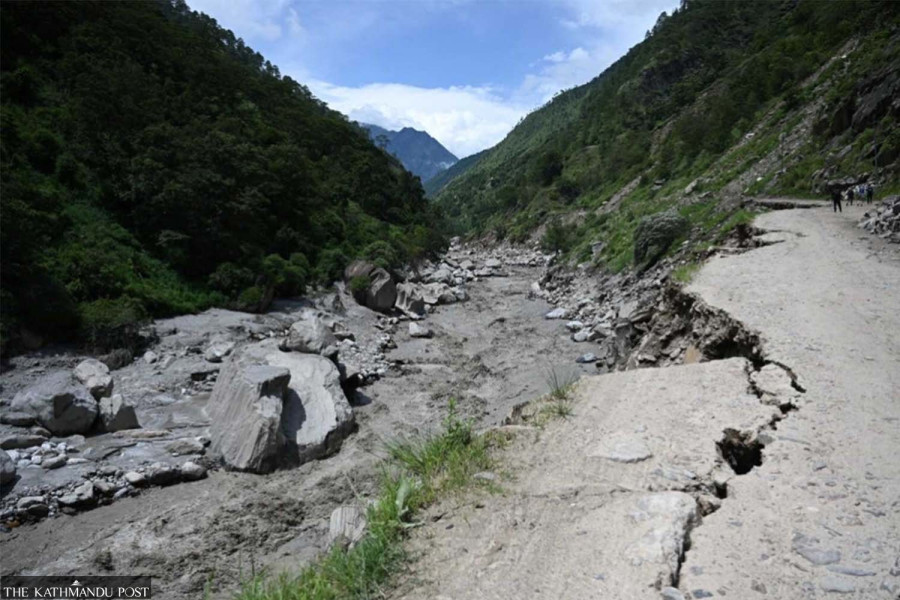
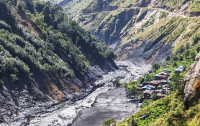
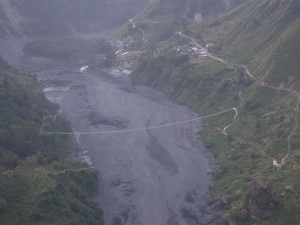
The floods and landslides caused extensive damage along multiple sections of the road section in July this monsoon season. Continuous erosion by the Bhotekoshi river had rendered the route unsafe, forcing authorities to suspend traffic for weeks. Although the road has since been reopened on a temporary basis, officials admit that heavy cargo vehicles still face serious difficulties due to the fragile terrain.
The situation worsened after floods washed away the concrete bridge over the Lhende river on July 8, leading to the complete shutdown of the Rasuwagadhi border point.
China has already installed a temporary truss bridge at the site, but the crossing has yet to be opened for vehicular traffic. Once the border resumes operations, authorities warn that the narrow and damaged road could struggle to handle the usual flow of freight vehicles, which normally averages around 100 cargo trucks a day.
According to the Department of Roads, the Chinese contractor is set to begin construction in February and the work is expected to be completed in 39 months. Bijay Jaisi, director general of the department, said the project was derailed soon after the agreement was signed. “Just as we were preparing to start the work, the Covid pandemic broke out, and the Chinese technical teams could not come to Nepal for nearly three years. That was the first major setback,” he said.
Jaisi added that further delays were caused by taxation issues. “It turned out that tax exemptions were required for construction materials such as stone, gravel and sand. Getting approval for this from the Ministry of Finance took another six months," he said.
The Nepal government has provided land for construction camps, but new obstacles have continued to emerge, including the need to relocate electricity poles along the alignment.
Jaisi argued that the delay may have prevented even greater losses. “If the road had already been built, the floods in July would likely have destroyed major sections. This is a geographically complex and vulnerable stretch. Even restoring temporary traffic after the floods took a long time.” He added the original 2019 design is now being revised to reflect lessons from recent flood damage.
The project, awarded to Chinese contractor ‘Tianlu Company’ for around Rs6.5 billion, is seen as vital for bilateral trade and post-earthquake recovery in Rasuwa, a mountain district of Bagmati Province.
Krishnanath Ojha, project chief at the Galchhi-Trishuli-Mailung-Syaphrubesi-Rasuwagadhi Road Project Office in Bidur, said preparations to start the upgrade are in final stages. “But the closure of the Chinese border has created serious problems,” he said. “Only after the crossing reopens can heavy machinery and construction materials be brought in from China. Even so, we are determined to start construction work from February.”
Ojha said the contractor has requested permission to halt all traffic for 15 days each month to carry out work safely. “In many sections, it is impossible to widen the road without cutting into the hillsides,” he said. “Allowing vehicles to pass while excavating slopes would pose a serious accident risk. We have already informed the District Administration Office in Rasuwa about the need for temporary road closures.”
Another potential source of delay is environmental clearance. Although an environmental impact assessment has already been approved, the Division Forest Office and the Langtang National Park have objected to tree felling without fresh consent.
“We have received letters stating that trees cannot be felled without their approval,” Ojha said. “We are preparing for a joint verification with the project office, the national park and the contractor to determine exactly how many trees will be affected.” He warned that a new assessment could further delay construction, though he insisted that relatively few trees are involved.
Delays are also affecting the broader Galchhi-Mailung-Syaphrubesi road, a 65-kilometre corridor, being upgraded on two sections. Overall progress stands at just 82 percent. The Mailung-Syaphrubesi section saw its contract terminated two years ago due to the contractor’s non-performance, and a revised detailed project report is now close to completion. Once the new DPR is ready, new tender bids will be invited for the section. Problems with demolishing houses and sheds in Bidur and Betrawati have added to the slowdown.
Meanwhile, the prolonged closure of the Rasuwagadhi border continues to take a heavy toll. The crossing, a major entry point for readymade goods, apples and electric vehicles, used to handle nearly 100 containers a day.
Tulsi Prasad Bhattarai, chief at Rasuwagadhi customs office, said imports remain completely stalled since July despite the installation of the truss bridge. “We have not seen concrete steps towards reopening the border,” he said, noting that livelihoods in the area have also been badly affected.
Rasuwa’s chief district officer Rajesh Panthi said Chinese authorities have indicated that a final load test on the bridge would be completed this week. “After that, there will be a joint meeting of officials from both sides to decide on an opening date,” he said. “No formal letter has arrived yet, but based on current information, the border should reopen by December.-end”
The Rasuwagadhi Customs Office had set a revenue target of Rs40.16 billion for the current fiscal year, but officials say collections have been zero since the start of the year due to the closure.




 19.22°C Kathmandu