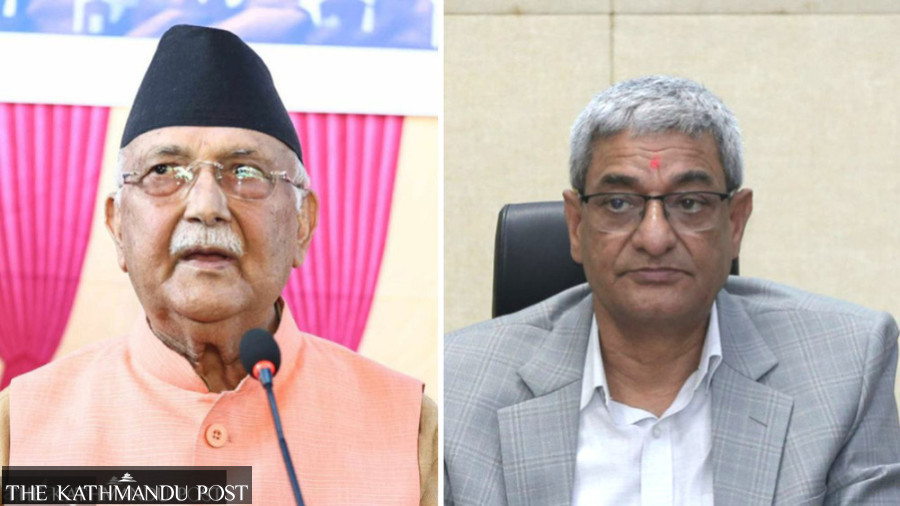
Just over two weeks from its deadline, the commission investigating the deaths and large-scale destruction during the September 8-9 Gen Z protests has yet to question then-prime minister KP Sharma Oli or his home minister Ramesh Lekhak. But a commission member said they are preparing to summon the two leaders soon.
The three-member panel, headed by former Special Court chair Gauri Bahadur Karki, was formed on September 21 by the interim government led by Sushila Karki, and asked to submit its report within three months. But so far it has not summoned the politicians who led the government and handled internal security at the time of the protests.
A total 76 people were killed during the protests—19 unarmed youths were gunned down on the first day alone. Gen Z representatives and people from different walks of life believe that the government was responsible for the killings of September 8 and, therefore, the prime minister and home minister must be held accountable.
Bishweshwar Prasad Bhandari, a member of the probe commission, however, said that the commission is in the process of summoning the political leadership at the time for questioning.
“It is true that the tenure of our commission is nearing its end. We are in the process of summoning the former prime minister and the home minister,” Bhandari told the Post, adding that the commission may seek more time if it is unable to complete its work by the deadline.
“We are also bound by law, which prevents us from sharing details of the investigation before its end.”
The commission has already recorded the statements of some police officers, among others, in connection with the violent suppression of the protests. Earlier it had summoned Rastriya Swatantra Party chief Rabi Lamichhane, who is in judicial custody on the charges of cooperative funds misappropriation. His statement focused solely on how he was released from Nakkhu Prison on September 9.
For general inquiry, the commission has called more than 100 people. Of these, statements of around 30 individuals have been recorded, said Bigyan Raj Sharma, its spokesperson.
“We have almost completed recording the statements of all police officers deployed on September 8 and 9,” Sharma told the Post.
Some officers maintain that they should not face legal action for carrying out their assigned duties.
“The police had fired around 2,500 rounds on September 8. If the shots had been fired with the intent to kill, it is unlikely that only 134 people would have been shot at. Among those who were shot, only around a dozen would not have been struck in the chest or head,” said one police officer summoned by the commission. “This means that security personnel deployed to protect sensitive locations should not face legal action.”
Meanwhile, then-inspector general Chandra Kuber Khapung of Nepal Police has told the Supreme Court that no police personnel can be subjected to disciplinary action for their actions during the Gen Z movement.
A writ petition had been filed by Maqbul Miya of Arghakhanchi, naming Khapung and others as defendants, demanding action against the police for the use of force during the movement. Following the initial hearing, the Supreme Court had ordered Khapung to furnish a written response within 15 days.
In his reply to the court on November 10, Khapung stated that the actions of Nepal Police were carried out in good faith, in accordance with prevailing laws—with the aim of maintaining law and order and protecting public property.
He further noted that the government has already formed a high-level investigation commission to look into the incidents of those two days. As the commission is currently conducting its inquiry, Khapung said it would be inappropriate to comment further until the commission reaches a conclusion, after which the law will determine the next steps.
Responding to the petitioner’s allegation that the IG had failed to fulfil his constitutional duties, Khapung argued that the petitioner had not been able to specify which constitutional or legal responsibilities he had failed to discharge.
Khapung told the court that under the law, the responsibility for maintaining district-level law and order lies with chief district officers, not the police chief.
He cited Section 6 of the Local Administration Act 1971 and Rules 68 and 70 of the Police Regulations 2014, which say maintaining law and order at the district level falls directly under the supervision and control of the chief district officer.




 23.25°C Kathmandu