



 26.26°C Kathmandu
Thu, Oct 1, 2026
National
Poll body mulls spending caps based on voter number, constituency size
Experts welcome the move but have doubts about effective implementation.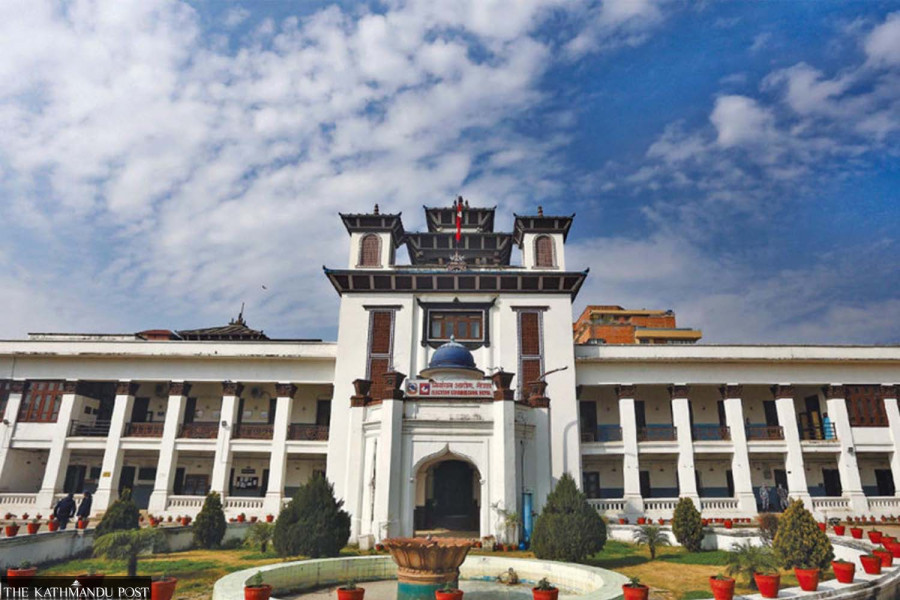
bookmark
Binod Ghimire
Published at : August 26, 2022
Updated at : August 26, 2022 08:17
Kathmandu
Amid reports that election candidates have been flouting the spending ceilings, the Election Commission is working to revise the spending limits for the upcoming elections.
Unlike in the past, when the maximum amount candidates could spend in electioneering was the same across the country, the commission is preparing to prescribe different ceilings for electoral constituencies based on voter numbers and area.
As per the commission’s ceiling in 2017, a candidate for the House of Representatives under the first-past-the-post system could spend a maximum of Rs2.5 million while the limit for candidates for provincial assembly elections was Rs1.5 million.
“We are for revising the ceilings in consultation with political parties,” Dinesh Thapaliya, chief election commissioner, told the Post. “The commission too has concluded that the one-size-fits-all formula doesn’t work. The ceiling should be different based on the population and area of the particular electoral constituency.”
In India, there is a different ceiling for the Lok Sabha and Bidhan Sabha elections depending upon the size of the states. As per the ceiling set by Election Commission of India in 2022, a Lok Sabha candidate can spend a maximum of IRs9 million in bigger states and IRs7 million in smaller states. For Bidhan Sabha [provincial assembly], the limit is fixed at IRs4 million for bigger states and IRs2.8 million for the same in the smaller states.
Experts on election affairs say it is better to revise the expenditure ceiling in consultation with the political parties. With rising inflation, the ceiling can be increased, they say.
“I also agree with the idea of having separate expenditure ceilings for the different constituencies,” Pradip Pokharel, chairperson of the Election Observation Committee Nepal, told the Post. “However, fixing the ceiling makes no sense unless it is implemented. The commission has failed in implementing the expenditure ceiling in the past. It needs to have a proper monitoring mechanism for an effective implementation.”
A study carried out by the observation committee revealed that in 2017 each candidate winning the federal parliamentary elections under the first-past-the-post system spent on average Rs21.3 million against the ceiling of Rs2.5 million. The runners-up spent an average of Rs14.9 million and the remaining candidates spent Rs8.5 million each. However, all the candidates submitted their reports at the commission purporting that their expenditure was within the limit.
Birendra Mishra, a former election commissioner, said under the current rule, the amount that can be spent in Manang with a voter population of just 5,000 is equal to the places where one constituency has over 50,000 voters. “It is good that the commission is fixing different ceilings,” he told the Post. “However, it needs to be implemented.”
Mishra said the commission in 1994 general elections had fined a number of candidates for flouting the expenditure ceiling. “However, I don’t see actions being taken these days although it is a public knowledge that candidates spend much more than they are allowed to,” he said.
In April, Nepali Congress leader Shashank Koirala had said that elections are becoming more expensive and he spent Rs60 million during the 2017 elections—multiple times higher than the Rs2.5 million ceiling set by the poll body for House of Representatives candidates. The commission sought clarification from Koirala but took no action.
Similarly, CPN (Maoist Centre) chairperson Pushpa Kamal Dahal earlier this month said millions of rupees were spent in the recent local elections. The commission has sought clarification from Dahal too but it is unlikely to take any action against him. Thapaliya, the chief election commissioner, said they haven’t been able to take stern actions because of a lack of evidence.
Thapaliya added that this time, the commission will constitute different monitoring mechanisms to enforce the expenditure limit and the code of conduct. “If the committees find proof of rule violation, we will take actions,” he told the Post. “Similarly, in case the commission finds the expenditure reports submitted by the candidates suspicious, it will audit them through independent auditors.”
Though Koirala claimed he had spent Rs60 million, the report he submitted to the commission said he only spent Rs2.1 million. Apart from issuing warnings and slapping monetary fines, the commission can even scrap the candidacy if one is found to have breached the election code of conduct along with the expenditure limit.
Hundreds of candidates will contest in the House of Representatives and provincial assembly elections being held on November 20.
Experts say the commission should use its legal authority to ensure the elections are fair. “I don’t understand why the commission can’t take stern actions when the code of conduct is openly violated,” Kapil Shrestha, chairperson of the National Election Observation Committee, told the Post. “Implementing the code of conduct is a prerequisite for fair and impartial elections.”
Binod Ghimire
Binod Ghimire covers parliamentary affairs and human rights for The Kathmandu Post. Since joining the Post in 2010, he has reported primarily on social issues, focusing on education and transitional justice.



Most Read from National
Balendra Shah UN speech: Full transcript of Nepal prime minister’s address to the 81st UN General Assembly
Government recommends ambassadors to India, US, China and 10 other countries
Heavy rains cut off key roads to Kathmandu
Families of missing foreign nationals want answers Nepal can’t give
The speech Nepal — and the world — had been waiting for
Editor's Picks

What triggered the Rasuwa flood? Scientists piece together a complex chain of events

The floods keep coming. Nepal keeps starting over

In a settlement destroyed by the Bhotekoshi flood, a disabled couple offer strangers the little they have

Nepal working on detailed assessment as Bhotekoshi flood reconstruction could cost up to $5 billion

Rabindra Dhant gave Nepal a reason to smile. Now his camp wants real action behind the praise
E-PAPER | October 01, 2026

×