One in five votes went to waste under the Proportional Representation category of the provincial assembly elections, in a “record high” percentage of ballots unaccounted for as they were for the parties that failed to reach the set threshold.
One in five votes went to waste under the Proportional Representation category of the provincial assembly elections, in a “record high” percentage of ballots unaccounted for as they were for the parties that failed to reach the set threshold.
According to the Election Commission, 2,083,840 votes were wasted under the PR
category out of a total 10,579,739 votes cast. The discarded votes account for around 19.69 percent of the total ballots cast.
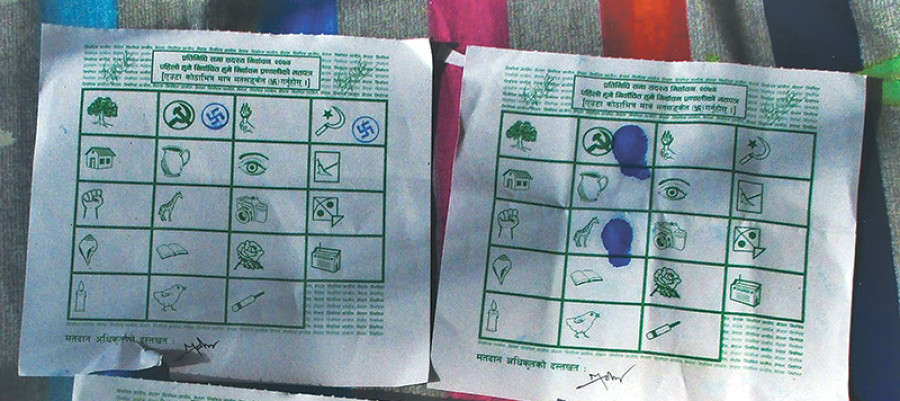
As many 1,560,432 votes—14.74 percent—turned to be invalid. This is the highest ever invalid vote percentage since the first parliamentary elections were held in 1992. In the local level elections held earlier this year, 12.55 percent votes were declared invalid.
The percentage of void votes under the PR category in the Constituent Assembly elections held in 2013 and 2008 was less than five percent.
According to the law on provincial assembly elections, a party that fails to secure 1.5 percent votes cannot be represented in the state assembly. This provision led to the wastage of 523,408 votes.
The high percentage of vote wastage came to light after the EC allotted seats to the political parties on the provincial assemblies on Friday.
The EC admitted that there had been an unusually high proportion of invalid votes in the PR polls. However, election officials said they would bring out the exact invalid vote percentage shortly. The amount of void votes suggests inefficiency of the voter education campaign.
The poll authority claims that it sent volunteers to people’s doorsteps. But this didn’t translate into valid votes. “The EC should take appropriate measures to avoid such situations in future,” said Dhakal. In the first-past-the-post polls, the percentage of invalid votes was 3.
Even for election observers, the high percentage of invalid votes is a surprise. “We had expected invalid votes to be around 10 percent but the figures went beyond our estimate,” said Abhaya Joshi, chairperson of SCOPE Nepal, a licensed election observer.
According to Joshi, voters were confused by the use of a single ballot paper for the PR category of both the House of Representatives and the provincial assemblies. Many voters stamped twice on the upper side of ballot papers meant for the House, leading to their invalidity.




 25.12°C Kathmandu