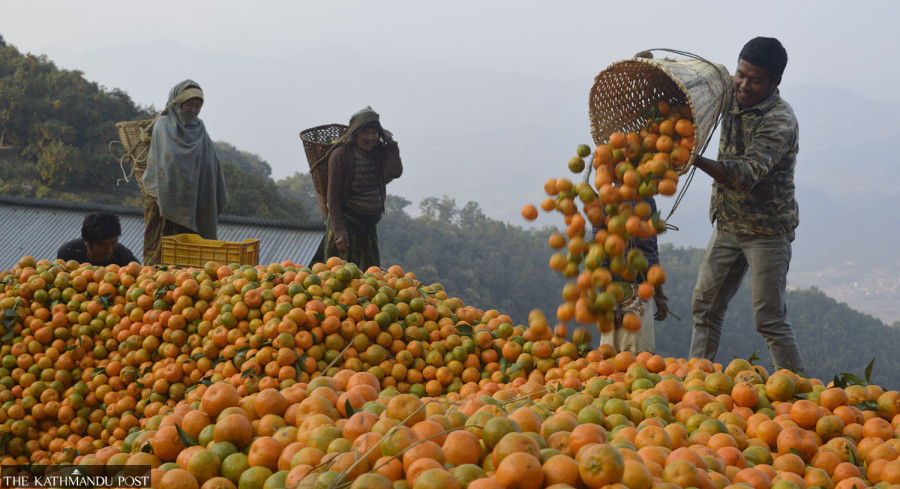
Nepali oranges largely meet domestic demand during their main harvest season, from November to February. But imports from India and other countries, fruit traders say, remain necessary during the rest of the year because local production is seasonal and storage facilities are inadequate.
Amar Baniya, chairman of the Nepal Fruits Wholesale Traders Association, said domestic oranges begin arriving in significant quantities from November and continue until February. During this period, imported fruit has a smaller presence in the market, as consumers prefer the taste of Nepali oranges despite their higher prices.
“Once the Nepali oranges arrive, consumers look for domestic produce. They prefer its taste, too,” said Baniya. “But Nepal produces oranges in only one season, in a single harvest. To meet demand throughout the year, we have to depend on imported oranges.”
Nepal grows citrus fruits in 65 of its 77 districts, from the Tarai plains to the mid-hills at elevations of around 1,400 metres. Taplejung, Panchthar, Tehrathum, Dhankuta, Sindhuli and Ramechhap are among the major orange-producing districts. The National Centre for Fruit Development has recommended varieties including Khoku, Banskharka and Paripatle oranges. Local varieties are also cultivated in Dhankuta and Kaski.
Despite the wide spread of cultivation, national output has barely grown in recent years. Centre data show that Nepal produced 198,406 tonnes of oranges in the fiscal year of 2020-21. Production fell to 195,508 tonnes in 2024-25, a decline of 2,898 tonnes over five years.
Output has fluctuated during that period. It dropped to 185,346 tonnes in 2021-22, rose to 198,779 tonnes in 2022-23, and fell again to 194,565 tonnes in 2023-24 before edging up the following year. These figures cover the main orange season, from November to February.
Manoj Chapagain, president of the Nepal Orange and Lemon Association, said fungal diseases were a major reason production had failed to rise despite the expansion of cultivation. According to him, the diseases damage flowers, fruit and trees, and can eventually dry out entire plants.
“We have not been able to control the fungal diseases affecting orange trees,” said Chapagain. “They damage the flowers and fruit, and can even dry up the trees.” He estimated that production could increase by 15 to 25 percent this year.
However, growers need effective disease-control measures if the increase is to be sustained. Diseases, including citrus greening, have damaged orchards in several districts. Farmers have also struggled with ageing trees, poor orchard management and inadequate technical support.
Baniya said Indian oranges usually enter the Nepali market in an initial batch between September and November. Their presence declines when domestic oranges become available, but imports rise again as the Nepali season ends. At present, Indian oranges sell for around Rs120 per kilogram, while Nepali oranges cost more than Rs130.
Customs Department figures show that Nepal imported 5,833 tonnes of oranges in the first four months of the current fiscal year, from mid-July to mid-November. Imports from India, South Africa and Egypt cost Rs379.12 million.
In the previous fiscal year of 2025-26, the country imported 19,271 tonnes worth Rs1.2375 billion. In 2024-25, imports totalled 18,245 tonnes and cost Rs1.1917 billion. The figures show that import volumes have risen again after falling from 28,739 tonnes in 2020-21 to 25,542 tonnes in 2021-22 and 17,072 tonnes in 2022-23. Imports then climbed to 23,113 tonnes in 2023-24, worth Rs1.4432 billion, before declining the following year.
Nepal declared oranges its national fruit in April, 2024. But growers say the recognition has not been matched by sufficient support to expand production, control disease, use fallow land or improve storage.
Chapagain said there was demand for Nepali oranges abroad, partly because of their distinctive taste, but growers lacked the volume and facilities to fulfil large orders.
“People place orders because oranges grown in the foothills of the Himalayas are known to be tasty,” he said. “If we receive an order for 10 truckloads from abroad, we cannot even supply one truckload.” He called for policies to encourage commercial orange farming on unused land in villages, wider use of modern cultivation technology and investment in storage. Without these measures, Nepal will continue to rely on imports outside its short harvest season and miss opportunities to export, he said.
The import bill was Rs1.3713 billion in 2020-21 and Rs1.2719 billion in 2021-22, falling to Rs881.68 million in 2022-23 before reaching Rs1.4432 billion in 2023-24.
Such fluctuations reflect changing domestic supply as well as market demand. Traders say the two seasonal arrivals from India help bridge the gap when Nepali orchards are not producing. Yet the dependence also means that a larger share of consumer spending goes towards fruit produced outside the country, while local growers lose potential income and jobs.




 14.12°C Kathmandu