



 23.9°C Kathmandu
Sun, Oct 18, 2026
Money
Border disruptions push up apple prices ahead of Dashain
China supplies most of Nepal’s imported apples, leaving the market exposed to rising freight costs even as domestic production grows.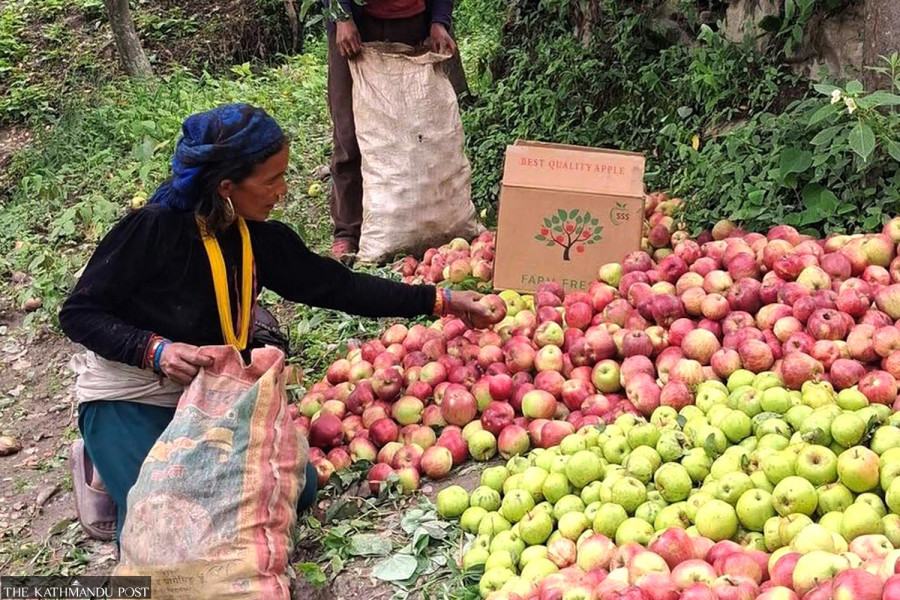
bookmark
Seema Tamang
Published at : October 18, 2026
Updated at : October 18, 2026 11:45
Kathmandu
Apple prices are rising ahead of Dashain as disruptions at Nepal’s northern border crossings with China have increased transportation costs, adding to pressure on consumers during the festive season.
The Rasuwagadhi and Tatopani crossings, key routes for Chinese goods, remain disrupted by flood damage and infrastructure problems. Traders have turned to alternative routes, including the Korala crossing in Mustang and the sea route through India’s Kolkata port, but say the additional transportation costs are being passed on to consumers.
Apple sales typically pick up during Dashain and Tihar, when the fruit features prominently in daily meals, religious rituals and gift-giving. Freshly harvested apples from Jumla, Mustang and Manang have begun reaching Kathmandu and other major cities, but imported apples from China and India continue to meet most of the seasonal demand.
Nepal imported 14,902 tonnes of apples worth Rs1.95 billion from China, India and other countries in the first two months of the current fiscal year, from mid-July to mid-September, according to the Department of Customs.
Amar Baniya, a fruit trader, said transportation costs for Chinese apples had more than doubled following disruptions to the usual trade routes.
“Since both crossings have been disrupted, traders have continued bringing Chinese apples by sea through Kolkata, but the cost is much higher,” he said. “The price of ordinary Chinese apples has risen by Rs40 to Rs50 per kilogram. Fuji apples will also become more expensive.”
Transporting a container through Tatopani previously cost between Rs60,000 and Rs100,000, while the cost through Korala could reach Rs500,000, Baniya said. Freight charges from Kolkata have also doubled, from $2,500 to $5,000 per container.
“Price increases are inevitable this time because of transport costs, but there will not be a shortage or a market crisis,” said Baniya.
Traders say Indian apples, including Chakleti, Kashmiri and Shimla varieties, remain available in sufficient quantities to help meet demand despite the disruption to Chinese supplies. Baniya expects imported apples to dominate the market this Dashain, with domestic apples accounting for less than 10 percent of sales.
Apples from Jumla, Mustang, Manang and other domestic growing regions are also reaching the market, but their high prices have limited their competitiveness against imported produce.
“Domestic apples should be cheaper, but they are expensive. They are selling wholesale for Rs250 to Rs270 per kilogram, whereas the price used to be Rs140 to Rs150,” Baniya said. “That is the price of ordinary apples. Imagine how much the better-quality ones cost.”
He said the high cost of domestic apples was making it difficult for them to compete with Chinese and Indian varieties.
Nepal remains heavily dependent on imported apples to meet domestic demand. In the fiscal year 2024-25, the country’s total apple supply reached 150,202 tonnes, of which 90,253 tonnes were imported and 59,949 tonnes produced domestically. Imports accounted for 60.09 percent of the total supply, while domestic production contributed 39.91 percent.
Domestic production has increased over the past five fiscal years, rising from 48,611 tonnes in 2020-21 to 59,949 tonnes in 2024-25, an increase of about 23 percent. But the growth has not been enough to reduce the country's reliance on foreign supplies, with the domestic share of total supply remaining below 40 percent.
In 2020-21, Nepal’s total apple supply stood at 137,669 tonnes, with domestic production accounting for 35.31 percent and imports 64.69 percent. The following fiscal year, total supply increased to 139,549 tonnes, and the domestic share rose to 37.80 percent.
In 2022-23, total supply fell to 136,058 tonnes, with domestic apples making up 38.80 percent. Supply recovered to 136,651 tonnes in 2023-24, when domestic production accounted for 39.89 percent.
In 2024-25, apple imports increased by about 9.9 percent from the previous fiscal year, highlighting the continuing gap between domestic production and market demand.
China remains Nepal’s principal source of imported apples, making the market particularly vulnerable to disruptions along the northern trade routes.
In 2020-21, Nepal imported 89,058 tonnes of apples, including 70,799 tonnes from China and 18,188 tonnes from India. China accounted for 79.50 percent of imports and India 20.42 percent.
In 2021-22, total imports stood at 86,796 tonnes, with China supplying 69,418 tonnes, or 79.98 percent, and India 17,313 tonnes, or 19.95 percent.
Chinese imports fell to 53,825 tonnes in 2022-23, accounting for 64.64 percent of total imports, while supplies from India rose to 29,392 tonnes, or 35.30 percent.
China’s share subsequently increased. In 2023-24, Nepal imported 82,145 tonnes of apples, including 71,181 tonnes from China and 10,387 tonnes from India.
In 2024-25, total imports reached 90,253 tonnes. China supplied 79,865 tonnes, while India supplied 10,881 tonnes, according to the figures provided.
Available figures for 2025-26 show that Nepal imported 102,484 tonnes of apples, including 85,766 tonnes from China and 16,718 tonnes from India. China accounted for 83.69 percent of the total and India 16.31 percent, underscoring Beijing’s dominant role in Nepal’s apple market.
Despite the growth in local production, traders say Nepal’s domestic apples remain expensive and struggle to compete with cheaper imports. The disruption to Chinese supplies has also exposed the risks of relying on a limited number of trade routes to meet seasonal demand.
Commercial apple farming is practised in several districts, including Jumla, Kalikot, Humla, Mugu, Dolpa, Mustang and Manang. Nepal’s apple harvest generally runs from mid-August to mid-December, overlapping with the major autumn festivals.
A government report identifies favourable climatic conditions for producing high-quality apples as one of Nepal’s key advantages. It also points to opportunities to replace imports, expand exports and develop value-added products through apple processing.
However, domestic growers continue to face competition from cheaper apples imported from China and India. Demand is also increasing as the population grows and consumers seek more fruit, while domestic output has not kept pace.
For now, traders expect imports from India and alternative supply routes to help prevent a market shortage during Dashain. But with transportation costs rising and the northern crossings still disrupted, consumers are likely to pay more for apples this festive season.



Most Read from Money

Nepal travel agents threaten to stop selling Thailand trips over visa rules

Explained: Why does an hour long flight to Dhangadhi cost more than a flight to New Delhi?

Malaysia rejects Nepal’s demand to open recruitment to all manpower agencies

No school, but a graduation cap for women dairy farmers

Nepal arrests four medical service providers as Malaysia recruitment row deepens
Editor's Picks

Dashain paints the country in festive colours
Buying a goat for Dashain? Look for the green mark
Explained: Why does an hour long flight to Dhangadhi cost more than a flight to New Delhi?

Bhotekoshi flood wasn’t a freak event. It’s the Himalaya doing what it does

How Tenzing Sherpa became Nepal’s breakout star at the Asian Games
E-PAPER | October 18, 2026

×