Nepal, India agree to review treaty amid widening trade deficit
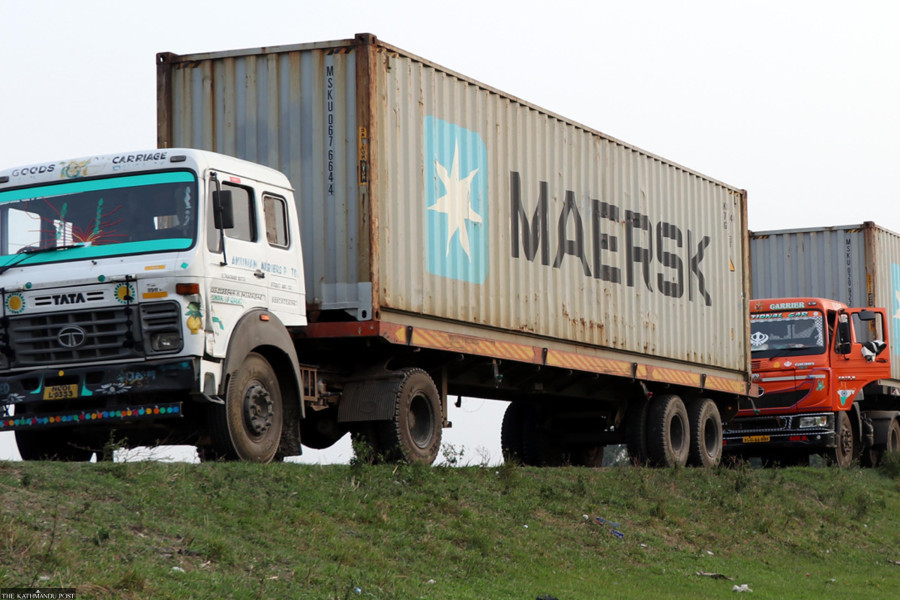
Experts call for changes to non-tariff barriers, reciprocal duty-free provisions, trade facilitation and investment as Nepal’s exports remain heavily dependent on a few products. Cargo trucks headed for Biratnagar awaiting clearance at Bhantabari customs point in Sunsari in this undated photo. Post file photo
Kathmandu and New Delhi last week agreed to review the much-awaited Nepal-India Trade Treaty to address non-tariff barriers and Nepal’s ballooning trade deficit.
Experts have pointed out that significant discriminatory barriers such as para-tariffs and non-tariff measures, high trading costs and inefficient trade facilitation have contributed to Nepal’s high trade deficit.
As Nepali farmers cannot compete with Indian farmers on production costs, huge quantities of primary agricultural products are imported from India into Nepal. One of the reasons for the trade deficit is the restrictive provisions introduced during the 2002 renewal of the trade treaty, which tied the duty-free preferences for primary products to the principle of reciprocity.
The issue has been discussed during three rounds of the comprehensive review of the trade treaty.
The Nepal-India Trade Treaty needs to be reviewed every seven years. But over the past 17 years, it has been automatically renewed, largely without substantive revision. The treaty was automatically extended in 2016 and again in 2023 under its seven-year renewal provision.
Experts say India too did not show urgency in reviewing the treaty. The current treaty provides for automatic extension for another seven-year period unless either side gives three months’ notice of its intention to terminate it.
The Nepal-India Inter-Governmental Sub-Committee (IGSC) on Trade, Transit and Cooperation to Control Unauthorised Trade, which met in New Delhi on September 16–17, opened the door to reviewing the treaty following Nepal’s request to address various issues in line with the changing global trade context.
As per the understanding, a technical committee will be convened within six months. The committee will review the scope of the treaty and identify issues that need revision, according to Nepali officials.
Trade experts said Nepal’s trade deficit with India has been ballooning as exports to India remain largely stagnant. The recent export boom is largely driven by refined soybean, palm and sunflower oil, which experts say raises questions about the sustainability of Nepal’s export growth, as Nepali traders have been utilising the tariff preferences available to least developed countries under SAFTA.
The treaty allows duty-free and quota-free access to Indian markets for Nepali goods meeting the stipulated rules of origin, including primary products such as agricultural goods.
However, quantitative restrictions have been imposed on four products—vegetable ghee, acrylic yarn, copper products and zinc oxide.
“Non-tariff barrier issues are very important for Nepal, so the trade treaty needs to be reviewed,” said Purushottam Ojha, a trade expert and former commerce secretary.
Non-tariff barriers have been an obstacle to exporting goods to India, he said. Nepali agricultural products are not getting adequate access to the Indian market due to sanitary and phytosanitary measures. Technical barriers have also obstructed exports of other manufactured goods.
Ojha said Nepal is facing documentary and procedural hassles and there is a need to simplify them.
“The trade cost can be minimised through digitalisation of trade processes. So the adaptation of technology also needs to be included while reviewing the treaty,” he said.
Nepali traders say the growing import of agricultural goods from India, which are cheaper than domestic production, has put domestic manufacturers and farmers under pressure. Imports are growing as Nepal also provides duty-free access to such products, said Ojha.
“As our supply system depends on Indian products, we need to cautiously take steps so that the supply does not get affected and our products also are not impacted,” said Ojha.
Removing duty-free market access for Indian primary agricultural products would enable Nepal to impose duties on imported agricultural goods from India, which are heavily subsidised, he said.
Agriculture, horticulture, floriculture and forest products, rice, pulses, flour, livestock, poultry and fish, bees, beeswax and honey need to be excluded from the reciprocal list, trade experts said.
Milk, homemade products and eggs should also not be subject to reciprocal provisions, they said.
According to research by the South Asia Watch on Trade, Economics and Environment (SAWTEE), Nepal cannot continue to afford tariff-free access to heavily subsidised agricultural products from India. Therefore, select primary agricultural products, including cereals, must be removed from the list of primary products to which both countries currently provide reciprocal tariff-free access, according to the research.
Nepali jute products have been subjected to anti-dumping duties in India for nearly a decade. In theory, according to SAWTEE, dumping occurs when goods are exported at a price lower than the price at which they are sold in the domestic market or third-country markets, or below their cost of production. Nepali jute manufacturers say they are not dumping their products.
Experts said the rules-of-origin criteria are unified and that there is a need to disaggregate the criteria so that exports of food products manufactured by small and medium-sized enterprises can grow.
To make trade agreements more comprehensive, as other countries have done, Nepal should include provisions on bilateral investment during the revision, said one expert.
“Issues of trade facilitation and investment need to be part of the agreement,” said Ojha. “Investment for product development is necessary. Bilateral investment can help exports grow.”
Customs and border-agency harmonisation and accreditation of certificates are other issues that experts said should be discussed during the revision.
Experts also highlighted the need for effective implementation of the existing trade treaty.
“There are many frameworks within the agreement, but the problem lies in implementation. Effective implementation of the agreement is necessary,” said Ojha.
India has been raising issues of the unauthorised trade of goods from Nepal, such as betel nuts, poppy seeds and black pepper, he said. Both countries need to work to control unauthorised trade, as effective implementation of measures against such trade remains a problem.
The Nepal-India Chamber of Commerce and Industry (NICCI) has also made suggestions for the treaty revision.
Rajan Sharma, general secretary of NICCI and a logistics expert, said the choice of transportation needs to be made easier and procedures and costs need to be simplified.
“The mechanism of choosing the border point also needs to be easy,” he said.
Paperless trade needs to be initiated, he said.
“Going paperless also means issues in cybersecurity. So risk management needs to be made strong. Problems on issuing Bureau of Indian Standards (BIS) certification, mutual agreements on standards, among others, need to be focused on during the agreement,” Sharma said.
Citing the recent IGSC meeting as a breakthrough in opening the door to a review of the trade treaty, an official at the industry ministry said the Nepali side is looking to make the treaty relevant to the changing global trade context.
“We will start working, preparing a consultation paper, identifying areas and discussing with stakeholders. The Nepal-India Trade Treaty includes the export of goods but not services. As trade in services has also been sharply growing, we will prioritise that too, including digitalising trade, among other issues,” said the official.
India is Nepal’s largest trading partner, accounting for more than 60 percent of its total trade. Bilateral goods trade reached more than Rs1.46 trillion in the last fiscal year 2025-26, with the trade deficit ballooning to Rs951.95 billion. Nepal imported goods worth Rs1.21 trillion from India and exported goods worth Rs258.65 billion during the year.
Nepal exported goods worth Rs258.65 billion in the last fiscal year, with refined soybean, palm and sunflower oil accounting for 57.59 percent of total exports. Nepal exported refined edible oil worth Rs148.96 billion during the year.
Besides edible oil, Nepal mainly exported coffee, tea and spices; fibres, textile yarn and fabrics; articles of wood; vegetables, fruit and nuts; food-industry residues and waste; and prepared animal fodder.
The first formal trade treaty between British India and Nepal was signed in 1792, followed by the Treaty of Friendship in 1923. After India’s independence, Nepal and India signed the first trade treaty in 1950, known as the Treaty of Trade and Commerce, which also mentioned transit rights. The treaty was initially concluded for 10 years.
After 1960, a trade treaty was signed with renewal every five years. In 1975, the trade treaty was not renewed as Nepal demanded separate trade and transit treaties. In 1978, three agreements were concluded—the Treaty of Trade, the Treaty of Transit and the Agreement of Cooperation to Control Unauthorised Trade.
Until 1996, exports of goods from Nepal to India remained minimal. After India granted Nepal rules-of-origin and duty-free quota-free preferences, the provision helped boost exports and investment. Amendments were made in 2002 and 2009, with discussions on further revisions continuing since then.
The 2009 treaty itself says the two sides should take measures to reduce or eliminate non-tariff, para-tariff and other barriers that impede bilateral trade, while also providing for simplification, standardisation and harmonisation of customs, transport and other trade-related procedures.
Krishana Prasain is a business reporter for The Kathmandu Post covering markets. Before joining The Kathmandu Post in 2018, she spent 3 years in New Business Age magazine covering business.




 26.05°C Kathmandu