Money is cheap in Nepal. Businesses still aren’t investing
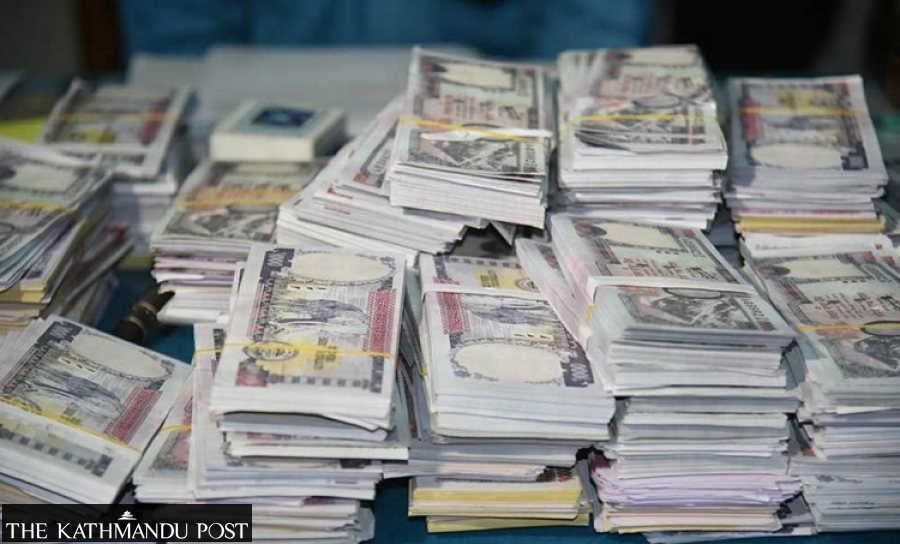
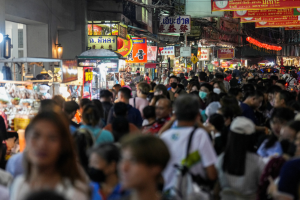
Banks are flush with lendable funds and interest rates are low, yet businesses remain reluctant to borrow and invest, reflecting weak confidence in the economy. Post file photo
Nepal’s economy grew by nearly 6 percent in fiscal year 2021-22, soon after the Covid-19 pandemic. The main driver was a release of pent-up demand and a sharp increase in imports after the pandemic had kept both activity and consumption in check.
The surge in imports put heavy pressure on foreign-exchange reserves, which fell to a level sufficient to cover only about six months of goods and services imports. The government and Nepal Rastra Bank moved to contain the pressure, using direct and indirect measures to curb imports and restrain domestic demand.
Those measures have since helped push foreign-exchange reserves to a level sufficient to cover 18.8 months of goods and services imports. Continued growth in remittances has also left the financial system flush with liquidity, helping push interest rates to decade-low levels.
Yet private-sector credit has grown by only around 6 percent a year over the past three years. During the same period, Nepal Rastra Bank repeatedly set a target of around 12 percent annual credit growth.
With businesses reluctant to invest, job creation has also remained weak. Foreign employment has again become the main option for young people. Nearly 2 million people left the country over the past three years, including both first-time migrant workers and those renewing their labour approvals.
Remittances have consequently hit record levels month after month. At the same time, banks’ credit-to-deposit ratio has fallen to around 65 percent.
For three years, the economy has been stuck in the same paradox: there is money in the system, but it is not being invested.
“There is a contradiction in the way things are being done here. The prime minister and finance minister consult industrialists and businesspeople only after the budget is presented. Likewise, the governor consults bankers only after the monetary policy is announced,” economist Dilli Raj Khanal said.
“The government’s approach has lacked maturity. It has failed to build confidence in the economy. We urged the government to introduce special measures to revive the economy and restore enthusiasm in the private sector. It did not happen. The budget included some recovery measures, but they were not enough,” Khanal said.
Even against this backdrop, some indicators showed signs of improvement in the first month of the current fiscal year. Both imports and exports increased, government revenue improved, and real estate transactions showed signs of recovery. The country also has a stable government, ample lendable funds in banks and financial institutions, low interest rates and stronger external-sector indicators.
The central bank’s first-month figures reinforce that picture. Deposits at banks and financial institutions fell by 0.3 percent, or Rs20.71 billion, in the month. Private-sector credit, however, rose by 0.4 percent, or about Rs23.5 billion. That marks an improvement from the contraction recorded a year earlier. But against the government’s 7 percent economic growth target, the pace of credit expansion remains weak.
“Palm oil and soybean oil still account for a large share of exports, but exports of the top 10 products have improved. On the import side, petroleum products and soybean oil make up a large share, along with chemical fertiliser, vehicles and spare parts,” said Satyendra Timilsina, head of the central bank’s research department.
Timilsina, however, acknowledged the contradiction.
“Liquidity remains high, and interest rates are low, yet the economy has not picked up as much as expected. The financial sector, however, has held steady. It has not deteriorated further, and banks are still paying dividends. That is a positive sign,” he said.
Real estate and the stock market have also shown modest improvement. Timilsina said the recovery can be seen in transaction values, the number of transactions and the area of land traded.
Economist and former Nepal Rastra Bank executive director Nara Bahadur Thapa said a 21-point reform package for the capital market has boosted investor sentiment. “The reform programme appears to have provided considerable relief to the capital market,” he said.
He also pointed to a provision reducing the period for banks’ share investments from six months to 45 days, describing it as an important measure for the market. The change could make it easier to channel funds into the capital market.
But money circulating through the stock market, property market or banking system is not the same as long-term investment in industry. For the economy to make a real recovery, money must ultimately reach sectors that create production, jobs and incomes.
The government’s revenue performance has also started the fiscal year on a stronger footing. It collected Rs183 billion in revenue in the first month, equivalent to 11.5 percent of the annual target and 16 percent more than in the same month last year.
Capital expenditure also increased. The government spent Rs7.66 billion on capital projects during the month, compared with Rs6.35 billion a year earlier.
Foreign grants rose sharply as well, to Rs5.53 billion from Rs1.27 billion in the same month last year.
Foreign direct investment also increased. Equity investment totalled Rs1.01 billion in the first month of the current fiscal year, up from Rs690 million a year earlier.
Timilsina cautioned against drawing firm conclusions from the early spending figures. Government spending typically starts slowly at the beginning of each fiscal year, he said, and capital expenditure is expected to pick up as the year progresses.
But one trend is moving in the opposite direction, with potentially greater consequences for households: inflation.
Consumer inflation rose to 5.96 percent in the first month of the fiscal year, from just 1.68 percent a year earlier. That is an increase of 4.28 percentage points in one year.
Food and beverage prices rose by 6.77 percent, while prices in the non-food and services group increased by 5.52 percent. Nepal Rastra Bank data show that consumer prices have been rising steadily since late 2025.
Economists and other experts attribute part of the increase to supply disruptions caused by conflict in the Middle East, difficulties in Nepal’s domestic supply system and rising prices in India.
Credit growth and government spending could accelerate in the coming months, adding to demand-driven inflationary pressure. If supply management fails to keep pace, the economy could see some recovery while households face a heavier burden from rising prices.
Wholesale inflation is already above 8 percent, raising concerns that the pressure on consumers could intensify in the months ahead.
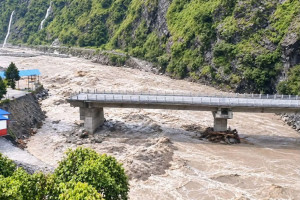
The Bhotekoshi floods have added another drag on the economy. The disaster caused extensive damage to farmland, private homes, offices and other infrastructure. The impact on overall economic growth can be measured only after authorities establish the scale of the direct economic losses.
Reconstruction, however, could generate fresh economic activity.
“After the earthquake, Nepal recorded economic growth of around 7 percent for several years. Rebuilding structures damaged by the Bhotekoshi floods, relocating settlements or resettling affected people could similarly produce growth of 7 to 8 percent,” said Thapa.
But the central problem may not be a shortage of money. It is confidence.
Min Bahadur Shrestha, a former vice-chair of the National Planning Commission, is pessimistic about the current situation. He said expectations had risen after a new political leadership took charge and an experienced economist became finance minister, but the investment climate had not improved as expected.
“I am disappointed,” Shrestha said. “I expected the economy to improve because political power had passed to a new generation and a knowledgeable person had become finance minister.”
He said the failure to increase investment and the continued apprehension within the private sector were serious concerns.




 26.52°C Kathmandu