



 14.81°C Kathmandu
Sat, Oct 24, 2026
Money
Udayapur Cement, once Nepal’s pride, teeters on the brink of bankruptcy
Buried under liabilities exceeding Rs5 billion, the factory has been unable to pay employees for 17 months.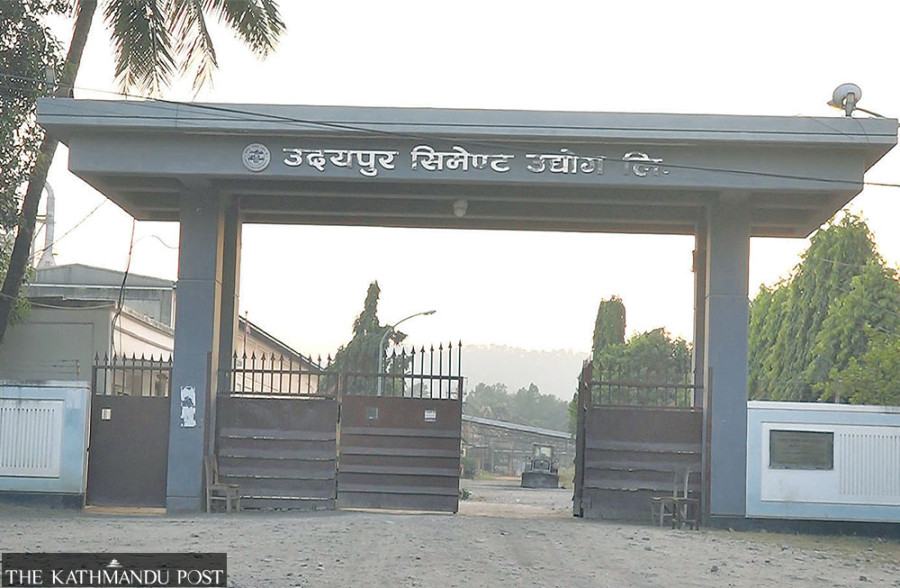
bookmark![]()
Following pressure from locals, a government team assigned to assess state property studied the industry, its land and limestone mine, and submitted a report to the government. Post Photo
Bhotraj Rai
Published at : August 23, 2026
Updated at : August 23, 2026 20:40
Udayapur
Shankar Thapa, a worker at the venerable Udayapur Cement factory in eastern Nepal, has been surviving for the past 17 months without a salary. “It has become extremely difficult to run the household without a pay,” Thapa told Kantipur recently. His children’s education has been affected, and he has had to borrow money to meet household expenses. “We have survived on loans for all these months,” he said. “Now we are struggling even to put food on the table.”
Thapa’s plight is shared by hundreds of workers at the state-owned factory, which is struggling to stay afloat amid mounting liabilities, ageing machinery and years of political interference.
According to Chakra Karki, secretary of the struggle committee, an ad hoc body formed to represent employees and workers, some workers have even died without being able to afford medical treatment after falling ill. Karki said 10 workers died while waiting for their salaries, while most of those still waiting for their pay have fallen deep into debt.
The industry has an approved staff strength of 580, but only 173 employees are currently working there.
They have also been deprived of provident fund contributions, insurance and other benefits. The 139 retired employees have yet to receive all the benefits due to them.
The factory said its liabilities towards employees alone have piled up to more than Rs1 billion, including 47 months of unpaid provident fund contributions, 37 months of contributions to the Citizen Investment Trust and three years of unpaid insurance premiums.
Despite having access to high-quality limestone, an established “Gainda Chhap” brand and a nationwide market, Udayapur Cement has been pushed to the brink of bankruptcy, with total liabilities now exceeding Rs5 billion.
The factory’s financial troubles have been compounded by years of political meddling, frequent changes in management and outdated production machinery, leaving the once-important state-owned cement producer struggling to maintain operations.
A lack of working capital has brought production to a halt since last February. Once regarded as a symbol of pride in Nepal’s public industrial sector, Udayapur Cement is now struggling for survival.
The industry has been trapped for years in a cycle of financial crisis, managerial instability, outdated technology, political interference and labour problems.
Established in 1987 at Jaljale in Triyuga Municipality-6 of Udayapur, the industry was built with assistance from the Japanese government and began production in 1992. Its design was prepared by Onoda Engineering of Japan, while Kawasaki Heavy Industries and Tomen Corporation constructed the plant.
The industry is wholly owned by the Nepal government, and one of its biggest strengths is its own limestone mine. The mine at Sindhalidanda, about 27 kilometres from the factory, is estimated to contain 73-75 million tonnes of high-quality limestone, according to the factory.
Gopi Krishna Neupane, a former general manager of the factory, said the limestone contains less than 2 percent magnesium oxide and around 52 percent calcium oxide. A study he conducted for his doctoral research found that only around 4 million tonnes had been extracted so far. At the current rate of production, he said, the mine could support the industry for more than 300 years.
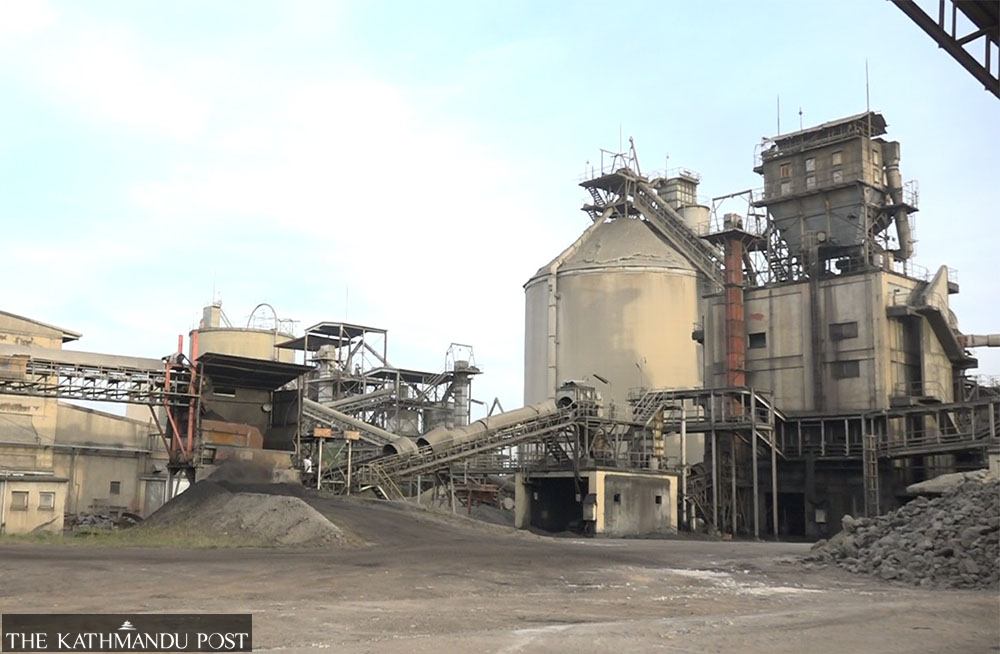
The industry has a daily production capacity of 800 tonnes. But with machinery and technology nearly four decades old, it can currently operate at only around 35 to 40 percent of capacity.
Mechanical engineers say that even with regular maintenance, four-decade-old technology makes it impossible to achieve the production efficiency and cost competitiveness of a modern cement plant. They have recommended modernising the kiln, coal mill, burner, conveyor and cement mill systems.
Neupane has suggested installing at least 10 megawatts of solar power, improving the ropeway and adding calciner technology. Such measures could reduce production costs and raise daily output to around 1,100 tonnes.
The factory’s financial crisis has continued to deepen.
Baijanath Jha, acting general manager of the factory, said its liabilities have exceeded Rs5 billion and are growing each passing day.
Almost all of the factory’s 30 bank accounts have been frozen. Some suppliers took legal action after the factory failed to make payments on time, resulting in the freezing of its accounts.
“This has directly affected the industry’s financial operations,” said Jha.
The factory does not have enough money to purchase raw materials, he said.
“Because suppliers have lost confidence in us, we have not been able to obtain coal, red soil, gypsum and other necessary materials on credit,” he said.
Jha said the industry also lacks skilled technical personnel as well as competent staff in administration, accounting and financial management.
According to him, investment in human resources is as important as investment in machinery to revive the industry.
A lack of money to buy cement bags meant that around Rs60 million worth of finished cement and clinker remained stockpiled at the industry for nearly six months.
The factory recently resumed sales only after obtaining bags on credit. It purchased 53,187 bags from Ashirwad Poly Packs Pvt Ltd in Chitwan.
The bags were supplied on the condition that the supplier would be paid from the proceeds of cement sales, according to the factory. After the bags arrived, the industry sold around Rs1.3 million worth of cement and paid approximately Rs1.2 million to the supplier, Jha said.
‘Gainda Chhap’ cement was once a well-established and highly regarded brand in the Nepali market. But its reputation alone has proved insufficient to withstand today’s competitive market.
Numerous private cement brands have entered the market with attractive advertising campaigns.
Traders say Gainda Chhap has struggled to compete with private brands that use modern technology, higher production capacity and aggressive marketing strategies.
Private cement manufacturers have been offering cement at comparatively lower prices, while Udayapur Cement has become less competitive because of its high production costs.
The factory currently sells cement at around Rs725 per bag. According to the factory, sales have declined because its product is around Rs100 more expensive than those of private manufacturers.
Local trader Bharat Rai said consumers who understand quality still choose Gainda Chhap, while those who prioritise price opt for other brands.
“Producing a quality product alone is not enough,” Rai said. “The product should be brought to the market at a competitive price.”
Another major problem facing the industry is managerial instability.
Twenty-nine general managers have been appointed to the industry in the past 33 years. Employees accuse successive governments of changing leadership based on political interference and power-sharing arrangements, making it difficult for the industry to formulate long-term strategies.
They say the industry has been hollowed out because successive governments failed to treat a national industry as an institution above the interests of individual parties, leaders and groups.
Jha said the lack of sufficient authority for management and overly complicated procedures for everything from procurement to financial decisions have compounded the problems.
Various complaints related to financial and administrative issues have also reached the Commission for the Investigation of Abuse of Authority. The anti-graft body has reportedly warned the factory to control unproductive spending amid its weak financial condition.
The CIAA has also filed a case over the disappearance of clinker worth Rs460 million and the misappropriation of public property.
Eight senior officials—including former general manager Surendra Kumar Poudel, former acting general manager Nawal Kishor Sah, former deputy general manager Mahesh Prasad Kafle and other former department chiefs—are facing trial at the Special Court in Kathmandu.
A team from the Prime Minister’s Office has conducted an assessment of the industry, and the government is expected to take steps to restart operations, according to Jha.
Pravesh Khadka, secretary of the Industry Rescue and Vigilance Committee, said local residents have repeatedly urged the government to save the industry.
The committee was formed several months ago after citizens became concerned about the possible collapse of an industry regarded as a source of national pride. At a time when new industries are not being established while existing ones are closing, local residents have begun efforts to save the plant.
Following pressure from locals, a government team assigned to assess state property studied the industry, its land and limestone mine, and submitted a report to the government. The report includes several options for operating the industry.
Khadka said locals have suggested operating the industry under a public-private partnership model.
He said the industry’s existing machinery could be upgraded immediately to increase production capacity. In the long term, however, a modern plant could be established in the Sukura area near the limestone mine on around 550 ropanis of land, with a daily clinker production capacity of 10,000 metric tonnes.
Under the proposed model, the federal government, provincial government, local government, residents of the mining area and employees would jointly hold a 45 percent stake, while the private sector would contribute the remaining 55 percent.
The proposed plant would require an investment of around Rs20 billion. Its clinker could be supplied to cement factories across Nepal and potentially exported to Bihar and Uttar Pradesh in India.
According to the industry’s annual report for fiscal year 2021-22, the proposed plant could generate more than Rs3 billion in annual government revenue.
Ramesh Rasaili, president of the Triyuga Chamber of Commerce and Industry in Gaighat, said the crisis will deepen if the old cycle of political appointments, unstable leadership, opaque procurement and weak management continues.
He suggested bringing in new, skilled personnel to make the industry more effective.
“If professional and empowered leadership, a transparent procurement system, modern machinery, financial restructuring, skilled human resources and a long-term investment plan can be implemented, the industry can regain its glory,” he said.
“But if it again becomes trapped in power-sharing and political games, the crisis facing state-owned industries could become even deeper.”




Most Read from Money

Why does an hour long flight to Dhangadhi cost more than a flight to New Delhi?

Nepal travel agents threaten to stop selling Thailand trips over visa rules
Malaysia rejects Nepal’s demand to open recruitment to all manpower agencies

No school, but a graduation cap for women dairy farmers

Nepal arrests four medical service providers as Malaysia recruitment row deepens
Editor's Picks




E-PAPER | October 24, 2026

×