



 14.81°C Kathmandu
Sat, Oct 24, 2026
Money
Lawmakers want to shrink the central bank governor’s term. Critics say that could open the door to political interference
A parliamentary panel has proposed cutting the tenure from five years to three, with a possible two-year extension based on performance — a change ex-governors warn could leave the bank exposed to political pressure just when it needs stability.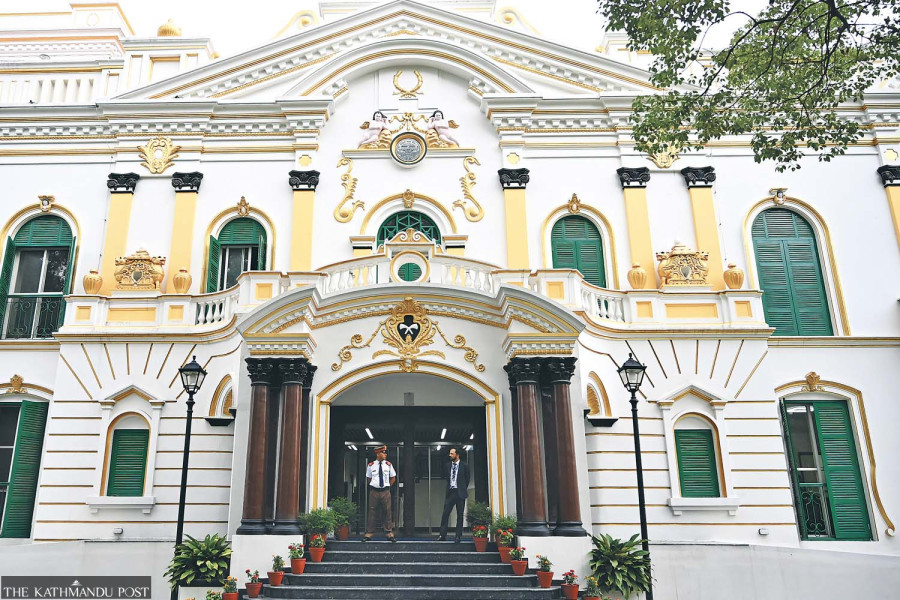
bookmark
Yagya Banjade
Published at : August 21, 2026
Updated at : August 21, 2026 09:23
Kathmandu
Former governors of Nepal Rastra Bank have criticised a parliamentary committee’s decision to cut the tenure of the central bank’s governor, deputy governors and board members to three years, warning the move could undermine institutional stability and policy continuity.
The Federal Parliament’s Finance Committee, discussing amendments to the Nepal Rastra Bank Act on Thursday, decided to set a three-year term for the central bank’s top officials, while allowing the Cabinet to extend their tenure by another two years based on performance.
If the amendment is endorsed unchanged by both the House of Representatives and the National Assembly, the Cabinet will have the power to decide whether officials should remain in office for another two years.
Former finance minister and former governor Yuba Raj Khatiwada said Parliament should reconsider the decision, arguing that the governor’s tenure was deliberately fixed at five years to ensure stability in monetary policymaking.
“This is fundamentally a question of leadership stability at the central bank. The governor’s tenure was set at five years, on par with that of lawmakers, to ensure policy continuity and make monetary policy more predictable,” Khatiwada said.
He said earlier discussions had even considered a six-year tenure for the governor, similar to that of officeholders of constitutional bodies, before settling on five years.
“I have also heard that the five-year term has been reduced to three years. This is a mistake,” Khatiwada said. “I believe this is the wrong move, based on my experience.”
Concerns that an unsuitable governor might remain in office too long, or that a government might be unable to appoint its preferred candidate, should not be used to justify weakening the central bank’s institutional stability, Khatiwada said.
Reducing the tenure, he warned, could leave the central bank under short-term, unstable leadership — and international institutions and development partners closely watch the independence and stability of central banks.
Former governor Vijaya Nath Bhattarai was even more critical, saying the move appeared designed to prevent governors disliked by the government or political groups from serving a full five-year term.
“This is nothing more than a policy of preventing people they do not like from serving as governor for a long period,” Bhattarai said. “It suggests that they want the central bank to operate according to the interests of a particular party or group for a fixed period.”
If the government and Parliament genuinely wanted to strengthen the central bank, Bhattarai said, they should reform the appointment process and eligibility criteria for governors rather than simply shorten their tenure.
“We should make a law that prevents the appointment of party workers, favourites, relatives or people close to those in power as governor,” he said. “Let us make the selection process transparent and credible, and allow a governor chosen on merit to work confidently for at least five years.”
Changing only the tenure, without reforming the appointment process and eligibility rules, reinforces the impression that the real objective is to destabilise the central bank, he argued.
“If five years caused a problem, what exactly will improve when the term is reduced to three years?” Bhattarai asked. “The government and the parliamentary committee need to explain the rationale.”
Finance Committee chair Krishna Hari Budhathoki defended the decision, saying it was intended to strengthen Nepal Rastra Bank by linking tenure to performance.
Under the proposed “three plus two” arrangement, a governor or board member performing well could be given an additional two years, he said, while those falling short would not necessarily remain in office for the full five years.
“There is no obstacle to extending the tenure by another two years if a governor or board member is performing well,” Budhathoki said. “But if someone is not performing well, there is no reason for them to continue occupying the position.”
Similar arrangements exist in India, Budhathoki said, where governors can serve for up to five years depending on the circumstances.
The Finance Committee has been discussing amendments to the Nepal Rastra Bank Act for several weeks. Under current law, the governor, deputy governors and board members serve five-year terms; the provision does not apply to the finance secretary, an ex-officio board member.
The committee decided to amend a sub-section of Section 18 of the Act, replacing the word “five” with “three” in the provision governing tenure. It also agreed to add a provision allowing the government to reappoint a governor, deputy governor or board member for another two years after the initial three-year term, if it deems the extension reasonable based on a performance evaluation.
The proposed changes still need approval from both chambers of Parliament before becoming law.
Yagya Banjade
Banjade covers government finance, banking, capital markets, and the economy for Kantipur Daily.





Most Read from Money

Why does an hour long flight to Dhangadhi cost more than a flight to New Delhi?

Nepal travel agents threaten to stop selling Thailand trips over visa rules
Malaysia rejects Nepal’s demand to open recruitment to all manpower agencies

No school, but a graduation cap for women dairy farmers

Nepal arrests four medical service providers as Malaysia recruitment row deepens
Editor's Picks




E-PAPER | October 24, 2026

×