Woman delivers baby on street outside Saptari hospital as couple can’t afford blood test
Health ministry and Nepal Medical Council dispatch teams to investigate the incident at Gajendra Narayan Singh Hospital in Rajbiraj. A poor couple says they were left without help after being asked to pay for blood tests before the woman could receive maternity care. Bidyananda Ram/TKP
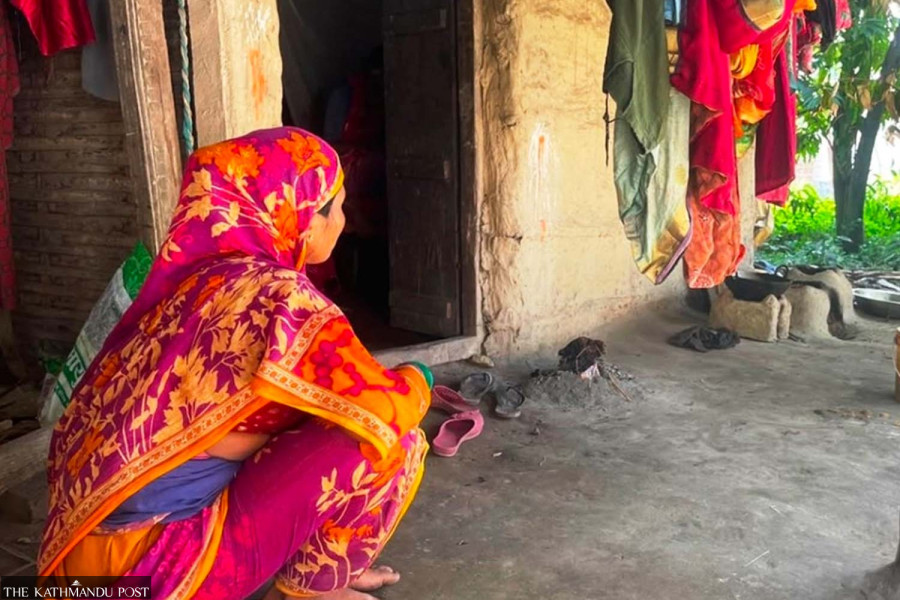
A 30-year-old woman gave birth on a pavement outside Gajendra Narayan Singh Hospital in Rajbiraj early Wednesday after she and her husband said they could not pay for a blood test.
The incident exposes the gap between the country’s free maternity care policy and the experience of impoverished families.
Babita Kumari Paswan of Parsahi in Rajbiraj Municipality-14, Saptari, arrived at the hospital at around 1 am in labour. She was accompanied by her husband, Hareram Paswan, and a neighbour. After an examination at the labour ward, staff gave Hareram a slip to pay for blood tests, he said.
The couple had only Rs2,000. When Hareram asked how much the tests would cost, he was told they could require up to Rs3,200.
“We had only Rs2,000 so I did not know what to do,” Hareram told Kantipur. “I called some relatives for help, but could not arrange for the money. I went outside to borrow from a shopkeeper I knew, and my wife followed me.”
He said they found the nearby shops closed at around 2am and returned to the pavement to wait until morning. “I had no option but to wait for the shops to open,” he said. “I asked people coming in and out of the hospital for help, but nobody showed us a way out.”
By around 4:30am, Babita’s labour pains became extreme. Aided by some women, she delivered a baby boy on the pavement, lying over a roadside drain.
“She endured the labour for about two-and-a-half hours before giving birth there,” said Hareram. He also alleged that nurses ignored them because they lacked money.
The family returned to the gynaecology ward after childbirth, but Hareram alleged that staff again treated them poorly and told them to leave. “They even said they would push us out if we did not leave. So we had no choice but to take an e-rickshaw home,” he said.
The video of Babita delivering on the pavement spread fast on social media, prompting the hospital to bring her and the newborn back for examination and treatment.
Hospital nurses claimed that the couple left in anger after a minor argument when Babita refused to allow them to clean her uterus after cutting the baby’s umbilical cord.
Hareram owns no land. He struggles to meet the basic needs of his wife and their three other children with daily wage labour.
Under the government’s Safe Motherhood Programme, introduced to reduce maternal and newborn deaths, antenatal check-ups and delivery services are provided free of charge at health facilities. The programme’s guidelines also require hospitals to cover the transport costs of women travelling to health facilities for childbirth.
In Babita’s case, the hospital claims that the family did not inform staff that they could not afford the tests.
Dr Jitendra Kandel, acting medical superintendent at the hospital, said that although childbirth services are free under the programme, patients may have to pay for detailed blood tests. He said Babita had undergone only two antenatal check-ups and had no previous blood-test reports, making a comprehensive assessment necessary.
“Not all tests are covered by the Safe Motherhood Programme,” said Kandel. “As she had not undergone these tests previously, we needed to conduct CBC, RFT, LFT, PT/INR, hepatitis B and C, VDRL, blood-group and other tests to ensure the safety of both the mother and the baby. This adds to the cost.”
He said, however, that such costs could also be covered through the hospital’s social service unit for poor and disadvantaged patients. “But they did not inform us that they had no money,” he said. Kandel said the couple left the hospital without informing anyone after Babita was admitted to the gynaecology ward.
After the video went viral, the hospital brought Babita and her newborn back in an ambulance on Thursday and is providing them with free health checks and treatment. The hospital said both mother and baby were in normal condition.
Following the incident, the Ministry of Health and Food Safety sought an explanation from the hospital within 24 hours. Medical Superintendent Dr Ranjit Kumar Jha said an investigation had begun and that the hospital was preparing to submit its report by 5pm Friday.
“We returned from Kathmandu on Thursday and are carrying out necessary inquiries,” said Jha.
The ministry and the Nepal Medical Council have also sent separate teams to Rajbiraj to investigate the incident. The ministry’s team led by Dr Pawan Jung Rayamajhi, chief of its Curative Service Division, and the five-member Nepal Medical Council team, including registrar Dr Suprabhat Shrestha and Ethics Committee member Dr Ajay Shah, were sent to Rajbiraj on Thursday to establish the facts surrounding the incident.
The Saptari case raises questions over whether poor patients know about and can access benefits under the government’s Safe Motherhood Programme.
The programme provides free delivery services at government health facilities, free medical treatment for mothers and babies, transport allowances and cash incentives for antenatal check-ups. The government introduced free institutional delivery services in 2009, and the institutional delivery rate has risen substantially since then.




 14.82°C Kathmandu