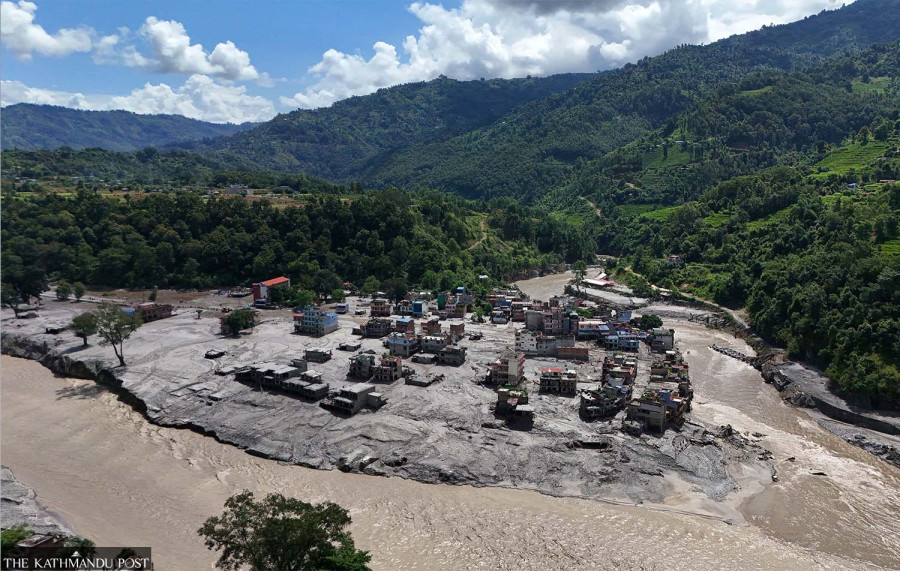
The government estimates that Nepal will need Rs723.31 billion to rebuild the infrastructure damaged by the August 26 Bhotekoshi floods.
The estimate comes from a Rapid Damage and Needs Assessment (RDNA) prepared by a joint technical team led by the National Planning Commission and the National Disaster Risk Reduction and Management Authority (NDRRMA). Infrastructure accounts for the largest share of the estimated recovery bill, at Rs473.57 billion, or 75 percent.
NDRRMA chief executive Dharmaraj Uprety said the estimate was based on data collected from ministries, government agencies and local units.
“This is a preliminary estimate. But we have compiled the figure using data from the Department of Roads, the Central Bureau of Statistics, and the ministries of agriculture and energy, among others,” Uprety said. “We also compared pre- and post-flood data from the statistics office and used drone surveys to assess conditions before and after the disaster and calculated losses and damage sector by sector.”
The energy and transport sectors suffered some of the heaviest damage. Thirteen hydropower projects with a total generation capacity of 759 megawatts and five solar plants with a capacity of 24 megawatts were affected. Restoring the energy and grid system alone is expected to cost Rs390.62 billion, according to government estimates.
The floods damaged 69 kilometres of roads and washed away 33 motorable bridges, while four others suffered partial damage. Of the 64 footbridges in the affected areas, 53 were damaged. Rebuilding the transport network is estimated to require Rs73.34 billion.
The disaster also caused extensive damage to homes, public buildings and essential services in Rasuwa, Nuwakot, Dhading, Gorkha and Chitwan districts. A total of 7,570 private homes were damaged, along with 48 public buildings, 18 schools, seven health facilities, and 30 cultural heritage sites. Recovery in the sector is estimated to require Rs103.54 billion.
The productive sector, including trade, businesses, banks and agriculture, is expected to need another Rs50.77 billion for recovery. The floods damaged 1,806 hectares of crops, 17 branches of various banks, and about 4,800 commercial establishments.
Among the 15 local units affected across the five districts, Bidur Municipality in Nuwakot recorded the highest number of damaged homes, at 3,026.
The assessment estimates that Rs94.75 billion will be needed for disaster-risk reduction and river management, while Rs515.4 million has been earmarked for clearing mud and debris.
The government has divided reconstruction into two phases. Immediate relief and short-term reconstruction over the next six months are estimated to cost Rs8.73 billion, while long-term reconstruction is expected to require Rs714.58 billion.
Upreti said the current figure was a preliminary estimate based on available data and that a more detailed Post-Disaster Needs Assessment would be prepared within a month. The detailed assessment would also involve the World Bank and other experts, he said.
The final figure could rise if the government takes new decisions or if additional costs are identified, Upreti said. The estimate would increase if entire settlements had to be relocated and new land purchased, or if household belongings and other personal assets were included. But he said he did not expect the final figure to rise substantially.
About 1.6 million people have been affected by the floods.
According to the latest figures, 1,370 deaths have been confirmed, and 5,130 people remain unaccounted for.
The disaster also affected 6,901 students at 19 schools in Rasuwa, Nuwakot and Dhading. Most of the schools will require reconstruction, while some can be repaired. Eight schools were destroyed, and eight suffered partial damage, while only three remained intact.
Four health facilities in Rasuwa, including the Syaphrubesi Health Post, Timure Health Post, the Timure Health Desk at Rasuwagadhi and the Mailung Community Health Unit, were destroyed. Baireni Hospital in Galchhi and the Charaundi Basic Health Service Centre suffered partial damage.
Two wastewater treatment plants in Dhunge and Bidur of Nuwakot were destroyed. The flood washed away about 4.5-km of pipeline of the Bidur drinking-water project. Around 4,000 households have been affected as a result. Damage to the Trishuli Colony, Devighat and Betrawati drinking-water projects affected another 465 households.
Buildings and offices of Langtang National Park in Timure, Syaphrubesi, Mailung and Bandare were completely or partially damaged. The Agriculture Development Centre in Nuwakot and the Plant Quarantine Office in Timure were also damaged.
The affected hydropower projects include Rasuwagadhi, Rasuwa-Bhotekoshi, Chilime, Langtang Khola, Upper Trishuli-1, Upper Trishuli-2, Upper Trishuli-3A, Upper Trishuli-3B, Mailung Khola, Madhya Trishuli Ganga, Trishuli, Devighat and Super Trishuli. Hydropower and solar projects with a combined installed capacity of 783.385 megawatts were affected, along with substations and transmission lines.
Meanwhile, a total of Rs12.63 billion has been deposited in the Prime Minister’s Disaster Relief Fund by Thursday. The funds were raised after the government appealed to people and organisations in Nepal and abroad to contribute to relief and rehabilitation efforts following the floods.
The government has already released Rs1 billion from the fund to the National Disaster Risk Reduction and Management Authority for relief and rescue operations in the flood-affected areas.




 17.6°C Kathmandu