Two days of Gen Z uprising, two versions of what happened
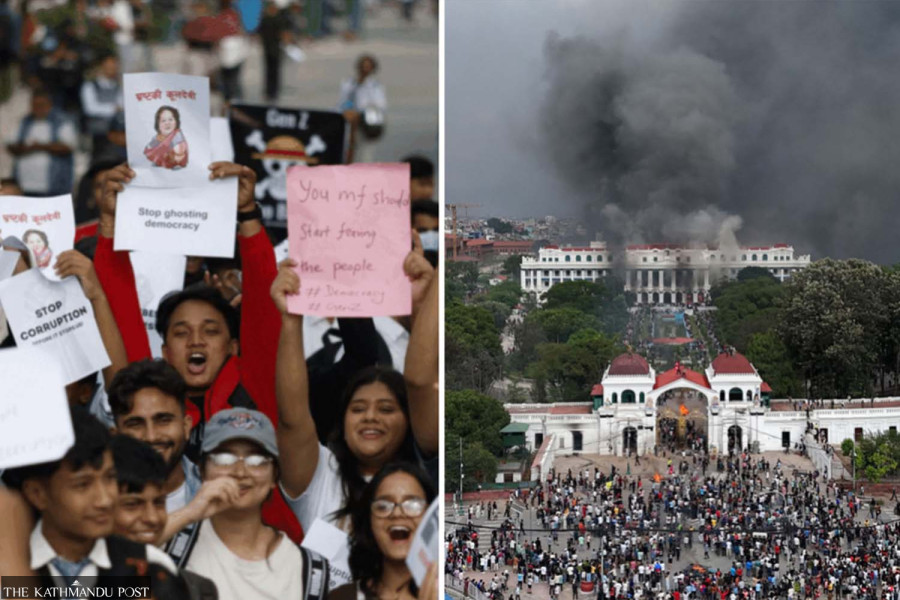
The old guard stresses September 9, while the RSP government points to the deadly crackdown of September 8. Neither side has fully pursued accountability for both. Gen Z protest in Kathmandu’s Maitighar Mandala on September 8, 2025 (left), and the Singha Durbar engulfed in flames the following day. Post file photos
A year after Nepal’s Gen Z uprising, its political forces remain divided over how to remember the two days that defined it.
In separate video messages on Wednesday, former prime ministers KP Sharma Oli and Pushpa Kamal Dahal focused on the violence and destruction of September 9, which followed the bloody crackdown on protesters a day earlier. Both called for an investigation into those responsible.
Oli, who was prime minister when the protests began, described September 9 as a day of “terrifying destruction”. Dahal, chair of the Nepali Communist Party, called the events “mysterious” and demanded a thorough investigation.
But the old political establishment has largely focused on the destruction of September 9 while saying little about the deadly state crackdown a day earlier. The Rastriya Swatantra Party-led government, which came to power on the back of the Gen Z uprising, has taken the reverse approach, emphasising the killings of unarmed students on September 8 while largely ignoring the property destruction that followed.
The competing narratives reflect the political interests of the old and new parties. But the National Human Rights Commission and the Gen Z inquiry commission led by former chief justice Gauri Bahadur Karki treated September 8 and 9 as distinct but equally serious events, and called for those responsible to be investigated and held accountable.
The failure to implement the two commissions’ recommendations, and the selective way political parties are remembering the uprising, raises a larger question: a year on, who gets to define what the Gen Z revolt meant—and how is its history being shaped by those now in power?
Human rights activists say the political fight over the two days allows both sides to shift blame onto their rivals while shielding their own from accountability and this only perpetuates a culture of impunity.
“Today’s government, led by a new party, is following the same path as the old parties and repeating their mistakes,” said human rights activist Charan Prasai, a former National Human Rights Commission member and former president of Amnesty International Nepal. “We have seen protests, arson, and killings before. But if no one is held accountable, what has really changed? How is this government any different from the governments that came before?”
“The Gen Z revolt was driven in large part by anger over impunity, poor governance and the lack of accountability,” Prasai said. “But it feels as though we are slipping back into the same old pattern. How can a government with such a strong popular mandate be unwilling to investigate those responsible? And why has it failed to act on the findings of the National Human Rights Commission and the Karki commission?”
Former National Human Rights Commission member Mohna Ansari said political calculations and the desire to preserve a culture of impunity have led the government and political parties to selectively focus on one of the days while ignoring the other. “The reports make it clear that both sides were involved, including their own party activists,” Ansari said. “That is why each side is choosing to focus on one day and ignore the other. Otherwise, the government should have investigated both days and implemented the recommendations.”
She said those who were in power on September 8 should have publicly acknowledged their mistakes.
“We saw this under [Sher Bahadur] Deuba and Oli, and we are seeing it again today,” she said. “Those in power are not interested in upholding the rule of law. They are interested in protecting themselves and those close to them. That is why no one dares to speak out.”
She also warned that allowing both sides to escape accountability would set a dangerous precedent.
The uprising began after the government led by Oli decided to block social media platforms that had failed to register with the authorities. On September 8, Gen Z protesters took to the streets in opposition to the decision. Security forces opened fire as the protesters, mostly unarmed students and youths, reached the Parliament area at New Baneshwar.
According to the National Human Rights Commission and Karki Commission reports, 27 people were killed, and serious human rights violations were recorded on September 8. The next day brought widespread attacks, arson and looting targeting state institutions, courts, businesses, private media and other property. Seventy-six people eventually died as a result of the violence, including those who later succumbed to injuries sustained during the two days.
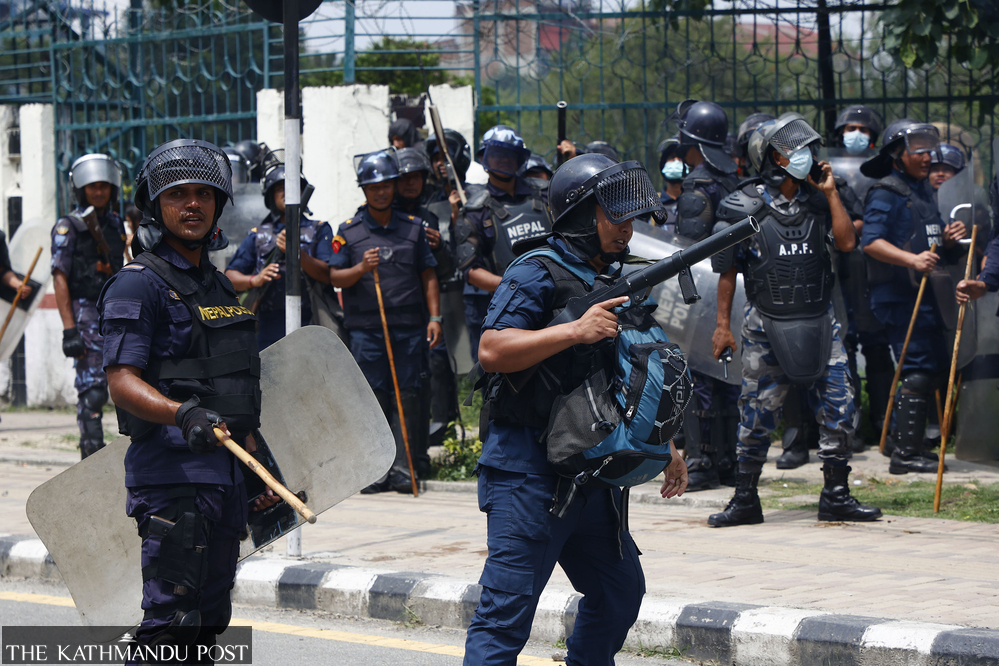
Police deploy outside Parliament to contain a Gen Z protest in New Baneshwar on September 8, 2025.
The National Human Rights Commission’s investigation, led by commissioner Lily Thapa, identified more than five dozen people for further investigation and possible action over the September 8 crackdown. It recommended action against Oli, then home minister Ramesh Lekhak, then communications minister Prithvi Subba Gurung and senior security officials.
The commission also recommended action against then Nepal Police chief Chandra Kuber Khapung, then Armed Police Force chief Raju Aryal and then National Investigation Department chief Hutaraj Thapa, holding all three responsible for human rights violations. It recommended barring the officials from future government appointments and keeping a record to enforce that decision. It also called for a detailed investigation into security personnel who opened fire on protesters.
For September 9, the commission identified 52 people, including 17 then RSP lawmakers, for investigation. It also recommended investigation and action against two groups, including the TOB.
Likewise, the Karki-led commission recommended investigation and action against Oli, Lekhak and other senior officials over the September 8 crackdown. It recommended a separate investigation into the violence and destruction of September 9.
The report was received by the government led by then prime minister Sushila Karki, but before it could be fully implemented, a new elected government under Prime Minister Balendra Shah took office.
At its first cabinet meeting, Shah’s government decided on March 27 to implement the Karki Commission’s recommendations. Oli and Lekhak were arrested the following day, but both were later released by the Supreme Court on habeas corpus orders. No further investigation or prosecution has followed.
Meanwhile, the government has not formally accepted the report of a separate commission led by former justice Prem Raj Karki, which was formed to investigate the events of September 9.
When lawmakers questioned Shah in Parliament on May 31, he acknowledged receiving only the recommendations section of the report and said the government would begin implementation after receiving the full report. That has yet to happen.
The failure to implement inquiry commission reports is hardly new in Nepal. Governments have previously shelved reports by commissions led by Janardan Lal Mallik, which investigated the suppression of the 1990 pro-democracy movement; Krishna Jung Rayamajhi, which investigated the crackdown during the 2006 people’s movement; and Girish Chandra Lal, which investigated the Tikapur incident. Reports on the 2018 gold smuggling scandal and other major incidents have also remained largely unimplemented.
The history of selective action and inaction has also shaped the competing political versions of the Gen Z uprising.
For one side, the destruction of September 9 provides grounds to question the legitimacy of the Gen Z movement. For the other, the state crackdown on September 8 is evidence of the failure of the old political order and a justification for the political transformation that followed.
Nepali Congress president Gagan Kumar Thapa says the events of the two days cannot be viewed separately.
Thapa said young protesters had taken to the streets peacefully on September 8 to demand good governance, only to face a deadly state crackdown. He also acknowledged that the old guard, including the Nepali Congress, bore responsibility for the anger that brought an entire generation onto the streets.
“We must establish the truth about both days: why the state cracked down on September 8, who was responsible for the deaths of young people, and who carried out the destruction on September 9,” Thapa said in a video message on Tuesday.
He said the violence of September 9 must also be investigated and those responsible held accountable. “There can be no justice without holding those responsible for the crimes of September 8 and 9 to account,” Thapa said.
Meanwhile, Oli has continued to reject the findings that the September 8 crackdown involved serious state abuses. He has instead argued that criminal groups infiltrated the peaceful demonstration and deliberately incited violence.
“They attacked Parliament and incited the protesters,” Oli said. “The protesters were deliberately driven towards Parliament, where someone opened fire covertly.”
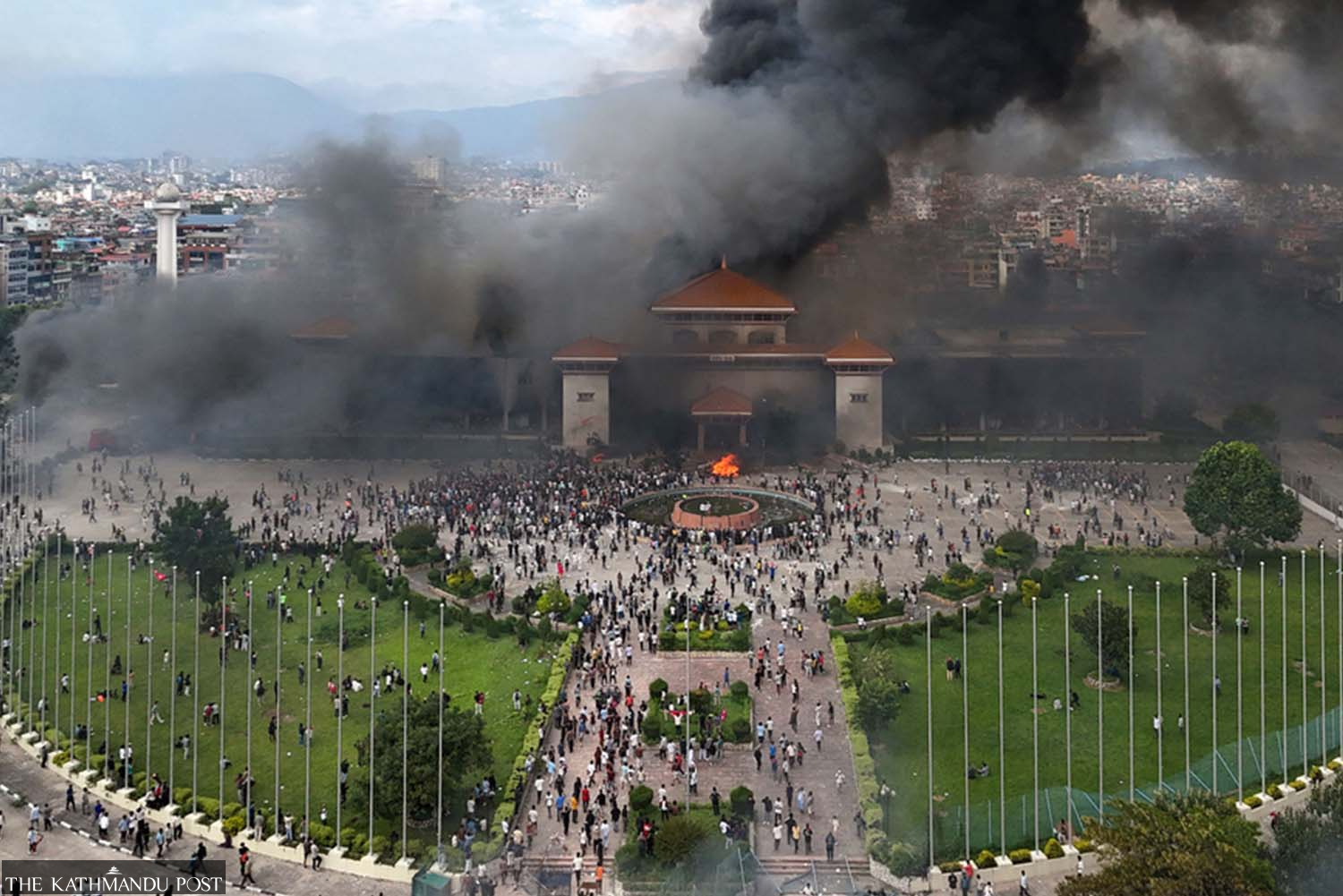
Smoke billows from then Parliament building after it was set on fire by Gen Z protesters on September 9, 2025.
In his video message, Oli described September 9 as the day of the “largest attack and destruction” against the pillars of the state, democratic institutions and the national economy.
He said the scale of the destruction the following day could not simply be explained as an emotional reaction to the deaths of protesters on September 8.
Dahal called for a broad investigation into the events of September 9, saying the scale and speed of the destruction raised serious questions.
“Looking back at that day, it is truly mysterious that an attack of this scale could take place against the sovereignty, democratic movement and aspirations of the Nepali people, and that such destruction could unfold within just a few hours,” Dahal said.
He called for an investigation to establish who organised the destruction and who was ultimately responsible, and criticised the government for failing to establish the truth or implement the National Human Rights Commission’s findings over the past year.
Dahal said the violence of September 9 did not reflect the aspirations of Gen Z protesters who had taken to the streets a day earlier demanding good governance and transparency.
“September 9 did not represent those feelings and aspirations. Instead, it appears that those who opposed the aspirations of Gen Z youths hijacked the September 8 movement and took control of it,” Dahal said.
The government that rose on Gen Z’s anger now faces its own reckoning
Prime Minister Shah and Home Minister Sudan Gurung have largely focused on September 8 when speaking about the uprising.
On the first anniversary of the movement, Shah posted a brief message on Facebook saying that good governance would be ensured and offered tributes to the martyrs.
Gen Z activists and families of those killed and injured had gathered at the former Parliament building in Baneshwar to mark the anniversary and spent much of the day looking for the prime minister. Many complained that the government had failed to honour its commitments to injured protesters and families of those killed.
Ganesh Chaulagain, father of Gen Z martyr Shreeyam Chaulagain, asked from the stage whether the state had fulfilled its responsibilities towards the martyrs and their families. “Have we fulfilled our responsibility towards the martyrs and their families? This question is not only for the state, but for all of us,” he said.
Gurung attended the event on behalf of the prime minister. At the venue, Pawan Khadka, who was injured during last year’s protests, was taken into police custody after criticising the government’s performance. His removal briefly heightened tensions.
Gurung criticised the old political parties and pledged to deliver on the demands of young people, but did not say that the September 9 violence would be investigated or that those responsible would be held accountable.
“As long as Prime Minister Balendra Shah and our party chair Rabi Lamichhane keep the hopes of Gen Z alive, I want to honour the trust you have placed in us to show what good governance looks like,” Gurung said.
In Parliament on Wednesday, lawmaker Rachana Khatri, the mother of a Gen Z martyr Rasik Khatiwada, also criticised the government for failing to meet families of those killed and injured.
“I want to ask this government two questions: How many years will it take for martyrs to get justice? How many more years will it take to meet the families of the martyrs and the injured?” she asked.
Gauri Bahadur Karki, who headed the Gen Z inquiry commission, said his panel had completed the work assigned to it, documented what it found about September 8 and recommended a separate investigation into the September 9 destruction.
“We fulfilled the responsibility entrusted to us. The report is now with the government, and what it does with it is up to the government,” Karki said. “Such commission reports must be implemented. Otherwise, impunity and anarchy will only grow. This is not about any particular party or leader.”
A year on, the competing accounts of September 8 and 9 remain unresolved. The investigations have documented serious allegations on both days, but the recommendations have yet to lead to full accountability.




 14.81°C Kathmandu