Martyr families question PM’s absence at Gen Z uprising anniversary
A year after the bloodshed, survivors and relatives of the dead say promises of justice, medical care, and support remain largely unfulfilled. Home Minister Sudan Gurung inaugurating the first anniversary program of Gen Z Martyrs’ Day in Kathmandu on Tuesday.
One year after security forces opened fire during Nepal’s Gen Z uprising, survivors and families of the martyrs gathered at the former parliament building at New Baneshwar in Kathmandu, the same place where dozens of protesters were shot a year ago, to take stock of what had changed.
For many, the answer was: little.
At the memorial marking the first anniversary of the protests, speakers accused the government of failing to honour commitments made to injured protesters and families of those killed. They demanded action against those responsible for the shootings, proper treatment for the injured, and the release of young protesters who remain in jail for their involvement in the movement.
Prime Minister Balendra Shah, whose government came to power winning the election held by the government formed after the movement, was conspicuously absent from the commemoration event.
The gathering was held at the Birendra International Convention Centre, which served as the parliament building at the time of the protests. The location gave the commemoration a particular resonance: it was here that protesters had demanded good governance and accountability, and here that some of the movement’s martyrs were shot.
The Gen Z uprising on September 8 and 9 and ensuing unrest left 76 people dead and over two thousand injured.
Ganesh Chaulagain, whose son Shreeyam Chaulagain was killed during the movement, put the central question to the state from the dais.
“Have we fulfilled our responsibility towards the martyrs and their families?” he asked. “This question is not only for the state, but for all of us.”
The audience responded with chants of agreement as speaker after speaker voiced similar grievances.
Home Minister Sudan Gurung and Law, Justice and Parliamentary Affairs Minister Sobita Gautam, among others, attended the event, but Gen Z representatives criticised the prime minister for staying away.
Tensions briefly flared when injured protester Pawan Khadka criticised the government’s handling of the movement. He was escorted out of the venue, further raising tensions.
The father of jailed protester Binod Karki said the government was still treating his son like a ‘terrorist’ simply for taking part in the demonstrations.
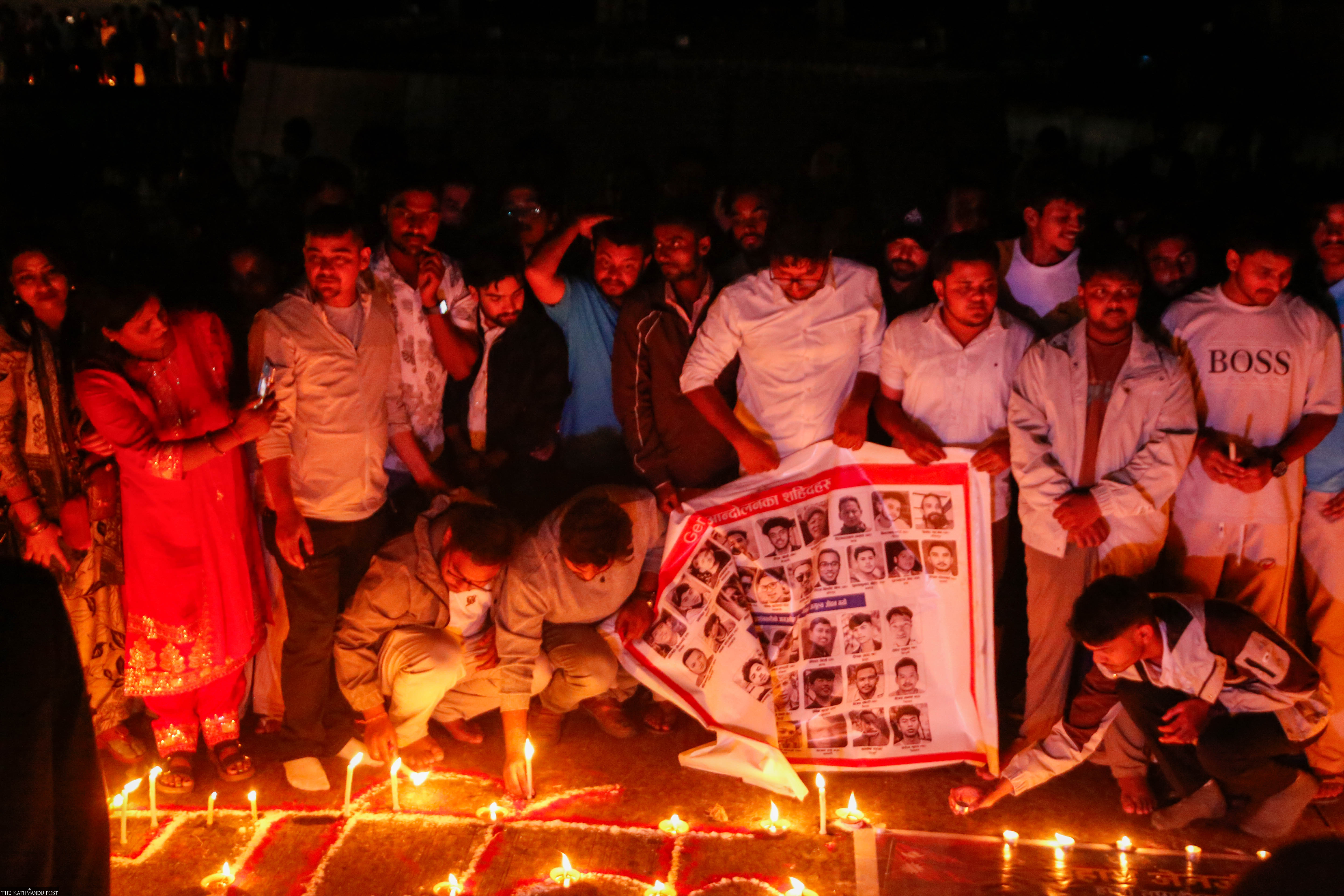
Candlelight tribute to Gen Z movement martyrs on the first anniversary. Dipesh Darshandhari/TKP
Basanta Kishor Shrestha, vice-president of the Gen Z Martyrs’ Families Society, called for those responsible for suppressing the protests to be prosecuted, even if new legislation was required.
“Until those who shot people in the chest and head are punished, the families of the martyrs will not find relief,” Shrestha said.
He contrasted the current government with the interim administration that preceded it.
“The previous interim government could not do it because it did not have a popular mandate. This government has a [near] two-thirds majority. It must take action.”
Former prime minister KP Sharma Oli and former home minister Ramesh Lekhak were arrested by the government formed after the March 5 election in connection with the crackdown on Gen Z protests. They were later released following court orders, but no fresh cases have been filed against them, a point repeatedly raised by speakers at the memorial.
As ministers Gurung and Gautam listened from the stage, martyr families and survivors continued to press for accountability.
The treatment of the injured was another major grievance.
Badal Rai, president of Gen Z Nepal, said the government had promised fully funded medical treatment but had failed to deliver.
“Is this system really working?” Rai asked. “There has been talk of sending injured protesters abroad for treatment, but the policy does not allow it. What were the ordinances passed by this government for, if not to provide treatment to the injured?”
Pratish Shrestha, representing injured protesters, said the government’s position today was inseparable from the sacrifices made during the uprising.
“The government is sitting in those chairs because of our blood, sweat and sacrifice,” he said. “We knocked on the doors of the state, and that is why government officials are in their positions today. Forgetting us is like cutting off your own roots.”
Calls for overseas medical treatment for severely injured protesters and support for the families of those killed, including assistance with food, housing and employment, were repeated throughout the event.
Minister Gautam said the government faced institutional obstacles in fulfilling some of the demands. She pointed to the National Assembly and the presidency, neither of which she said was aligned with the government.
“You keep saying that you have the numbers in the House of Representatives,” Gautam said. “We have nearly a two-thirds majority there, enough to pass legislation. But legislation passed by the House must also go through the National Assembly. Once it is passed there, it goes to the president before it becomes law.”
She added that the public would ultimately have to judge which actors were preventing the government from delivering on its promises.
Home Minister Gurung, meanwhile, pledged that the government would continue working to meet the demands of young protesters.
He said he wanted to honour the trust placed in him by Prime Minister Shah and Rastriya Swatantra Party chair Rabi Lamichhane to ensure that the hopes raised by the Gen Z movement did not fade away.
“I want to keep that trust alive,” Gurung said.
He said all ministers were working continuously to deliver on the government’s agenda and expressed frustration at what he described as attempts by politicians from the established parties to reinterpret the movement.
But as Gurung left the venue after making his remarks, the grievances had not subsided.
Families of those killed and injured protesters continued to demand answers. For them, one year after the uprising, the promises that accompanied the change in government remain largely unfinished business.




 16.49°C Kathmandu