Lone woman earning a livelihood offering horse rides to highland visitors
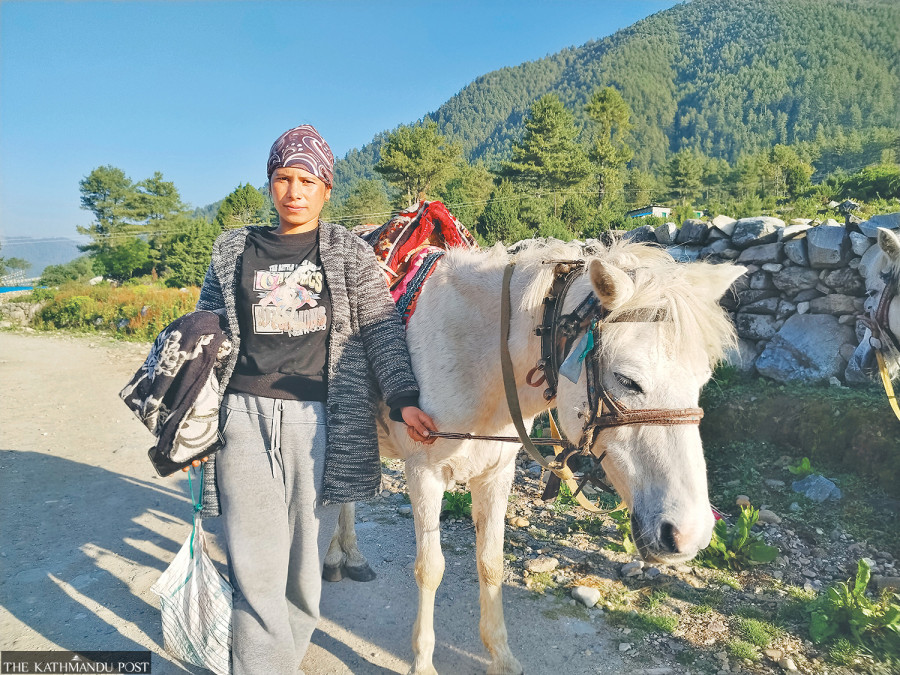
At 26, Asha BK has carved out a place in a male-dominated horseback tourism business, guiding visitors across the alpine meadows of Bukipatan while preserving a generations-old family occupation.Asha BK with her horse in Dhorpatan, in this recent photo. She says she earns more than Rs40,000 a month offering horseback rides to visitors. Post Photo
It was 5am when a group of tourists staying at a nearby homestay called, asking for horses to take them to Bukipatan, a high-altitude alpine meadow where thousands of sheep, yaks and horses graze during the summer.
Twenty-six-year-old Asha BK of Dhorpatan Municipality-7 sprang into action. She fed her horse chickpeas and boiled maize, gave it water, stuffed buckwheat flatbread, potato curry and a bottle of water into her bag. Before 6 am, she had saddled the horse and headed to the homestay to pick up the visitors.
Knowing she would spend the entire day guiding tourists around Bukipatan on horseback, she informed her father, Pan Bahadur. Along with her neighbours, Bhumiraj BK, Maitaram BK and Tek Kumar BK, she reached the Pakhathar Community Homestay.
From there, the tourists mounted their horses and the group set off for Bukipatan.
Among more than 50 registered horse ride operators in Dhorpatan, Asha is the only woman.
After completing her Secondary Education Examination (SEE) from Gyanodaya Secondary School in Dhorpatan and Grade 12 from Uttarganga Secondary School, she chose not to pursue a salaried job.
Instead, she decided to continue her family's traditional occupation.
For the past six years, she has been guiding tourists on horseback to Bukipatan, Niseldhor, Jaljala and the Dhorpatan valley.
She bought her white horse four years ago for Rs60,000. It is now worth around Rs80,000. To purchase it, she borrowed money from a hotel owner nearby.
She recalls working every day to repay the loan by offering horseback rides. Today, the debt has been cleared, the horse is entirely hers.
Depending on visitors' preferences, she takes them either to nearby attractions or on longer rides to Bukipatan, Garpa and Tikadhara. Sometimes she travels alone; at others, she joins fellow horse keepers to form a group.
Some tourists contact her a day in advance so she can prepare, while others make plans early in the morning. Their destinations vary according to their interests, including Dhorpatan Valley, Niseldhor, Jaljala and Bukipatan.
Bukipatan, reached after a steep climb from Dhorpatan Valley, is one of the area's most popular destinations. Roads extend only as far as Dhorpatan Valley. Beyond that, inside the Dhorpatan Hunting Reserve, there are only foot trails. Local residents use these trails to take sheep, goats and other livestock to the alpine pastures.
At an altitude of around 4,000 metres, Bukipatan is difficult to reach on foot, and many visitors risk altitude sickness. As a result, most tourists opt to travel on horseback. A journey that begins at 6 am usually ends late at night. Asha therefore carries salt, ginger and timur (Sichuan pepper) pickle or powdered chutney in her bag.
"If a tourist develops altitude sickness, I give them these," she said. She learned the remedy from her neighbour, Bhumiraj BK.
The official fare for a horseback ride to Bukipatan is Rs4,500, although operators usually charge Rs4,000. Riding around the Dhorpatan Hunting Reserve office and airport area costs Rs200, touring Dhorpatan Valley costs Rs1,000, and a trip to Niseldhor costs Rs1,500.
"Most tourists who ride horses want to make TikTok videos and short clips," Asha said. "We take them to the places they want and also help them take photographs and videos."
According to her, most visitors heading to Bukipatan are adventure enthusiasts.
The number of tourists visiting Dhorpatan has increased since the Burtibang-Dhorpatan road was opened.
Statistics from the Dhorpatan Hunting Reserve also show visitor numbers rising with improved road access. Before the road reached Dhorpatan, everyone travelling there relied on horses. The horseback tourism business has become more organised over the past eight years. Operators now register with the municipality and pay taxes.
Even today, horses remain essential during the monsoon when roads are blocked, during the Janai Purnima Dhorbaraha fair, and for transporting potatoes. In the past, daily necessities were carried to Dhorpatan on horseback from Palpa, Ridi, Tamghas and Butwal.
"Earlier, horses were the only way to transport goods. Now vehicles deliver supplies directly to the villages," said local Chak Bahadur Adai. "Today, horses are mainly used for taking tourists around and for recreation."
After the establishment of the Dhorpatan Hunting Reserve, wardens, reserve staff, chief district officers and other government officials also travelled on horseback. Although roads have now reached the area, horses remain indispensable for reaching Bukipatan and other trekking trails.
Asha's neighbours, Maitaram BK and Tek Kumar BK, have also been in the horse riding business for many years.
They say they transport everyone from politicians and government employees visiting from the district headquarters to elderly people and others unable to walk.
"After finishing my studies, I couldn't find a job," Asha said. "So I chose to continue my family's traditional occupation and earn my own living. I am the only woman in this profession."
She says she earns more than Rs40,000 a month offering horseback rides. Although horse feed, medicine and care are expensive, the income is enough to support her family while allowing her to save some money.
Horse trainer and ride guide Bhumiraj BK said horses begin light training at around three years of age carrying small loads. Only after they reach about four years old are they considered fit to carry people.
"A horse works regularly from the age of four to 22," he said. "With proper care and adequate rest, it can continue working until it is about 24."
According to him, horses should be castrated after they reach four years of age.
"Otherwise, when they see a mare, they may become excited and throw the rider off," he said.
There are now hundreds of horses in Dhorpatan, but only 50 ride operators are officially registered with the municipality to carry tourists. They renew their membership paying an annual fee of Rs500.
Asha serves as the treasurer of the Horse Riding Operators' Committee, chaired by Tek Kumar BK. She said the municipality's Livestock Development Branch also supports operators by providing vitamins and medicines needed to keep the animals healthy.




 16.87°C Kathmandu
.jpg)