Nepal’s micro and small industry registrations plunge 75 percent in five years despite policy push
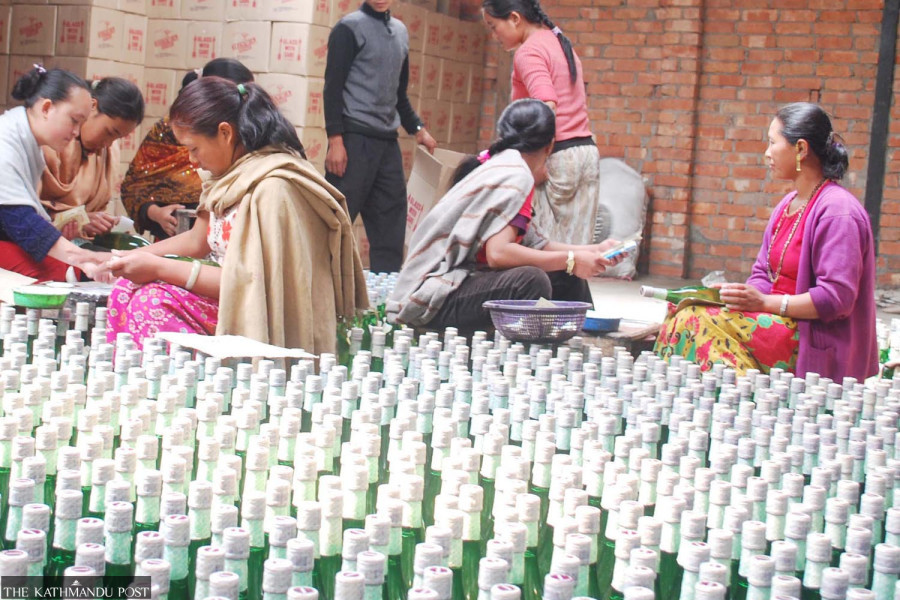
Entrepreneurs cite lack of finance, poor market access and ineffective government support, while experts say most micro enterprises remain informal and struggle to grow. According to the Central Bureau of Statistics, nearly half of Nepal’s business establishments remain unregistered, while more than 90 percent of workers employed by micro, cottage and small enterprises. File Photo
The number of micro, cottage and small enterprises (MCSEs) registered in Nepal has plunged by nearly 75 percent over the past five years despite a series of government policies and programmes aimed at promoting the sector.
Entrepreneurs say inadequate access to finance, poor market access and government support that often benefits only those with political or bureaucratic connections have discouraged them from registering and operating formally.
According to the Micro, Cottage and Small Industries [enterprises] Statistics published by the Department of Industry, only 21,029 micro, cottage and small enterprises were registered in the last fiscal year, down 74.8 percent from 83,386 registrations in fiscal year 2020-21.
The number of registrations has declined steadily over the years—from 65,039 in 2021-22 to 37,142 in 2022-23, 23,633 in 2023-24, and 21,029 in the last fiscal year.
The Department of Industry said it has stopped registering micro, cottage and small businesses with domestic investment of up to Rs250 million under its jurisdiction following the government's new 100-point reform plan, with such registrations now handled at lower administrative levels.
"Although the government has been promoting the facilities available for micro, cottage and small enterprises, many entrepreneurs may still be unaware of them," said a Department of Industry official who requested anonymity.
"The government has also not been fully successful in making entrepreneurs aware of the benefits of formally registering their businesses," the official added.
The government established the Micro, Cottage and Small Industry Promotion Centre in February 2020 to provide training and technology transfer in trades such as beauty services, tailoring, electrical work and plumbing.
The centre received a budget of Rs310 million in the last fiscal year, covering both administrative expenses and training programmes. Its allocation has been reduced to Rs130 million for the current fiscal year.
In 2024, the government introduced the Micro, Domestic and Small Industries Promotion Policy to encourage local production, utilise the skills of returning migrant workers and simplify investment procedures.
However, the policy has yet to produce meaningful results.
According to the Central Bureau of Statistics, nearly half of Nepal's business establishments remain unregistered, while more than 90 percent of workers employed by micro, cottage and small enterprises with fewer than 10 employees work under informal employment arrangements.
The National Economic Census 2018 recorded 923,356 business establishments across the country, of which only about half were formally registered.
The sector—comprising 69.3 percent micro enterprises, 25.2 percent small enterprises and 5.5 percent medium-sized enterprises—employs around 2.74 million people.
Overall, micro, small and medium enterprises account for 99.8 percent of all business establishments, 84.7 percent of total employment and 62.2 percent of annual sales in Nepal. They also account for virtually all businesses managed by women, representing 99.96 percent of female-led enterprises.
A Nepal Rastra Bank study titled Present Situation of Micro, Small and Medium Enterprises in Chitwan and Makawanpur found that 52.7 percent of surveyed enterprises reported declining business performance, including 23.7 percent reporting a moderate decline and 29 percent reporting a sharp decline. Only 27.1 percent said their business had improved, while 20.3 percent reported stable performance.
Entrepreneurs say limited access to capital remains their biggest challenge.
Manju Kumar Koju, co-chairperson of the Cottage and Small Industry Committee under the Federation of Nepalese Chambers of Commerce and Industry, said most micro and cottage enterprises operate from homes on a very small scale and therefore lack adequate capital.
"Neither the government nor the private sector has done enough to help market products made by micro and cottage businesses, which discourages entrepreneurs," Koju said.
"Despite the policies, genuine entrepreneurs are receiving few benefits. Many are either shutting down their businesses or continuing to operate informally," he said.
Although government policies provide subsidised loans and machinery support, Koju alleged that such benefits often go to entrepreneurs with direct access to government officials, while genuine small business owners struggle to survive.
The Nepal Rastra Bank report also identified economic and political instability as major constraints, saying frequent policy changes and macroeconomic uncertainty have undermined business confidence and limited expansion.
It noted a significant gap between the needs of MSMEs and the effectiveness of existing institutional support mechanisms, with many entrepreneurs perceiving government and central bank support programmes as inadequate. The report called for more accessible, stability-focused and technology-driven interventions.
A World Bank report titled Survival or Growth? Nepal's Microenterprise Landscape and the Case for a Differentiated Policy found that most informal microenterprises remain outside the formal economy not by choice but out of necessity.
The report concluded that the vast majority of informal businesses operate at the subsistence level with little prospect of growth. It also highlighted significant structural differences between formal and informal enterprises, recommending a differentiated policy approach that combines livelihood support and social protection for subsistence businesses with targeted productivity and formalisation support for firms that demonstrate growth potential.
Krishana Prasain is a business reporter for The Kathmandu Post covering markets. Before joining The Kathmandu Post in 2018, she spent 3 years in New Business Age magazine covering business.




 17.48°C Kathmandu