



 21.9°C Kathmandu

Thu, Oct 22, 2026
Money
Supreme Court weighs special benches as government pushes infrastructure tribunal
With legal disputes, land acquisition and contract-related cases contributing to years-long delays in major projects, the government is seeking a quicker mechanism to resolve infrastructure disputes.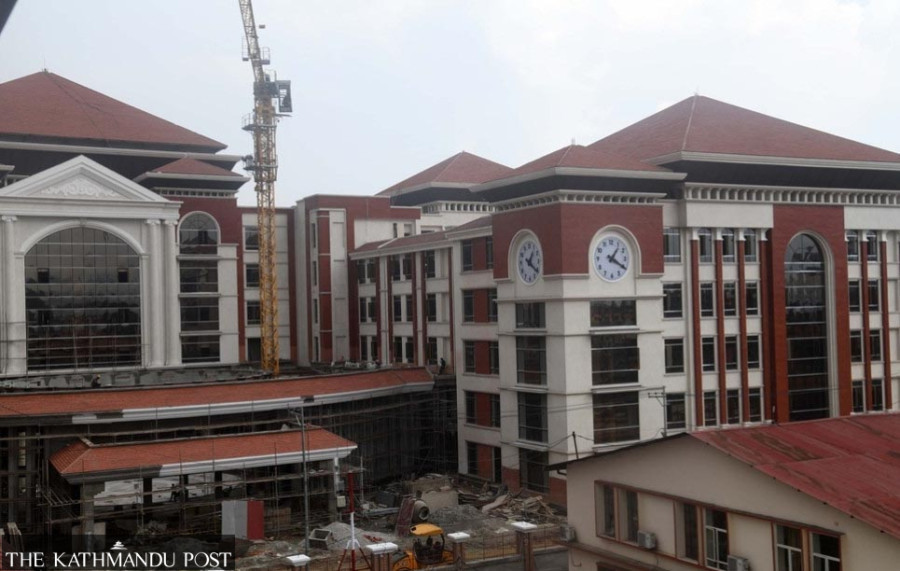
bookmark
Durga Dulal
Published at : August 18, 2026
Updated at : August 18, 2026 21:28
Kathmandu
The land acquisition process for the Nagdhunga–Naubise–Mugling road, one of Nepal’s most vital transport corridors connecting the Kathmandu Valley to the Tarai and onwards to India, took 35 months—nearly 150 percent longer than planned.
The Tribhuvan International Airport improvement project in Kathmandu faced multi-year delays, eventually leading to contract termination and a series of legal battles in district and high courts before the dispute reached an international court.
Such delays are not isolated cases. In Nepal, major infrastructure projects frequently face prolonged delays due to court cases, interim orders, land acquisition disputes, compensation issues, funding problems and disagreements over contracts.
A recent World Bank report found that, given the multiple complications stemming from legal and funding issues, completing 17 National Pride Projects could take 41 years. That is nearly a generation.
Many projects launched between the late 1980s and 2000s remain far from completion. The prolonged delays have not only increased project costs but have also created uncertainty over whether and when some of the projects will be completed.
Against this backdrop, the government led by Prime Minister Balendra Shah has proposed establishing a separate tribunal to hear infrastructure-related disputes and fast-track their resolution.
The proposal has now reached the full court of the Supreme Court, which brings together a larger-than-normal group of judges to discuss issues of importance to the judiciary.
The government sent the proposal to the full court for its opinion based on a study conducted by the Ministry of Law, Justice and Parliamentary Affairs. It sought the Supreme Court’s opinion because the proposed infrastructure court or tribunal would be headed by a person with qualifications equivalent to those of a High Court judge, according to the draft.
The full court discussed the draft sent by the government on Monday.
Most of the judges who participated in the discussion, however, suggested that instead of establishing a separate court or tribunal to hear infrastructure-related cases, specialised benches should be created within the high courts.
Chief Justice Manoj Kumar Sharma sought suggestions on whether to establish a separate tribunal or create special benches at the high courts, as the government is expected to receive the Supreme Court’s opinion within days.
According to Chief Justice Sharma, most judges participating in the discussion favoured creating specialised infrastructure benches at the high courts rather than setting up a separate tribunal.
The proposed arrangement would be similar to the commercial benches already operating in the high courts, with a specialised infrastructure bench also established at the Supreme Court to hear appeals.
Sharma said the full court would meet within a day or two to consolidate the suggestions before providing its opinion to the government.
According to one Supreme Court justice who participated in the discussion, establishing an infrastructure tribunal through legislation falls within the authority of the legislature, while the government would be responsible for managing the resources required to operate such a body.
However, most judges raised concerns about whether a separate tribunal would actually make access to justice easier for litigants or instead create additional complications.
“Rather than having a single court for the entire country that would require people from Humla and Jumla to travel all the way to Kathmandu, our suggestion was to establish a special bench at the high court to make access to justice easier,” the justice said.
“In the first phase, benches could be established at all seven high courts and, if necessary, expanded through temporary benches. It would also be appropriate to have a special infrastructure bench at the Supreme Court.”
The Supreme Court said the full court would provide its recommendation by next week on whether to establish special benches or a separate tribunal. The government will move ahead with drafting the necessary legislation after receiving the recommendation.
Another Supreme Court justice said the constitution allows the establishment of specialised courts for specific types of cases, meaning the government could establish such a body if it believes there is a genuine need.
But the government should also be mindful of the problems that such a system could create, the justice said.
Questions could arise over the ability of specialised bodies to properly adjudicate cases as well as over the appointment of judges, he said. His suggestion was that infrastructure disputes should be handled by judges with sufficient experience in adjudication.
Following the election held on March 5, the government assigned the Ministry of Law, Justice and Parliamentary Affairs to study the need for an infrastructure court or tribunal to fast-track the resolution of disputes involving critical development projects.
The ministry, on April 8, formed a specialised study committee under Law Secretary Parashwar Dhungana.
After the committee recommended that disputes related to development and construction be handled through a separate tribunal rather than regular courts, the government sent the report to a full-court sitting of the Supreme Court for its opinion.
The study report says establishing an infrastructure tribunal would help end the situation in which development projects involving large amounts of state investment become stalled or unviable because of prolonged disputes.
The Cabinet will draft the legislation required to establish the tribunal after receiving the Supreme Court’s recommendations.
Article 152 (1) of the Constitution provides for the establishment of specialised courts. It states that except for matters specified under Article 127, “other specialised courts, judicial bodies or tribunals may be established and constituted under federal law to hear and settle cases of specific kinds and nature.”
The government has moved ahead with preparations to establish an infrastructure court under this constitutional provision, similar to the Labour Court and Consumer Court.
But legal experts warn that the proposed tribunal could quickly become overwhelmed unless the government clearly defines which disputes would fall under its jurisdiction.
Senior advocate Baburam Dahal, an expert on public procurement and construction laws, estimates that such a court could have at least 50,000 cases from the outset.
He said it would therefore be necessary to establish a threshold determining which cases could be filed before the proposed tribunal.
“Otherwise, if all infrastructure-related cases are sent there, it will not be possible to hear them,” he said. “There are construction and contract-related disputes in all 77 districts. Government offices are parties to almost all of them. This could create a court with an enormous caseload.”
The government’s study committee has proposed that the body hear writ petitions related to land acquisition, compensation determination and contracting procedures for infrastructure and development projects.
It has proposed that such cases be settled within 60 days.
The committee has also recommended that the Chief Justice of the Supreme Court and chief judges of the high courts continuously monitor whether cases are being heard and settled within the proposed 60-day period.
The study report highlights the broader economic and social costs of prolonged litigation.
“Hundreds of projects across the country have remained stalled for years because of litigation,” the report says. “As a result, ordinary citizens have been deprived for long periods of the services and benefits that such projects are intended to provide.”
The proposed tribunal would also hear disputes arising from projects constructed and operated under public-private partnerships, as well as disputes during the construction phase involving contractors, consultants, workers, suppliers and affected local communities.
The committee has proposed that the infrastructure tribunal be headed by a High Court judge, with members including a financial expert with experience and expertise in project management and an expert from the engineering sector.
The proposed tribunal would have one chairperson and at least five or six members. Its members would include technical experts ranging from civil engineers to structural engineers.
The committee has also recommended maintaining a roster of engineers so that technical members can be assigned according to the nature of individual cases.
The report proposes that appeals against decisions of the infrastructure tribunal be filed at the Supreme Court and that a separate infrastructure bench be established there to hear such appeals.
The government’s proposal is therefore now at a crucial stage: while the executive sees a specialised tribunal as a way to break the cycle of prolonged litigation and project delays, the Supreme Court appears inclined towards using the existing judicial structure through dedicated benches.
The final recommendation of the full court will determine whether Nepal moves towards a new infrastructure tribunal or relies on specialised benches within its existing courts to speed up the resolution of disputes that have long held back major development projects.
Durga Dulal
Durga Dulal is a journalist associated with Kantipur Daily, covering law, justice, and constitutional affairs.




Most Read from Money
Nepal travel agents threaten to stop selling Thailand trips over visa rules

Why does an hour long flight to Dhangadhi cost more than a flight to New Delhi?
Malaysia rejects Nepal’s demand to open recruitment to all manpower agencies

No school, but a graduation cap for women dairy farmers
Nepal arrests four medical service providers as Malaysia recruitment row deepens
Editor's Picks




E-PAPER | October 22, 2026

×