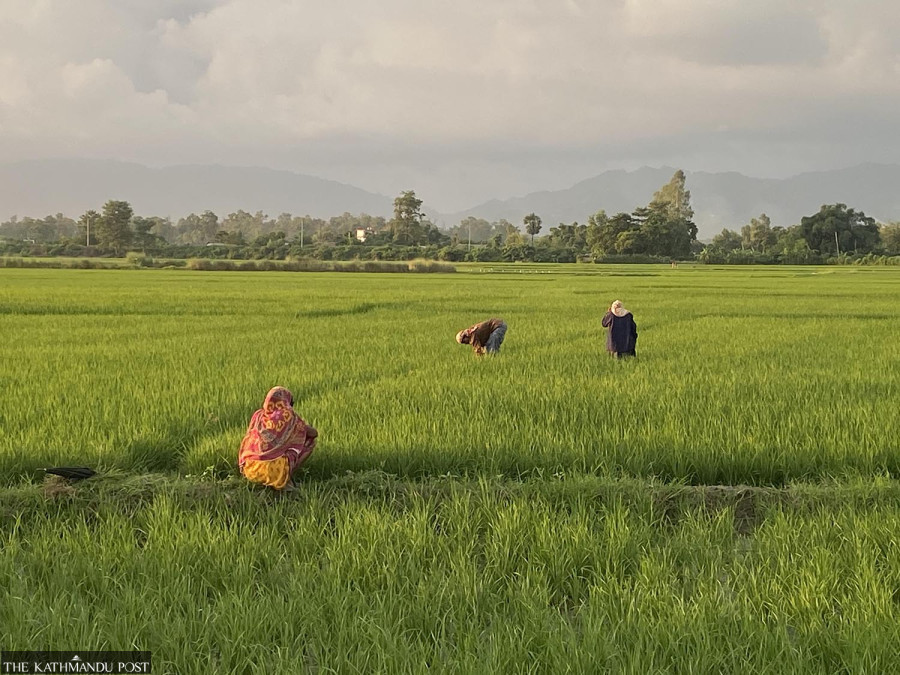
Agricultural insurance has expanded in Nepal, but its benefits have yet to reach crop farmers to the expected scale. More than 700,000 policies have been issued over the past five years, covering Rs238.36 billion in insured value, but most of the policies are for livestock and fish rather than crops.
Government data show that farmers’ interest in livestock and fish insurance has grown steadily, while crop insurance remains limited.
Between fiscal 2021-22 and 2025-26, insurers issued 704,864 agricultural insurance policies. Livestock and fish insurance accounted for about 23 percent more policies than crop insurance over the period.
In fiscal 2021-22, 7,254 crop insurance policies were issued, compared with 24,266 policies covering livestock and fish. The gap widened sharply the following year, with 8,178 crop policies against 180,715 livestock and fish policies.
Crop insurance accounted for 9,730 policies in 2023-24, compared with 146,394 livestock and fish policies. In 2024-25, the number of crop policies fell to 1,677, while livestock and fish insurance rose to 160,332. In 2025-26, 2,107 crop insurance policies were issued, compared with 164,211 for livestock and fish.
The government currently subsidises agricultural insurance premiums. Under a scheme that took effect in mid-July, the government covers 80 percent of the premium for policies with an insured value of up to Rs10 million and 50 percent for policies above that amount.
The agricultural, livestock and herb insurance programme covers 27 crops, including ginger, cardamom, mangoes and pulses. Livestock and fisheries insurance covers six categories, including poultry, pigs and fish.
The programme is intended to protect farmers against losses caused by hailstorms, floods, landslides, drought, fire and disease outbreaks among livestock and poultry, while encouraging investment in agriculture.
But complaints are growing over delays in government subsidies and difficulties in accessing insurance, particularly when farmers seek compensation after suffering losses.
Jagannath Tiwari, joint secretary at the Ministry of Agriculture, Livestock, Forest and Environment, said monitoring had exposed several problems in the insurance and claims process for livestock and crops.
Inspectors found insurers charging premiums above the prescribed rates, assigning different insured values to the same animal in different years and issuing policies in violation of technical requirements. Some insurers were also found to be covering livestock and crops that had not been recommended by the government, he said.
“Farms with bank loans are sometimes given higher insured values, while the date when the risk begins is made different from the date the policy is issued,” Tiwari said. “We have also found cases where individual accident insurance is taken out, but a group policy is issued, and where a single photo or video is used instead of separate photos and videos of each animal.”
Tiwari said the government needed to review insurance subsidies and premium rates, improve coordination with provincial and local governments and simplify the insurance process.
He also called for joint inspections of farmers’ farms to reduce irregularities in subsidy payments and clearer rules for determining insured values to prevent disputes among farmers, technicians and insurers.
Shashi Ram Acharya, treasurer of the National Farmers Group Federation, said insurance would become more attractive to farmers if compensation were based on the value of their produce rather than production costs.
Farmers receive lower compensation when policies are based on production costs, he said, discouraging them from taking out insurance.
“Farmers lack adequate information and awareness about agricultural insurance,” Acharya said. “They are told one thing when they buy insurance, but when they suffer a loss and file a claim, they face various hurdles, delays and months of waiting.”
Such experiences have created a widespread perception among farmers that insurance is more trouble than it is worth, he said.
Acharya said insurance coverage was also difficult to expand in remote areas because agents often cannot recover their travel costs when visiting farmers to insure individual animals.
“The government provides subsidies of up to 80 percent for livestock insurance,” he said. “But if an agent has to travel a long distance to insure a single buffalo, the cost of travelling there and back may not even be covered.”
Acharya said insurance companies needed to be made more accountable and responsive if agricultural insurance was to work effectively. He also called for awareness programmes at the local-government level so farmers understand how insurance works, what is covered and how to make claims.




 14.21°C Kathmandu