



 13.76°C Kathmandu
Tue, Oct 20, 2026
Money
Priority lending is dragging down Nepali banks into huge bad debt
Agriculture, construction, and deprived-sector lending lead the default wave.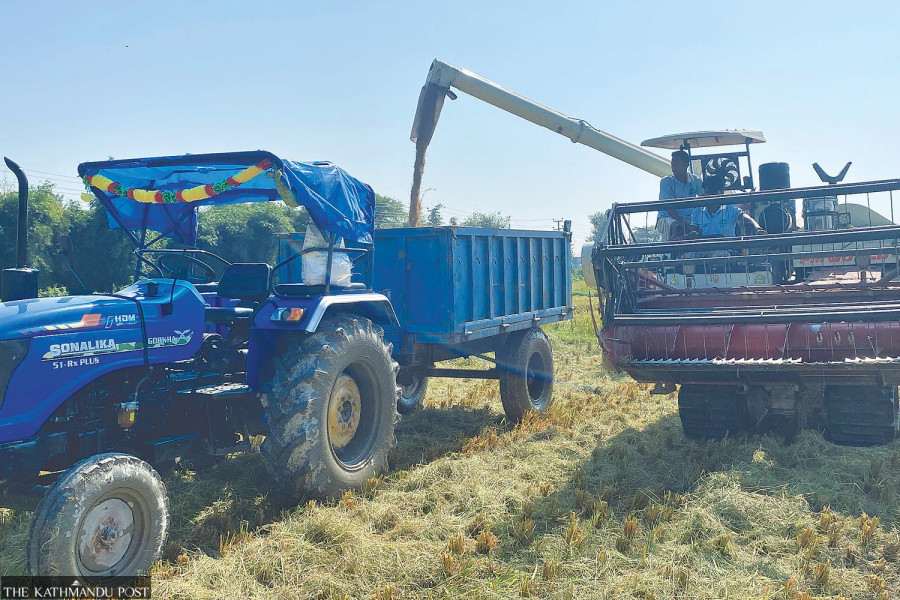
bookmark
Yagya Banjade
Published at : July 3, 2026
Updated at : July 3, 2026 06:17
Kathmandu
Loans extended by banks and financial institutions to sectors where the Nepal Rastra Bank (NRB) requires mandatory lending have emerged as some of the biggest sources of non-performing loans. This has raised concerns over the effectiveness of the central bank's priority lending policy.
Banking data, regulatory disclosures and industry experts indicate that agriculture and micro, small and medium enterprises (MSMEs)—all identified as priority sectors by the central bank—have experienced a sharp deterioration in loan quality over the past two years.
Although these sectors were intended to expand financial inclusion and support productive investment, they have instead become increasingly vulnerable as slowing economic activity, weak demand and shrinking household incomes have undermined borrowers' repayment capacity.
The trend has prompted the NRB to revise its priority sector lending framework. In March, the central bank broadened the list of sectors eligible under mandatory lending requirements after acknowledging concerns over both the effectiveness of the existing policy and the growing stress within the banking system.
Until the revision, banks were required to channel fixed proportions of their lending into agriculture, energy, and MSMEs. Under the new framework, tourism, information technology-based businesses and export-oriented businesses that use domestic raw materials have also been included.
Commercial banks are now required to allocate at least 10 percent of their total lending to agriculture, while a minimum of 20 percent must collectively go to tourism, MSMEs, energy, information technology and export businesses that use domestic raw materials. The long-standing requirement that at least 5 percent of total lending be directed towards deprived sectors remains unchanged.
Taken together, banks are still required to extend at least 35 percent of their loan to sectors specified by the regulator. Ironically, these are also the areas where loan defaults have become most pronounced.
According to banking sector disclosures up to mid-April, agriculture and fisheries alone account for around 23.5 percent of total non-performing loans. Construction-related lending, including hydropower projects, contributes roughly 10.5 percent, while wholesale and retail trade represents another 10 percent of bad loans.
Officials at the NRB acknowledge that agriculture, energy and MSMEs have recorded comparatively higher levels of loan defaults than many other sectors.
"The overall slowdown in the economy has weakened economic activities, and agriculture as well as micro, small and medium enterprises have been the hardest hit," said Guru Prasad Paudel, spokesperson for the central bank.
"Small entrepreneurs usually don’t have alternative sources of income and have limited scope for business diversification. When economic activities slow, their capital base takes an immediate hit, and many have yet to recover," said Paudel.
He added that inadequate protection mechanisms, including supportive credit policies and inclusive insurance schemes, have made small borrowers more vulnerable.
"Compared to large borrowers, small entrepreneurs have fewer options to diversify their businesses or generate alternative income. The state therefore needs stronger policies that provide effective protection and incentives for them," he said.
The growing stress is particularly visible in deprived-sector lending, a category designed to improve financial access for low-income households and socially marginalised groups, including women, indigenous communities, Dalits, persons with disabilities, landless families, small farmers, artisans and labourers, records show.
Banks rarely lend directly to these borrowers. Instead, they provide wholesale loans to microfinance institutions, which subsequently extend collateral-free loans to low-income clients. Banks are then allowed to classify such wholesale lending as deprived-sector credit to meet regulatory requirements.
As repayment problems have intensified among microfinance borrowers, the quality of banks' deprived-sector portfolios has also deteriorated.
Data published by the central bank show that the average non-performing loan ratio among microfinance institutions climbed to 11.32 percent by mid-April, up sharply from 7 percent in mid-July last year.
The value of bad loans held by the country's microfinance institutions climbed to Rs54.08 billion, representing an increase of more than 74 percent compared to the previous fiscal year's end. Nepal currently has 52 licensed microfinance institutions, although only two are authorised to collect deposits from the public. The remaining institutions rely heavily on wholesale borrowing from commercial banks and other financial institutions. For banks, rising defaults in the microfinance sector therefore represent an indirect increase in their own credit risk.
Ram Bahadur Yadav, president of the Microfinance Bankers' Association, said the deterioration reflects worsening economic conditions in rural Nepal rather than deliberate loan defaults.
"Microfinance institutions have extended nearly Rs500 billion in loans, and around 85 percent of those loans are unsecured [relying on group guarantees rather than physical collateral]," said Yadav. "When economic activity slowed, many small businesses simply could not survive. Borrowers wanted to repay their loans but were no longer earning enough to do so."
He said many factories that once employed workers for five or six days each week are now operating only two or three days because of weak demand. As a result, incomes of rural communities have been hit.
"As markets contracted and businesses started making losses, borrowers lost their repayment capacity," said Yadav. He also argued that regulatory policy has contributed to the apparent rise in bad loans.
"The NRB has allowed microfinance institutions to restructure or reschedule their loans. However, once a loan is restructured or rescheduled, it must be immediately classified as non-performing," he said. "That accounting treatment has also pushed up the reported bad loan ratio."
Banking sector data show that the overall average non-performing loan ratio of banks and financial institutions reached 5.6 percent by the third quarter of the current fiscal year of 2025-26.
Sector-wise, agriculture recorded the highest concentration of bad loans, followed by construction, wholesale and retail trade, transport, communications and public utilities. Manufacturing, metal industries, machinery and electrical equipment, as well as hotels and restaurants, have also reported rising loan distress, though at lower levels.
Chartered accountant and former banker Anal Raj Bhattarai believes the problems are rooted in the design of mandatory lending itself. "There was enormous pressure on banks to meet regulatory lending quotas regardless of market conditions," he said. "As a result, adequate attention could not always be given to assessing credit quality."
Bhattarai said the central bank's objective of directing credit towards productive sectors was sound in principle, but argued that lending targets should have been accompanied by stronger efforts to develop entrepreneurship, improve business skills and strengthen market access.
"Providing loans alone was never enough," said Bhattarai. "Without developing entrepreneurship, many borrowers either failed to use the loans effectively or could not generate the expected returns even when the funds were invested in productive activities."
Bhattarai said the requirement for banks to maintain compulsory exposure to deprived-sector borrowers and MSMEs became increasingly difficult to manage as the banking industry expanded rapidly over the past decade.
"When the mandatory deprived-sector lending rule was introduced, the banking industry's total loan portfolio was only around Rs700 billion. Today outstanding loans exceed Rs5.9 trillion, but the same percentage requirement has remained in place," he said. "Once banks are compelled to lend regardless of market conditions, compromises in asset quality become almost inevitable."
Bhattarai also argued that a large section of Nepal's MSME sector remains outside an effective regulatory framework. "Many small businesses operate informally and are accountable to no institution. When the economy weakened, the structural weaknesses that had remained hidden began to surface," he said, adding that mandatory direct lending requirements should be reconsidered while improving broader support for entrepreneurship.
Santosh Koirala, president of the Nepal Bankers' Association, said prolonged economic weakness has disproportionately affected smaller businesses that lack financial buffers.
"The economy has struggled to regain momentum, and recent political uncertainty, including the Gen Z protests, the interim government and preparations for parliamentary elections, has further weakened business confidence," said Koirala. "Agriculture, deprived-sector lending and MSMEs have experienced the most visible repayment problems."
According to Koirala, some borrowers diverted loans away from their intended purposes, but many others who invested properly still failed because business conditions deteriorated sharply.
"The problem cannot simply be explained by poor lending decisions," he said. "Many borrowers genuinely lost their ability to repay after markets slowed."
Koirala also pointed to the lingering effects of regulatory relief introduced during the Covid pandemic.
"Large numbers of loans remained alive because of restructuring and repayment relief provided during the pandemic," he said. "Once those support measures expired, the true quality of many loans became visible. Real estate, share-backed lending and MSME loans have been particularly affected."
Sujit Shakya, chief executive officer of NIC Asia Bank, echoed that assessment, saying aggressive lending immediately after the pandemic, combined with compulsory regulatory targets, significantly increased banks' exposure to vulnerable borrowers.
"At that time banks were under regulatory pressure to channel a fixed proportion of lending into MSMEs, while competition among banks also encouraged rapid credit expansion," said Shakya. "That combination explains why MSMEs now account for such a large share of non-performing loans."
Banking data show that the industry's average non-performing loan ratio rose to around 5.25 percent during the third quarter of the current fiscal year from 4.98 percent a year earlier. Five commercial banks have already reported bad loan ratios exceeding 7 percent.
Although prudential standards generally expect non-performing loans to remain below 5 percent, the NRB has so far refrained from imposing stronger supervisory measures, partly because broader economic conditions continue to weigh on the financial sector.
Former president of Nepal Finance Companies Association, Saroj Kaji Tuladhar argued that banks have traditionally shown greater flexibility towards large corporate borrowers than towards smaller clients.
"When a large borrower encounters repayment problems, banks usually make every possible effort to avoid classifying the loan as non-performing. But the small borrowers are ignored,” said Tuladhar.
According to him, the simultaneous crisis affecting cooperatives and microfinance institutions has disrupted cash flows across thousands of small businesses.
"In the past many borrowers managed liquidity by borrowing from multiple cooperatives and microfinance institutions. Once those channels closed simultaneously, their cash cycles collapsed and repayment capacity disappeared," said Tuladhar.
Official figures underline the scale of the deterioration. The banking system's average non-performing loan ratio increased from 3.02 percent in mid-July 2023 to 5.42 percent by mid-February 2026. The latest Economic Survey presented by Finance Minister Swarnim Wagle warns that development banks and finance companies have recorded significantly higher bad loan ratios than commercial banks.
Although the overall level remains within a manageable range, the report cautions that continued growth in non-performing loans could threaten financial stability unless timely corrective measures are implemented.
The deterioration is occurring alongside weakening investment activity.
During the first six months of the current fiscal year, only 461 new businesses were registered nationwide, down from 581 during the corresponding period a year earlier. Industrialists attribute the decline to persistent structural obstacles, including difficulties related to land acquisition, forests, labour shortages and regulatory uncertainty, all of which have weakened investor confidence.
Prachanda Bahadur Shrestha, president of the Confederation of Banks and Financial Institutions Nepal, said the banking sector is now operating under intense pressure despite abundant liquidity.
"Liquidity exists on paper, but demand for credit has weakened because confidence in the economy remains fragile," he said. "Cash flows have dried up across many sectors and this has affected fundamentally strong businesses as well."
He warned that rising defaults are creating another challenge by forcing banks to accumulate growing volumes of non-banking assets after taking possession of collateral from defaulting borrowers.
"More than Rs60 billion worth of non-banking assets has already accumulated on banks' balance sheets because borrowers have been unable to repay," said Shrestha. "Capital that should have been financing productive investment is instead tied up in unproductive assets, reducing banks' capacity to support economic recovery."
Yagya Banjade
Banjade covers government finance, banking, capital markets, and the economy for Kantipur Daily.





Most Read from Money

Nepal travel agents threaten to stop selling Thailand trips over visa rules

Why does an hour long flight to Dhangadhi cost more than a flight to New Delhi?
Malaysia rejects Nepal’s demand to open recruitment to all manpower agencies

No school, but a graduation cap for women dairy farmers
Nepal arrests four medical service providers as Malaysia recruitment row deepens
Editor's Picks




E-PAPER | October 20, 2026

×