



 26.12°C Kathmandu

Sun, Aug 23, 2026
Money
Private education sector adds Rs160 billion to Nepal’s GDP annually
On average, each institution spends around Rs11.04 million annually, charges students a monthly fee of Rs3,305 and pays employees an average monthly salary of Rs15,683.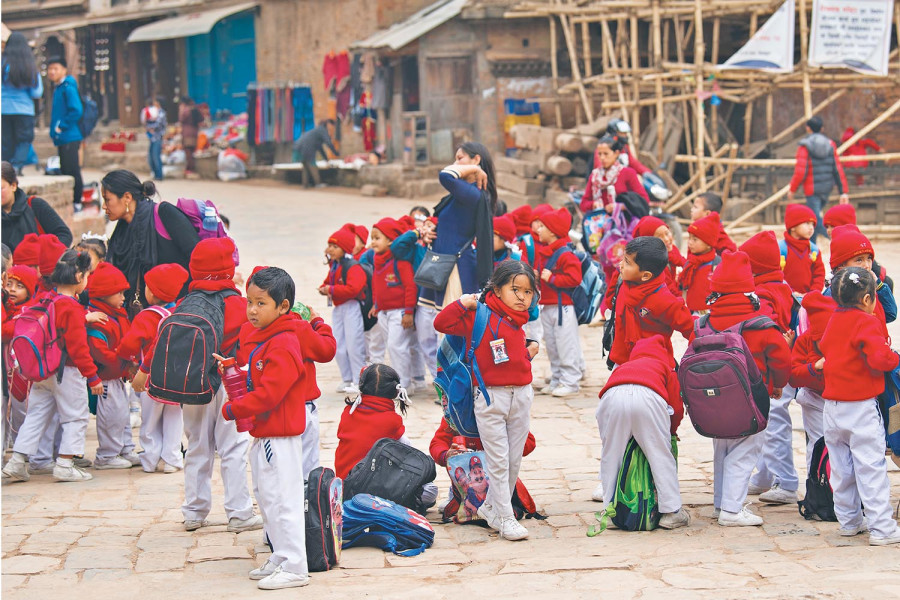
bookmark
Sangam Prasain
Published at : June 24, 2026
Updated at : June 24, 2026 21:02
Kathmandu
Nepal’s private education sector generates an estimated Rs195.5 billion in gross annual economic output and contributes around Rs160 billion to the national economy, according to the first comprehensive survey of non-government educational institutions released on Tuesday.
The sector’s growing economic footprint underscores its role as a major service industry, supported by fixed capital investment of over Rs309.2 billion and providing employment to more than 300,000 people.
The Nepal Education Institution Survey 2023-24, conducted by the National Statistics Office (NSO), provides the first detailed assessment of the economic contribution of educational institutions operated by private, community-managed, cooperative and trust-based entities since the sector was opened to private investment.
The survey covers the period from mid-July 2023 to mid-July 2024 and includes all schools and colleges that are not owned by the government.
The survey estimates that educational institutions generated gross output worth Rs195.5 billion during the reference year. After accounting for inputs and investments totalling Rs114.4 billion, the sector added approximately Rs160 billion to Nepal’s gross domestic product (GDP).
Bagmati Province accounted for the largest share of the sector’s value addition, contributing Rs70.9 billion, or roughly 44 percent of the national total. Madhesh ranked second with Rs22.9 billion, followed by Lumbini and Koshi, which contributed Rs21.24 billion and Rs21.19 billion respectively.
The remaining provinces generated smaller shares. Gandaki recorded value addition of Rs12.75 billion, Sudurpashchim Rs7.95 billion and Karnali Rs3.04 billion.
The findings show that the economic contribution of non-government educational institutions is heavily concentrated in Bagmati, while Karnali and Sudurpashchim lag behind.
Nationwide, the survey counted 10,411 non-government educational institutions employing or engaging 311,516 people. Of them, 300,021 were employees, while 11,495 were proprietors or unpaid family workers.
On average, each institution spends around Rs11.04 million annually, charges students a monthly fee of Rs3,305 and pays employees an average monthly salary of Rs15,683.
The institutions spent approximately Rs74.6 billion on wages, salaries and employee benefits during the survey year. They also held gross fixed assets worth Rs309.2 billion and incurred intermediate consumption—goods and services used in the production process—amounting to Rs35.4 billion.
Nepal nationalised all community and private schools in 1971. However, the policy was reversed in 1980, allowing private investment in education and paving the way for the rapid expansion of private schools and colleges. The private education sector has expanded steadily ever since.
“After privatisation, schools expanded rapidly, but there had been no comprehensive survey of the sector,” said Hem Raj Regmi, spokesperson and data curator at the National Statistics Office. “This is the first survey that provides reliable data on the contribution of private education to GDP and gives a clear picture of private sector investment in education.”
The survey shows significant differences in fees across provinces and educational levels.
Students in Bagmati pay the highest fees, averaging Rs5,176 per month. Gandaki follows with Rs3,249, while Koshi and Lumbini charge Rs2,700 and Rs2,545, respectively. Average monthly fees stand at Rs2,483 in Madhesh, Rs2,307 in Karnali and Rs2,067 in Sudurpashchim, the lowest in the country.
At the school level, fees are comparatively modest. Pre-primary and primary education institutions charge an average of Rs2,341 per student per month, while general secondary schools charge around Rs3,004.
Post-school education is significantly more expensive. Technical and vocational education institutions charge an average monthly fee of Rs11,498, the highest among all categories, while higher education institutions charge around Rs5,814.
The survey also highlights Bagmati’s dominance across nearly all performance indicators. The province hosts the largest number of educational institutions, employees and engaged persons. It also records the highest levels of wages and salaries, fixed assets, intermediate consumption, total inputs, gross output and value addition.
Bagmati has the highest labour productivity, with value added per person engaged reaching Rs571,000. It also records the highest annual expenditure per institution at Rs17.57 million and the highest average monthly salary at Rs18,335.
Madhesh stands out for efficiency. It has the lowest input-output ratio of 0.42 and the highest value added per unit of capital at 0.66. The province also records value added per person engaged of Rs555,000, indicating relatively efficient use of capital and labour.
By contrast, Karnali and Sudurpashchim show lower productivity levels. Value added per person engaged stands at Rs395,000 in Karnali and Rs356,000 in Sudurpashchim. Both provinces also have lower average fee levels despite maintaining relatively high value-added-to-output ratios.
The survey further reveals a highly uneven distribution of educational institutions across provinces.
Bagmati hosts 2,903 institutions, accounting for about 28 percent of the national total. Koshi, Madhesh and Lumbini follow with 1,917, 1,891 and 1,556 institutions respectively. Sudurpashchim has 907 institutions, Gandaki 862 and Karnali only 375.
Most non-government educational institutions are relatively small. Institutions employing between 10 and 20 people form the largest group, numbering 3,467 and accounting for roughly one-third of the total. Another 2,386 institutions employ between 20 and 30 people.
Combined with institutions employing fewer than 10 people, these categories account for around two-thirds of all educational institutions, indicating that the sector is dominated by small and medium-sized establishments.
As staff size increases, the number of institutions declines sharply. Only 259 institutions, or around 3 percent of the total, employ more than 100 people, underscoring the fragmented nature of Nepal’s non-government education sector.
Sangam Prasain
Sangam Prasain is Business Editor at The Kathmandu Post, covering tourism, agriculture, mountaineering, aviation, infrastructure and other economic affairs. He joined The Kathmandu Post in October 2009.

Most Read from Money

NAIMA Mobility Expo opens today. 18 new two-wheeler, 29 four-wheeler brands on offer

I left New York for Kathmandu. Did the egg crisis follow me?
Who owns basmati? Nepal enters a global battle over a prized grain
In Nepal, bankers are learning to fear the loan
Why Nepal’s economy will need more than a two-thirds majority
Editor's Picks


E-PAPER | August 23, 2026

Enter The Kathmandu Post
Advertisement

×