Why Nepali migrant workers are being buried in Iraq instead of home
High repatriation costs, legal hurdles and policy gaps leave families with no choice but to bury their loved ones overseas.Repatriating bodies of dead Nepalis from the Gulf costs an amount far beyond the means of the families back home. Provided to the Post
At 2 pm on Friday, Kharimaya Ghale watched her only son being laid to rest, not from a cemetery but through a video call from Iraq. Like a growing number of Nepali families unable to afford the cost of bringing home the bodies of migrant workers, the Lamjung woman was forced to bid him a final farewell from thousands of kilometres away.
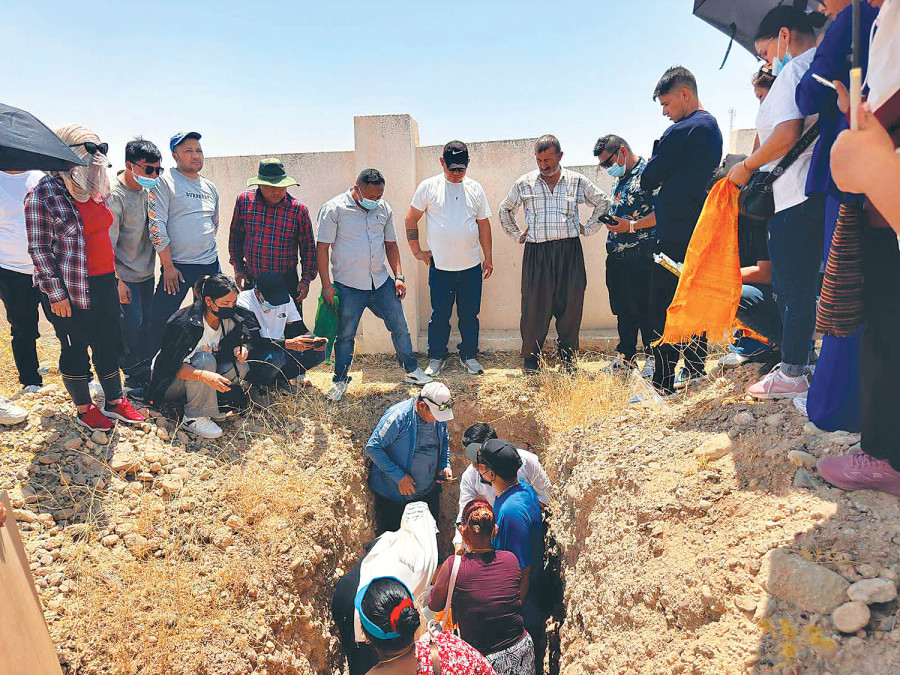
From her home in Pachok, Dordi Rural Municipality-5, Lamjung, Kharimaya, along with her daughter-in-law Ganga Ghale, two grandsons and relatives, watched as the grave of her 38-year-old son, Lekhman Ghale, was dug and filled at Gwer cemetery in Erbil.
Lekhman, who had gone to Iraq two years ago for work, died during treatment on March 28. His mother had hoped to bring his body home for his funeral.
“There was no one who could bring my son’s body back,” Kharimaya told Kantipur. “Everyone said it was impossible. They feared they would lose their jobs and would not be allowed to re-enter Iraq. The mobile phone of the agent who had sent him to Iraq was switched off. So we had to leave him there.”
She was told that repatriating the body would cost an amount far beyond the family’s means.
“They told us it would cost a huge amount of money,” she said. “My daughter-in-law and I went from one office to another trying to arrange it. I wanted to bring my son home and perform his final rites according to our traditions. Now, we can only complete the rituals from here.”
Beside Lekhman’s grave, another was dug on Friday for Mina Kumari Kashi of Bagmati Rural Municipality-5, Makwanpur.
Her family, too, watched her burial through a video call.
Kashi, who had worked in Iraq for seven years, was found dead in her room on November 10, 2025. Iraqi police are investigating the case, and one Nepali national has been arrested on suspicion of murder.
Her family had appealed to the Ministry of Foreign Affairs to arrange to bring her body home. On November 13, 2025, Bijay Kumar Bhlon, ward chair of Bagmati Rural Municipality-5, wrote to the ministry requesting diplomatic intervention.
However, the request went unanswered. Unable to raise the money required for repatriation, the family eventually agreed to bury her in Erbil.
According to Binod Shrestha, president of the Non-Resident Nepali Association Iraq, the Kurdistan Regional Government has designated cemetery space in Erbil and Sulaymaniyah for Nepali nationals whose bodies cannot be repatriated.
“For those whose bodies cannot be sent back to Nepal, a fenced burial area has been allocated,” Shrestha said. “Seven Nepalis have so far been buried at Gwer cemetery in Erbil.”
He said local administrative approval and burial fees are required, with the costs usually covered through donations collected from the Nepali community.
Shrestha said the increasing number of deaths has made it difficult for the community to continue bearing the financial burden.
“If there are only one or two cases, we can somehow collect the money,” he said. “But when the cases increase, it becomes impossible. Sending one body back costs around $3,200 [roughly Rs500,000]. Most families simply cannot afford it.”
The problem is not confined to Kurdistan.
On July 14, the body of 22-year-old Sanchamaya Lopchan of Gelche, Jugal-2, Sindhupalchok, was buried in Baghdad, 21 months after her death. Lopchan was found dead in October 2024. Her family had repeatedly appealed to the government to bring her body back to Nepal.
Tika Bahadur Bishwakarma of NRNA Iraq said the family ultimately agreed to the burial because of the prohibitive cost of repatriation.
“Sending a body from Baghdad costs about $6,000, nearly Rs900,000,” he said. “There was disagreement over who should bear the expense, and the family could not afford it.”
Keeping bodies in hospital mortuaries for extended periods also creates additional problems, he said.
“Over time, the body decomposes and becomes unrecognisable.”
Bishwakarma said bringing home the body of a deceased migrant worker is often more difficult than rescuing a living one.
“A consent letter has to come from the family,” he said. “It travels from Kathmandu to Baghdad through Kuwait, which takes time. If there is a responsible employer, the process is easier. Otherwise, it becomes extremely complicated.”
The body of Bimal BK, who died on January 22, also remains in Baghdad.
“The family has not agreed to a burial,” Bishwakarma said. “We have requested the local administration to allow exhumation and repatriation. That requires a high court order, and we have been visiting the court regularly. It has become an extremely difficult situation. The embassy is also making efforts.”
Policy gaps leave families stranded
According to the Nepali Embassy in Kuwait, the Foreign Employment Board does not cover the cost of repatriating the bodies of Nepalis without valid labour permits who die in Iraq.
“If a worker has a valid labour permit and the employer refuses to bear the repatriation cost, the board pays for it,” an embassy official told Kantipur. “But the board does not provide funds for those who die in Iraq without labour permits. We have been urging the government to establish a separate fund at the embassy for Nepalis without labour permits. Only then can families be relieved of this burden.”
NRNA Iraq estimates that around 30,000 Nepalis work in the Gulf country, about 80 percent of them women employed as domestic workers.
Although the Cabinet had decided to regularise Nepalis working in Iraq by issuing labour permits when they return to Nepal on leave, the Ministry of Labour has so far limited permits to workers employed by companies, excluding domestic workers.
A Cabinet decision dated December 26, 2025, states that Nepalis holding Iraqi residency cards would be eligible for labour permits upon submitting the original and a copy of the residency card while in Nepal.
NRNA Iraq says the Department of Foreign Employment has failed to implement that decision equally.
“We demanded that all Nepalis working regularly in Iraq should receive labour permits,” Shrestha said. “The Cabinet decision clearly states that those holding residency cards are eligible. The department has discriminated against its own citizens.”
Department figures show that only 203 people, including seven women, have so far received labour permits.
Mira Acharya, director general of the department, said permits have been issued only to those employed by companies in Iraq and the Kurdistan region.
“The policy on domestic workers is still not clear,” she said. “We are discussing the matter with the ministry. Iraq is not included in the existing directives governing labour permits for domestic workers. Those directives appear to require amendment.”
Mina Magar, 35, who has worked as a domestic worker in Sulaymaniyah for the past 12 years, said the policy has left thousands of workers in legal limbo.
“If we return to Nepal on leave, we cannot come back to Iraq without relying on traffickers or informal arrangements,” she said. “There is no guarantee those arrangements will work. If we could return with proper labour permits, we could visit home without fear.”
She added, “But if something happens to us, neither the state nor our families can look after us. We are left stranded even in death.”
Hom Karki is a reporter with two decades experience covering migrant workers issues and the Nepali diaspora. He was previously based in the Gulf for Kantipur Daily.




 23.95°C Kathmandu