



 22.41°C Kathmandu
Tue, Oct 20, 2026
Money
Households using over 50 electricity units to pay five percent VAT, others face 13 percent
Inland Revenue Department issues directives to implement new fiscal measures, including electricity VAT, health and education levies, and revised tax rules from new fiscal year.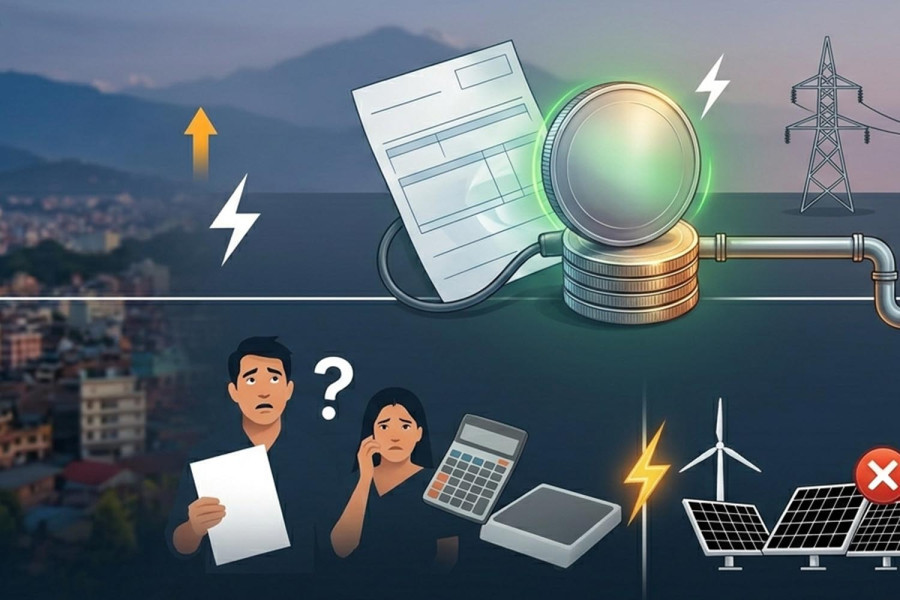
bookmark
Post Report
Published at : July 18, 2026
Updated at : July 18, 2026 17:57
Kathmandu
Households consuming more than 50 units of electricity a month will now pay a five percent Value Added Tax (VAT) on the electricity used above that threshold, while businesses and other non-domestic consumers will be charged 13 percent VAT on their entire electricity bill.
The Inland Revenue Department (IRD) has issued the Electricity Services Value Added Tax Collection Directive, 2026, paving the way for the new tax regime to take effect from July 17.
Under the directive, households using up to 50 units of electricity a month will continue to enjoy a VAT exemption. Once monthly consumption exceeds 50 units, however, a five percent VAT will be levied on the units consumed beyond the exempt threshold.
The concession applies only to households. Industrial, commercial, institutional and other non-domestic consumers will pay 13 percent VAT on the full value of their electricity bill. According to the Nepal Electricity Authority (NEA), the higher rate applies to all non-household consumer categories.
Electricity traded between licensed electricity businesses will remain exempt from VAT. As a result, electricity suppliers issuing VAT invoices must register under the VAT system.
Dirghayu Shrestha, acting managing director of the NEA, said the authority had already completed VAT registration and upgraded its billing software to accommodate the new tax structure.
“The government’s policy is to levy five percent VAT on domestic consumers and 13 percent on all other consumers, and we have updated our billing system accordingly,” Shrestha said.
He said VAT registration would also allow the authority to claim input tax credits on purchases of equipment, materials and other goods used in its operations.
For consumers, the change means a household using 45 units of electricity in Shrawan (July 17-August 16) will remain exempt from VAT. If its consumption rises to 60 units in the following month, the five percent VAT will apply only to the additional 10 units above the exemption threshold. By contrast, a District Administration Office consuming 100 units will be charged 13 percent VAT on the entire electricity bill.
The government first introduced the measure through the Finance Bill, 2026, by amending the VAT Act to exempt household electricity consumption of up to 50 units a month. Consumption beyond that limit would be subject to VAT.
The original draft of the bill, however, would also have imposed VAT on electricity traded between electricity businesses, such as sales from private power developers to the NEA. Following concerns from the energy sector, Parliament amended the provision before passing the bill.
The final law exempts both electricity traded between licensed electricity businesses and household consumption of up to 50 units per customer each month. Only domestic consumption above the threshold will now attract VAT.
According to the NEA, around 2.6 million domestic consumers use more than 50 units of electricity every month.
The authority’s data show nearly two million households consume up to 20 units a month, while another 421,000 use between 21 and 30 units and 615,000 consume between 31 and 50 units. Among consumers liable to pay the new VAT, 1.075 million use between 51 and 100 units, 1.089 million consume between 101 and 250 units, and another 442,000 use more than 250 units a month.
The VAT has drawn criticism from some stakeholders in the energy sector, who argue that electricity tariffs are already determined under the Electricity Regulatory Commission Act, 2017. The law requires tariffs to reflect operating costs, depreciation, loan repayments, maintenance expenses, infrastructure development, returns on equity and obligations under power purchase agreements.
They argue that imposing VAT on top of regulated tariffs amounts to an additional burden on consumers. The government, however, maintains that the new levy will help generate additional resources for investment in the energy sector.
Speaking in the House of Representatives on June 19, Finance Minister Swarnim Wagle said the government was considering raising the VAT threshold to 100 or even 150 units before the measure took effect.
“At present, consumption of up to 50 units is exempt. We are studying whether the tax should instead apply only to consumption above 100 or 150 units,” Wagle said. “We intend to move in that direction before implementation from July 17.”
Despite those remarks, the directive issued by the Inland Revenue Department retains the original 50-unit threshold approved through the Finance Bill.
Health and education levies from July 17
The IRD has also issued directives to implement the three percent health and education equity fees announced in this year's budget.
From fiscal year 2026-27, beginning July 17, patients receiving treatment at private hospitals or diagnostic laboratories will pay an additional three percent health equity fee on their bills.
Prakash Poudel, director at the Inland Revenue Department, said the levy applies only to payments made directly by patients to hospitals or pathology laboratories.
“There were queries about whether the fee would apply when a hospital purchases services from a pathology laboratory. It does not,” Poudel said. “The levy is charged only when a patient makes a direct payment to a hospital or laboratory. Transactions between hospitals and laboratories are commercial transactions and remain exempt.”
The government will also impose a three percent education equity fee on charges collected by private schools and colleges.
The department said the fee must be added to invoices issued in students’ names and will apply to all charges, including admission, tuition and examination fees.
Poudel said schools that collected annual fees in April would need to determine whether the new levy had already been factored into those payments.
“If the fees were collected in a lump sum before the new fiscal year, the school must either issue a supplementary invoice for the additional three percent or demonstrate that the levy had already been included in the amount collected,” he said.
Nepal has attempted to tax private education before. During Baburam Bhattarai's tenure as finance minister, the government proposed a one percent tax on private educational institutions and a separate 1.5 percent contribution to the Rural Education Fund.
Ride-sharing services brought under VAT net
Ride-sharing services have been brought under the Value Added Tax (VAT) system for the first time, with both passengers and service providers affected by the new arrangement.
Passengers using ride-sharing platforms will now pay a five percent VAT on the fare paid to riders. Meanwhile, the service fees and commissions charged by ride-sharing companies to riders will attract a 13 percent VAT.
The 13 percent VAT on corporate income generated by ride-sharing platforms was already in place. However, the levy on passenger fares is a new measure introduced through the latest fiscal changes.
The Inland Revenue Department (IRD) clarified that users paying the five percent VAT on ride fares will not be eligible for input tax credits or VAT refunds. It has also made it mandatory for ride-sharing drivers to register for a Permanent Account Number (PAN).
Capital gains tax and income tax slabs revised
Several other tax measures introduced through the current fiscal year's budget have also come into effect. Customs duties, excise duties, the Domestic Production Promotion and Protection Fee (DPF), the Clean Infrastructure Investment Fee and the green tax have been applicable since May 29.
The government has also revised the capital gains tax regime for the sale of securities of listed companies, making it a final tax.
Under the new arrangement, investors selling shares held for more than one year will pay a 7.5 percent capital gains tax, while those selling shares within a year will pay 10 percent. Previously, investors paid 7.5 percent tax on shares sold within one year and five percent on shares held for more than one year.
The government has also overhauled personal income tax slabs by doubling the tax-exempt threshold for individuals from Rs500,000 to Rs1 million.
Under the revised structure, income up to Rs1 million will be taxed at one percent. Income between Rs1 million and Rs1.5 million will attract a 10 percent tax, while income between Rs1.5 million and Rs2.5 million will be taxed at 20 percent. Earnings between Rs2.5 million and Rs4 million will be subject to a 27 percent tax, and income above Rs4 million will be taxed at 29 percent.
The revised system reduces the number of income tax brackets from six to five and lowers the maximum tax rate from 39 percent to 29 percent.



Most Read from Money

Nepal travel agents threaten to stop selling Thailand trips over visa rules

Why does an hour long flight to Dhangadhi cost more than a flight to New Delhi?
Malaysia rejects Nepal’s demand to open recruitment to all manpower agencies

No school, but a graduation cap for women dairy farmers

Nepal arrests four medical service providers as Malaysia recruitment row deepens
Editor's Picks




E-PAPER | October 20, 2026

×