Having built a hybrid engine, Nepali engineers prepare for 4.1-metre rocket’s vertical test flight
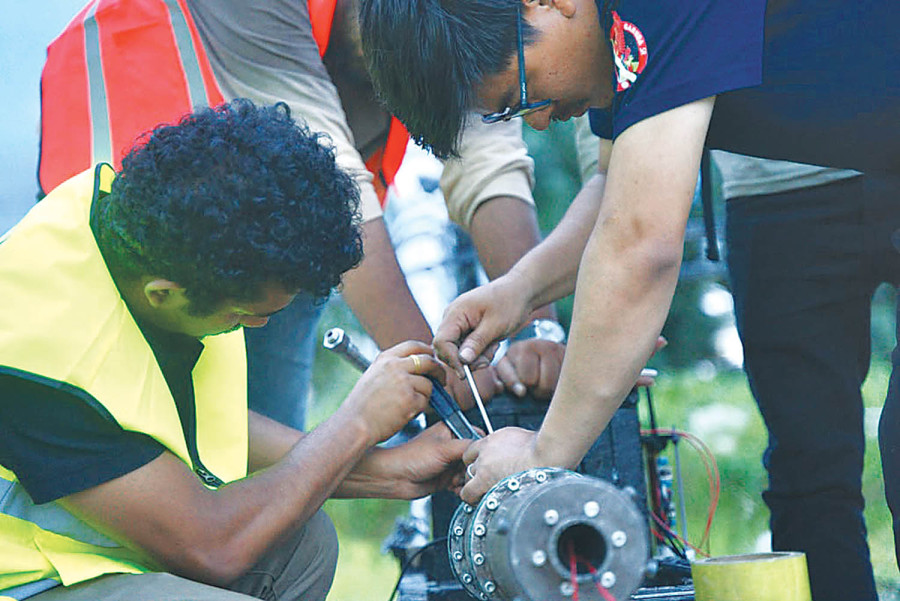
After 55 engine tests, a Nepali startup is preparing to fly a homegrown hybrid rocket. Its struggle to secure approval reveals a country building space technology faster than the rules needed to govern it.Mach24 team examines ignition, chamber pressure, oxidiser flow, and combustion stability. Courtesy of Mohan Tamang
For a few seconds, Nepal’s space ambitions burned inside a metal chamber.
During a series of ground tests, a hybrid rocket engine roared to life as sensors measured pressure, combustion and performance. Each firing marked another step in a cycle of designing, testing, studying the data, and returning to the hardware.
A small team of Nepali engineers had done this 55 times. By the end of those tests, they had developed something unprecedented in the country: a hybrid rocket propulsion system designed and built in Nepal.
Now they want to see it fly.
Mach24 Orbitals, a Nepali aerospace startup working with the Nepal Academy of Science and Technology, is preparing a 4.1-metre rocket for a vertical test flight. Weighing 42 kilograms and measuring just 17 centimeters across, the prototype is designed to shoot roughly one kilometre into the sky.
In the scale of spaceflight, one kilometre is a tiny distance. The commonly recognised boundary of space lies around 100 kilometres above Earth. For Nepal, however, the flight could still mark a major leap.
It would be Nepal’s first flight of a single-stage hybrid rocket, moving the country from experimental rocketry toward more advanced homegrown aerospace technology. Mach24 is already designing a larger, eight-metre rocket and hopes eventually to produce commercially viable propulsion systems for the global small-satellite industry.
Yet after solving the engineering challenge of making a rocket engine fire, the team encountered another obstacle.
Nepal lacked a clear pathway for what came next. For around two months, the proposed flight was tossed around a government system without a standard process for approving such a test. A single rocket launch required coordination across the science, aviation, defence, public safety, and national security sectors.
The permit has since been approved, though a launch site and date remain to be finalised.
Mach24 co-founder Mohan Tamang told the Post that the experience exposed a growing mismatch in Nepal’s space ambitions. The country’s engineers are pushing ahead with new technologies while its institutions struggle to keep pace in learning how to govern them.
“If there were policies, things would be swifter,” Tamang said. “Right now, there is no standard road. There needs to be a standard.”
Rubita Magar, chief of business at Mach24 and a co-founder, told the Post that the delay carried consequences beyond the launch itself, pushing back the company’s timeline at a critical stage when technical progress is closely tied to its ability to attract investment.
“The delay set back our timeline and, with it, our window to raise funding for the next phase,” Magar said. “Momentum matters a great deal for an early-stage company, and that was a real cost.”
Mach24’s flight ambitions began with Garuda.
In 2020, a student team led by Tamang built and launched the experimental rocket, an effort that later received recognition at the 2021 Spaceport America Cup. The experience eventually helped give rise to Mach24 Orbitals, founded with a larger goal of developing commercially viable, low-cost launch technology from Nepal.
At the centre of that effort is its hybrid engine. The system uses solid fuel and a separately stored oxidiser, combining some of the simplicity of solid propulsion with greater control over the engine’s operation.
For Sunil Bista, Mach24’s chief propulsion engineer, learning to build such an engine meant entering a field with almost no established pathway in Nepal.
“When I started working on rocket propulsion, there was no established ecosystem or clear career path in Nepal, so I had to learn from first principles through textbooks, research papers and hands-on experimentation,” Bista said.
Without an established domestic rocket industry, experienced propulsion mentors or easy access to specialised components, the team had to build its expertise alongside the technology itself.
Bista describes the approach as “fail fast, learn faster”. Designs that appeared sound on paper did not always behave as expected once an engine was ignited.
“What works in theory doesn’t always work in practice,” he said. “Every static fire test, whether successful or not, provides insights that help improve the next design.”
Test after test, the Mach24 team examined ignition, chamber pressure, oxidiser flow, and combustion stability. Sensors collected data from each firing while components were adjusted. Designs changed as each test produced information for the next.
By the 55th firing, Tamang said, the company had accumulated technical knowledge previously unavailable in Nepal. “It was the first time that an engine like that was developed in Nepal,” he said. “We have created proprietary intellectual property, and we are looking at a patent.”
The successful ground tests have now shifted the challenge from propulsion to flight.
On the ground, engineers can test an engine repeatedly under controlled conditions. A flight test brings the propulsion system together with the rest of the rocket and places the entire vehicle in the environment for which it was designed.
“What this flight proves is the validation of the hybrid propulsion system and the rocket system integration,” Bista said.
A successful mission, he said, would mean validating the propulsion system and collecting the flight data needed to improve the company’s next rocket.
According to a NAST letter seeking government coordination and approval, the prototype requires a safe area with a radius of approximately 1.2 kilometres for its planned flight. The test is expected to take place outside Kathmandu Valley.
“We are in discussion with the Nepali Army through the Ministry of Science, Technology and Innovation to decide the venue and date to launch,” Hari Ram Shrestha, head of NAST’s Space Research Centre, said.
The struggle to arrange a one-kilometre rocket test points to a larger challenge confronting Nepal’s emerging space sector. Students, researchers, companies and public institutions have pushed into satellites, rocketry and space education, while the laws and institutions needed to govern that progress have struggled to keep pace.
The regulatory uncertainty surrounding Mach24 raises a broader question: what role does Nepal want to play in space?
Mahabir Pun, Nepal’s minister for science, technology and innovation, acknowledged both the promise of Mach24’s work and the absence of a clear regulatory system for projects like it.
Asked what the development of a homegrown hybrid rocket engine says about Nepal’s potential to build its own space-technology industry, and whether the government recognises the lack of a standard pathway for experimental rocket launches, Pun offered a brief response.
“It has potential,” he told the Post. “There is a regulatory gap for sure.”
Magar said addressing the gap requires a system that allows companies to know in advance what is required of them.
“Nepal needs a dedicated aerospace authority for launch licensing and permissions,” she said. “We also need clear, published altitude and airspace thresholds that don’t require case-by-case ministerial approval for every test, along with a proper liability and insurance framework so a single test flight doesn’t turn into a months-long approvals process.”
“Without that, every company that follows us will run into the same obstacle we did,” Magar added.
That question extends beyond rockets. Shrestha said NAST’s Space Research Centre is working to reduce Nepal’s dependence on satellite data supplied by other countries, which can delay information needed for disaster response and planning.
Space technology also underpins communications, navigation, weather forecasting, environmental monitoring and agriculture, making domestic capability increasingly relevant to everyday life.
Magar argues that this is why Nepal’s development challenges should not automatically be seen as a reason to stay out of the sector.
For Mach24, she said, investing in space is ultimately a question of technological self-reliance rather than national prestige.
“Nepal already imports all of its satellite capacity today, across telecom, weather forecasting and disaster monitoring,” Magar said. “Building domestic space capability is fundamentally about reducing long-term dependency and cost, not novelty.”
Mach24’s ambitions go beyond the domestic market. “Nepal is our base, not our market,” Magar said.
For the next several years, the company plans to focus on propulsion development and testing services before moving towards its longer-term goal of launching small satellites for customers across the Asia-Pacific region and beyond.
“Becoming a launch service provider is where we’re headed, and we’re upfront that we’re not there yet,” Magar said.
Getting there will require more than engineering.
Raising capital has been the hardest part of building an aerospace company in Nepal, Magar said.
“There is no established space-investor base in Nepal, so we’re not just pitching Mach24, we’re making the case that space is an investable category here at all,” she said.
Specialised talent presents another constraint. Nepal has little established pipeline for aerospace or propulsion engineering, leaving the company to train engineers itself or recruit from the small pool of Nepali specialists abroad who may be willing to return.
That challenge connects the space sector to one of Nepal’s larger economic concerns — the departure of skilled young workers.
Tamang sees aerospace as part of Nepal’s struggle to retain technically skilled young people. “We are talking about stopping brain drain,” he said. For Nepal to keep engineers, he argues, the country also needs industries capable of giving them ambitious work.
Magar similarly sees Mach24 as an export-oriented company that could generate expertise and specialised employment inside Nepal even if its eventual customers are elsewhere.
“We’re building a company meant to serve a regional and global market, and Nepal benefits from the jobs, expertise and industry that come with hosting a globally competitive sector, the same way any country benefits from a strong export industry,” she said.
Yet Nepal still lacks a comprehensive legal and institutional framework for a sector that cuts across numerous areas of government.
Suresh Bhattarai, chairperson of the Nepal Astronomical Society, argues that Nepal urgently needs a dedicated space law rather than limiting its approach to a satellite policy. While a satellite policy could guide the country’s use and development of satellites, Bhattarai argues, a space law would establish legal rules for activities such as launches, private operators, liability and coordination among government agencies.
He also advocates for a national space agency housed directly under the Prime Minister’s Office. Space technology, he argues, intersects simultaneously with defence, communications, education, disaster management and foreign affairs, making it difficult to place under the authority of a single ministry.
Mach24 has attracted angel investors and developed its technology privately while collaborating with NAST and other government institutions. Tamang argues that the state can play a decisive role without building the industry itself. Clear regulations, predictable approval processes and greater recognition of aerospace as an emerging industry could give engineers and entrepreneurs room to develop their work.
Mach24 is now looking beyond its first kilometre.
Within five years, Magar said, success would mean establishing a repeatable record in propulsion development and testing, seeing a functioning regulatory framework emerge in Nepal and securing a funded path towards the company’s first orbital-class launch.
The company is targeting 2029, though Magar acknowledged that the timeline depends on factors outside the engineering team’s control.
“We’re clear that meeting that timeline depends as much on the regulatory and funding environment coming together as it does on the engineering itself,” she said.
Nepali-designed technology has already reached orbit. NepaliSat-1, the country’s first satellite, was launched in 2019, and other Nepal-built satellite projects have followed. The next challenge is developing the vehicle that could eventually carry payloads there.
“What remains is the harder half of building and launching the vehicle that takes others there,” Magar said. “That’s achievable, but only with sustained support from government and funding partners, not a one-time effort.”




 20.73°C Kathmandu