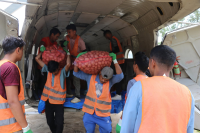
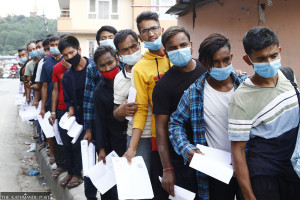
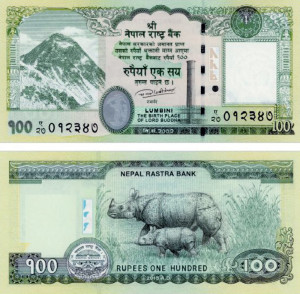
Stronger dollar, shift to Western labour markets and growing use of formal digital channels help Nepal post a record Rs209.75 billion in monthly remittance earnings. The sharp increase in remittance earnings came even as the number of migrant workers declined by 3.36 percent during the review period. Post file photo
Nepal has been receiving an average of Rs7 billion in remittances every day, exposing the country’s deepening dependence on overseas earnings even as labour migration slows and geopolitical tensions persist in West Asia.
Nepal’s monthly remittance inflows have reached an all-time high despite concerns that the West Asia conflict would dampen demand for Nepali workers abroad.
According to Nepal Rastra Bank, the country received a record Rs209.75 billion in remittances between mid-March and mid-April.
With the latest surge, remittance inflows in the first nine months of the current fiscal year rose 39.1 percent to Rs1.65 trillion compared to the same period last fiscal year. The sharp increase came even as the number of migrant workers declined by 3.36 percent during the review period.
Labour migration expert Jeevan Baniya said the conflict in West Asia had not significantly affected remittance earnings because there had been no major job losses among Nepali workers.
“Besides, the appreciation of the US dollar, euro and pound has also boosted earnings,” he said.
Around 4.4 million Nepalis are currently estimated to be working abroad.
Growing tensions in West Asia—particularly involving the US, Israel and Iran—and concerns over the safety of Nepali citizens had prompted the government to temporarily halt labour migration approvals earlier this year.
On March 1, Nepal suspended the issuance of both individual and institutional labour permits for workers travelling to several Middle Eastern countries. The government resumed issuing permits on April 20.
“The impact of the temporary suspension was not significant,” Baniya said.
In the first nine months of the current fiscal year, Nepal issued labour permits to 587,445 individuals, including 294,186 first-time migrants and 293,259 renewals. In the same period last fiscal year, the figure stood at 607,874.
Analysts say the depreciation of the Nepali rupee against the US dollar also played a major role in the robust remittance growth.
In US dollar terms, remittance inflows increased 31.9 percent to $11.55 billion during the review period, compared to a 7.5 percent rise in the same period last year.
The central bank said the Nepali rupee had depreciated by 7.5 percent against the US dollar in mid-April 2026 compared to mid-July 2025. The buying exchange rate stood at Rs148.07 per US dollar in mid-April, up from Rs137 in mid-July last year.
Remittances are projected to be equivalent to around 33.02 percent of Nepal’s GDP this fiscal year, sharply higher than 27.80 percent last year, underscoring the country’s growing dependence on overseas earnings, according to the National Statistics Office report.
Last fiscal year, 839,266 Nepalis left for foreign employment, including 505,957 first-time migrants and 333,309 renewals. The previous year, the total stood at 741,297. The figures exclude the 119,409 Nepali students who left the country in 2024.
Baniya said the labour market for Nepali workers was expanding beyond traditional Gulf destinations, with increasing migration to Western countries.
“Remittance inflows from students and immigrants in Europe, Japan, Australia and the US have also remained strong,” he said.
Analysts say government incentives encouraging the use of formal banking channels have shifted a large share of remittance transfers away from informal hundi networks towards regulated systems, improving both transparency and official documentation of inflows.
Digitalisation has also transformed remittance transfers.
“One major change in remittance flows is digitalisation,” said Baniya, deputy director at Social Science Baha.
South Korea was once considered a major source of remittances sent through hundi, an informal and illegal transfer channel. In 2017, the International Organisation for Migration in Seoul told The Korea Times newspaper that more than 80 percent of Nepali workers in South Korea used hundi due to limited formal banking options.
“Now, most banking services and peer-to-peer transactions in South Korea have gone digital, so money is increasingly coming through legal channels,” Baniya said.
Experts say stronger anti-money laundering compliance in recent years has further improved trust in formal remittance systems and is likely to push more transfers into official channels.
At the same time, Nepal’s weak domestic economy continues to drive outward migration. Analysts say the failure of agriculture, manufacturing and services sectors to create sufficient jobs has reinforced the cycle of labour migration, with rising remittance inflows masking deeper structural weaknesses.
The central bank has described Nepal as an increasingly labour-exporting economy, with many rural households relying heavily on at least one family member working abroad.
Political instability, corruption and weak accountability continue to push both skilled and unskilled young Nepalis overseas in search of better opportunities and economic security.
Helped by strong remittance growth, Nepal’s gross foreign exchange reserves increased 30.5 percent to Rs3.49 trillion in mid-April 2026 from Rs2.67 trillion in mid-July 2025. In US dollar terms, reserves rose 20.8 percent to $23.55 billion from $19.50 billion over the same period.
Sangam Prasain is Business Editor at The Kathmandu Post, covering tourism, agriculture, mountaineering, aviation, infrastructure and other economic affairs. He joined The Kathmandu Post in October 2009.




 21.38°C Kathmandu