



 14.81°C Kathmandu
Sat, Oct 24, 2026
Money
In Sindhuli, cows are connected
Sensor-based monitoring of high-yield Holsteins is boosting milk output, cutting labour and transforming livelihoods in Kamalamai.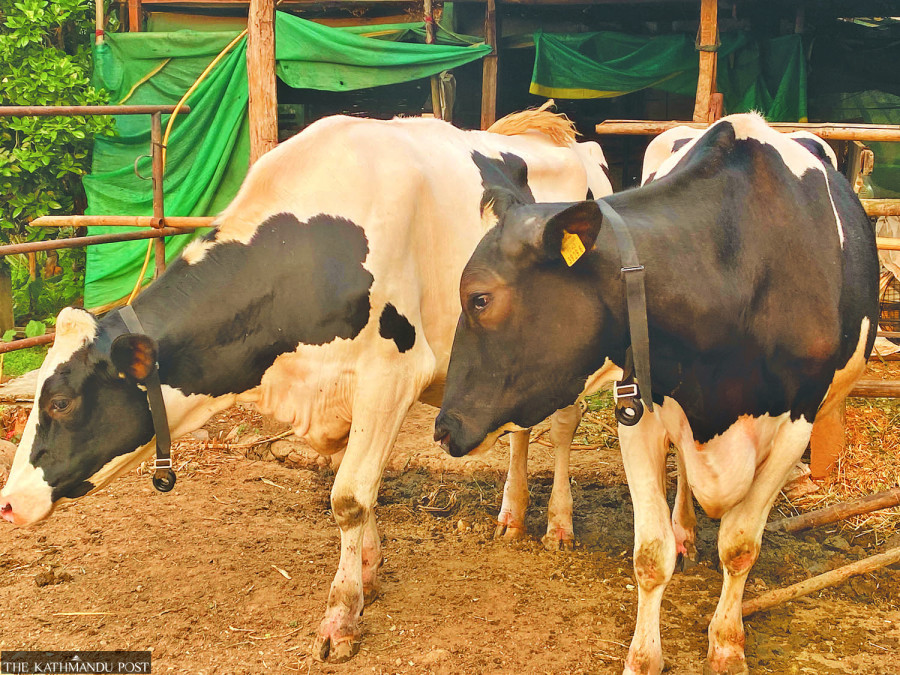
bookmark![]()
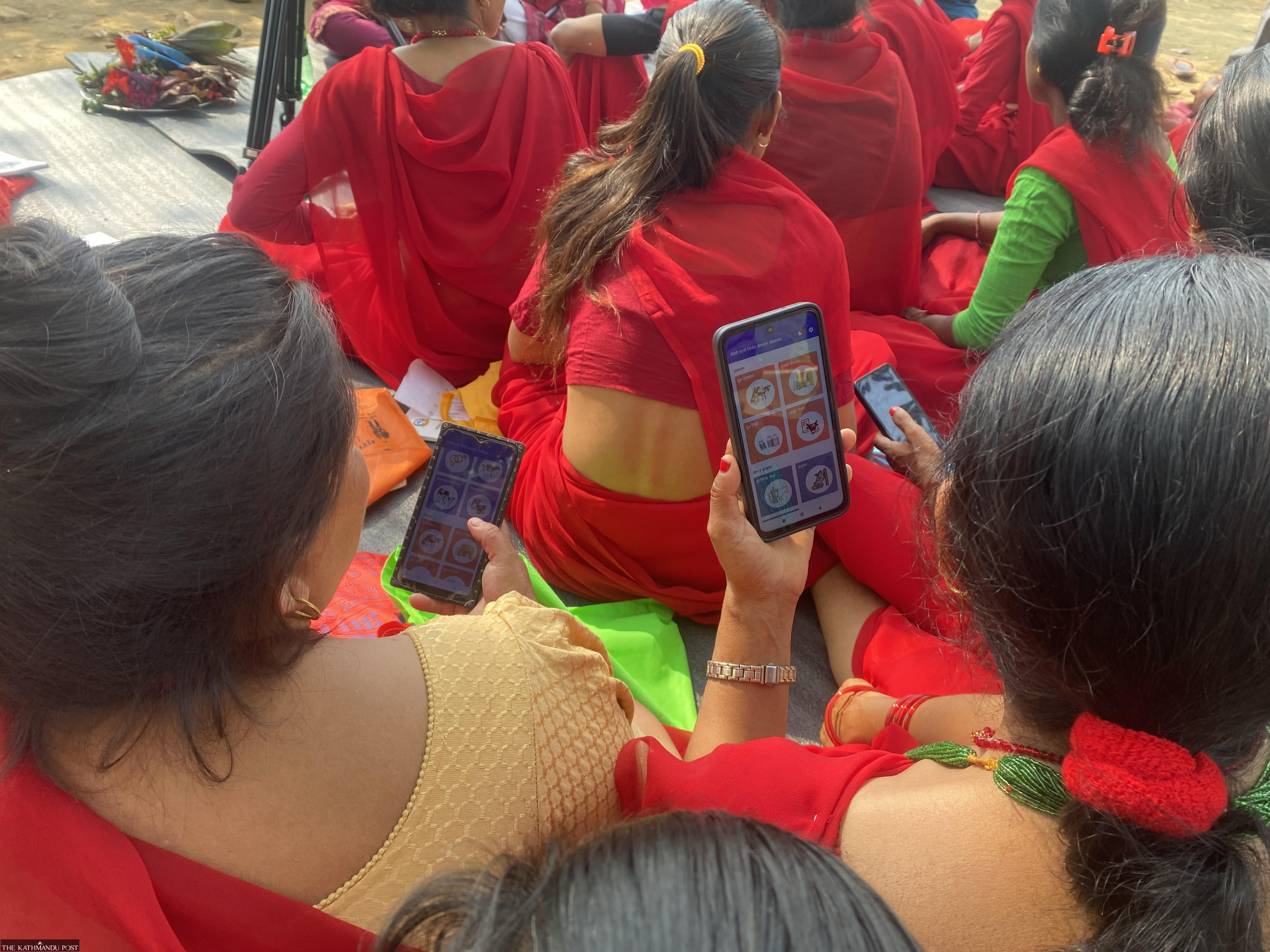
A farmer displays a mobile application that tracks cattle health, feeding patterns, and milk production. Sangam Prasain/TKP ![]()
Sangam Prasain/TKP
Sangam Prasain
Published at : April 20, 2026
Updated at : April 20, 2026 10:46
Sindhuli
In a cluster of villages scattered across Kamalamai Municipality in Sindhuli, a quiet transformation is underway—one that blends traditional cattle rearing with cutting-edge technology.
At first glance, the scene appears familiar: tall black-and-white Holstein cows grazing or resting in sheds. Locals casually refer to them as “Korean cows,” a nod to their origin. But a closer look reveals something unusual. Around each animal’s neck hangs a small, black device—a sensor.
Villagers have begun calling it “AI”.
In livestock terminology, AI has long stood for artificial insemination. But here in Sindhuli, the acronym has been reclaimed by a more famous modern namesake: artificial intelligence. This sensor-based monitoring device is designed to track cattle health and behaviour in real time, offering early warnings of disease, improving productivity, and significantly reducing the need for antibiotics.
The initiative, jointly piloted by Heifer International Nepal, Heifer Korea, Korea International Cooperation Agency (KOICA), and Kamalamai Municipality, is being described as the first project of its kind in Nepal’s livestock sector. Its goal is ambitious—to enhance animal welfare, optimise dairy output, and reduce the physical burden on farmers.
“By employing machine-learning algorithms, AI can predict health issues in cattle before they reach critical stages. This enhances both welfare and productivity,” said Lee Hae-won, who leads Heifer’s Korea branch.
“Every morning, whether we are in Korea or Nepal, in Kathmandu or Sindhuli, we monitor the animals through our mobile phones,” she said.
The system continuously collects data on each cow—its feeding patterns, physical activity, rumination (chewing), and even subtle behavioural changes. These data points are then processed by AI algorithms that detect anomalies.
“A sudden drop in feed intake, irregular movement, or even coughing can trigger alerts. Farmers and technicians are immediately notified, allowing early intervention before a minor issue escalates into a serious health problem,” said Lee.
Beyond health monitoring, the technology is reshaping daily farm operations. Tasks that once required hours of manual observation—checking feed consumption, monitoring breeding cycles, or identifying illness—are now streamlined.
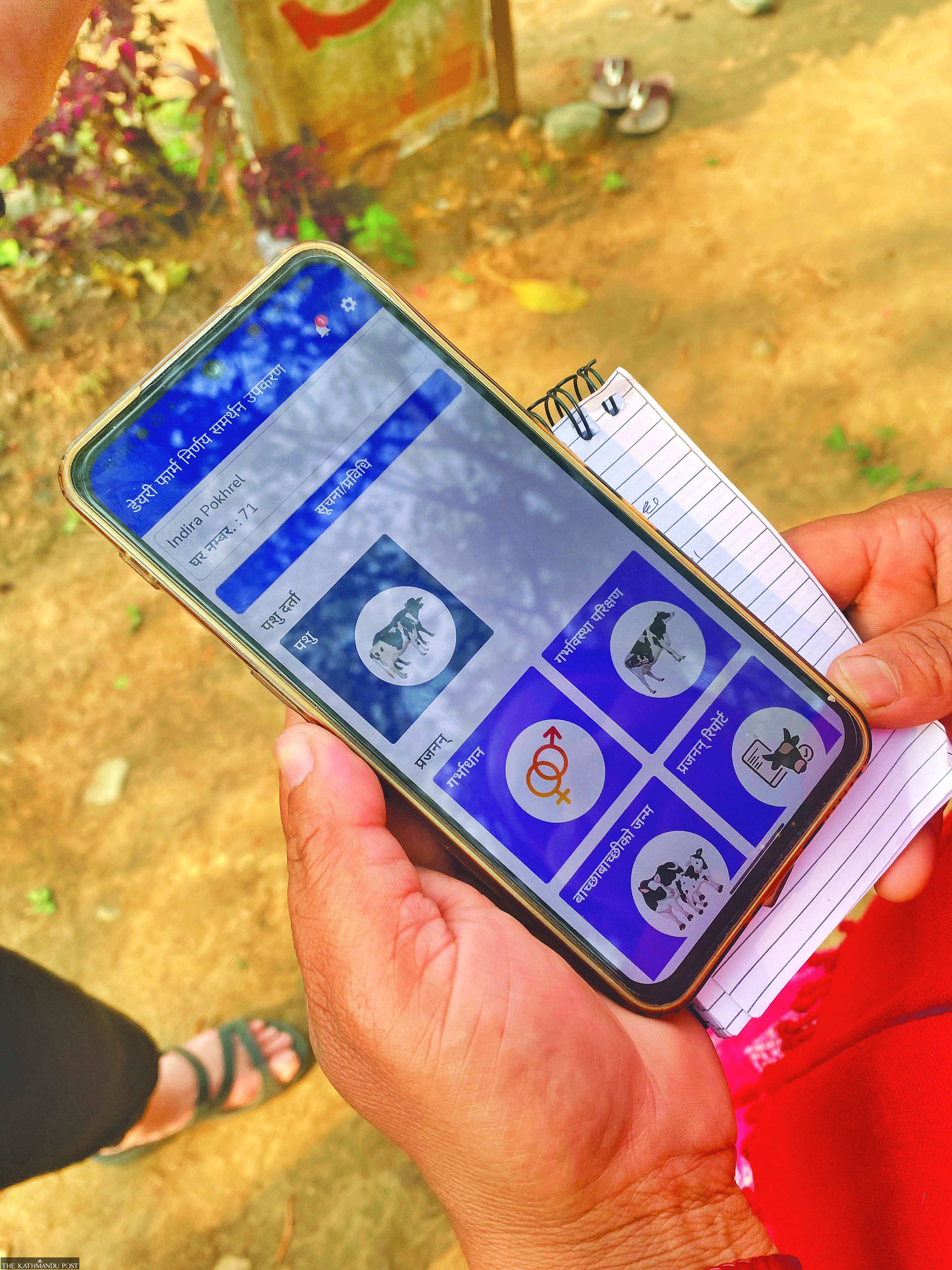
The AI system can predict calving dates, detect estrous cycles (psychological changes induced by reproductive hormones), and flag animals that may require assistance during delivery. It significantly reduces labour hours while improving accuracy.
On a recent Wednesday afternoon, the human side of this technological shift was visible under the shade of a large tree in Kamalamai. Nearly two dozen women had gathered for a “farmers’ school,” a digital literacy session aimed at helping them integrate technology into their daily work.
Seated in a circle, each woman scrolled through mobile applications installed on their phones. They entered data on milk production, feed intake, veterinary care, and household expenses.
The training was led by members of the “didi group”—experienced women farmers—who were passing on their knowledge to the “bahini group,” or younger participants.
Among them was Indira Pokhrel, who now sees her mobile phone as far more than a communication device.
“In the past, we judged whether a cow was healthy just by looking at its belly,” said Pokhrel, 41, a member of the Ghaiyadevi Women’s Group. “We believed a fat belly meant the animal was eating well. But that understanding was completely wrong.”
“Now, with the app, we can track the exact weight of the cattle and determine how much food and water they need. We can even calculate our daily income and expenses.”
The digital system has brought a level of precision previously unimaginable in smallholder farming.
A healthy cow, for instance, requires around 40 kilograms of fodder and up to 100 liters of water per day—figures that were largely unknown to farmers until recently.
“We were unaware of proper feeding systems before,” Pokhrel said. “Now we can even audit our monthly income and plan household expenses accordingly.”
The mobile application also records breeding cycles, predicts optimal timing for artificial insemination, logs births and abortions, and tracks vaccination schedules—all through a Smart Livestock Recording system.
This technological leap is part of a broader initiative known as the “Milky Way” project.
The origins of the project trace back to December 2022, when South Korea’s Ministry of Agriculture, Food and Rural Affairs, the National Agricultural Cooperative Federation, and Heifer Korea jointly transferred 101 Holstein heifers and eight breeding bulls to Nepal. Of these, 80 were allocated to Sindhuli.
The aim was to boost Nepal’s dairy productivity. The dairy sector already contributes around 9 percent to the country’s gross domestic product, but productivity has historically lagged behind global standards.
Since then, the number of Holstein cattle in Sindhuli has grown from 80 to 123. Among them, 11 are currently pregnant, signalling steady expansion.
Heewon Kim, a senior veterinarian from South Korea who has been closely studying the cattle, expressed surprise at how quickly the Holsteins have adapted to Sindhuli’s climate.
“Holsteins are typically known for high production in open pastures, but here they have adapted well and are even being raised as house-trained animals,” he said.
For farmers, the transformation has been nothing short of life-changing.
Nisha Karki, a resident of Bagaincha Tole, is expecting her third calf this year from a Holstein cow she received under Heifer’s “Passing on the Gift” initiative.
“I used to dream of owning a cow that could produce 30 to 40 litres of milk a day,” she said. “In 2022, that became true.”
Today, Karki milks up to 60 litres daily from her two cows, earning around Rs100,000 per month, with a net profit of Rs50,000.
Her husband works as a school security guard, earning Rs20,000 monthly.
“It used to be very difficult to run the household and educate our children,” she said. “Now, all our expenses are covered by dairy income.”
Karki has two children, aged 19 and 14, and says their future looks far more secure today.
“I used to keep three local cows. Together, they produced only 24 litres a day, and it felt like a loss-making business because of the labour involved,” she said. “Now, one Holstein is equal to five local cows.”
Across Kamalamai, similar stories are emerging.
Women’s groups are now planning to expand membership from 364 to 630 and increase daily milk production from 2,000 litres to 10,000 litres within five years. They also aim to establish six to seven milk collection centres, up from the current three.
Among the standout cases is Kabita Neupane, a farm entrepreneur from Rajpani.
One of her Holstein cows produces an astonishing 48.6 liters of milk per day—believed by project officials to be among the highest yields in South Asia.
To maintain such output, Neupane milks the cow four times daily, including once at midnight.
“That level of production was beyond my imagination,” said Neupane, 50, who runs the Neupane Cow Farm.
Previously, she owned 20 Jersey cows, which together produced around 150 litres per day. Today, with just four Holsteins, she achieves the same output.
Her monthly earnings now reach Rs200,000, with about half counted as net profit.
Encouraged by the results, she plans to expand her herd to 20 Holsteins.
Not everyone has made the transition, but many are eager.
Pratigya Giri, 38, from Sangwale village, still relies on a local cow that produces just 8.5 litres daily.
“When we heard that Kabita was producing nearly 50 litres a day, we ran to see the cow,” she said. “We were amazed—and honestly, a bit jealous.”
“The women with Holsteins bring entire cans of milk to the cooperative. We barely manage four or five litres.”
Determined to change her situation, Giri recently purchased a hybrid cow for Rs110,000, financed partly through an interest-free cooperative loan.
She now attends the farmers’ school regularly, learning both digital tools and modern livestock practices.
“I keep asking when I will receive a Holstein,” she said with a laugh. “The income potential is beyond imagination.”
Like many others, she has also shifted her farming priorities.
“In Sindhuli, many farmers are no longer focusing on paddy or cereals,” she said. “Growing grass for fodder is more profitable.”
Rukmani Adhikari, 47, offers yet another example of adaptation.
A livestock farmer for over 16 years, she once managed 30 cattle. But after introducing Holsteins into her herd, she began downsizing.
“I now have eight cows, including four Holsteins,” she said. “I produce 65 litres of milk daily and sell it at Rs60 per liter.”
Her strategy centres on having fewer animals with high yield.
“With young people leaving villages, labour is scarce,” she said. “High-yield cows reduce workload and increase profits. For us, Holstein is a hope.”
In Sindhuli, that hope is no longer abstract. It is now measured in litres of milk, recorded in mobile apps, and monitored through sensors hanging quietly from the necks of black-and-white cows.
Sangam Prasain
Sangam Prasain is Business Editor at The Kathmandu Post, covering tourism, agriculture, mountaineering, aviation, infrastructure and other economic affairs. He joined The Kathmandu Post in October 2009.



Most Read from Money

Why does an hour long flight to Dhangadhi cost more than a flight to New Delhi?

Nepal travel agents threaten to stop selling Thailand trips over visa rules
Malaysia rejects Nepal’s demand to open recruitment to all manpower agencies
No school, but a graduation cap for women dairy farmers
Nepal arrests four medical service providers as Malaysia recruitment row deepens
Editor's Picks




E-PAPER | October 24, 2026

×