



 18.31°C Kathmandu

Sun, Oct 18, 2026
Money
Loans are cheaper than ever. Borrowers are still holding back
With banks flush with funds but credit demand subdued, mounting excess liquidity points to deeper signs of a liquidity trap in Nepal’s economy.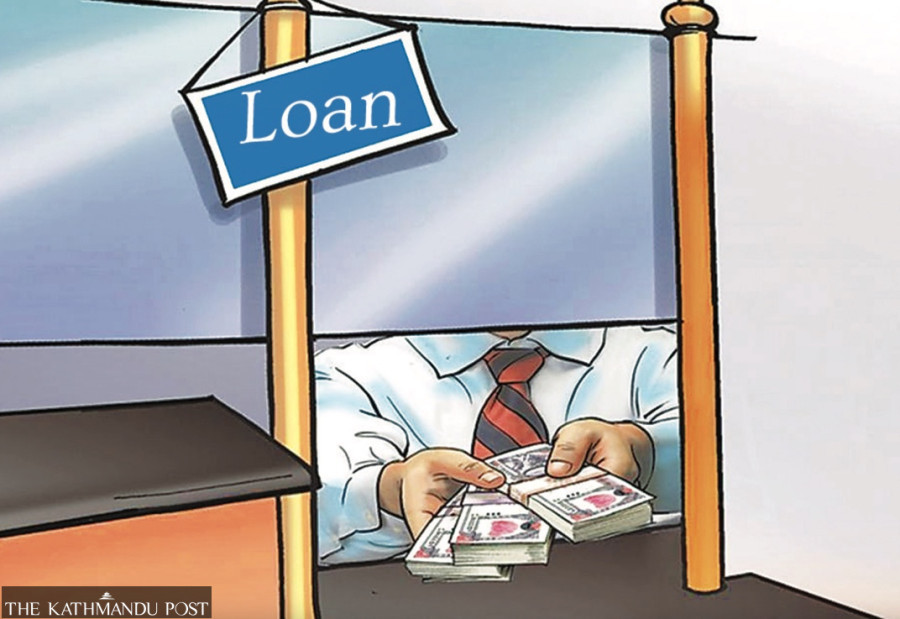
bookmark
Yagya Banjade
Published at : April 17, 2026
Updated at : April 17, 2026 10:22
Kathmandu
The weighted average lending rate charged by banks and financial institutions in Nepal has fallen to 6.90 percent, marking the lowest level on record.
The rate had climbed as high as 13.03 percent in the fiscal year 2022-23 before entering a sustained downward trend, according to the latest data released by Nepal Rastra Bank for mid-March. The decline reflects a broader shift in monetary conditions, driven largely by excess liquidity in the banking system and subdued demand for credit.
Officials at the central bank and financial sector analysts say the current lending rate represents a historic low. However, they caution that this average does not translate directly into borrowing costs for all customers. Interest rates vary widely depending on the lending institution, the borrower’s risk profile, and the category of loan.
Suman Neupane, assistant spokesperson for Nepal Rastra Bank, said that available data confirm the weighted average lending rate has reached its lowest point so far. While deposit rates have dipped lower during certain periods in the past, the current lending rate is the lowest recorded since systematic tracking began.
“Over the past two decades, interest rates have moved in cycles, with alternating periods of low and high,” Neupane said. “Around fiscal year 2003-4, deposit rates were in the range of 3 to 4 percent, while lending rates remained significantly higher, between 10 and 11 percent. There were also phases of relatively low rates before and after the 2015 earthquake. At present, both deposit and lending rates are at unusually low levels.”
The decline in lending rates has mixed implications. While lower borrowing costs are beneficial for businesses and households seeking credit, they also reduce returns for depositors. This dynamic may encourage funds to shift into less productive or more speculative sectors. At the same time, falling lending rates tend to pull down deposit rates, further compressing returns on savings.
Economists warn that this environment increases the risk of capital outflows, particularly in a regionally interconnected economy. Even a modest interest rate differential with India can incentivise cross-border capital movement, often facilitated through informal trade channels in border areas. With Nepal’s interest rates now lower than those in India, analysts say the risk of capital flight has intensified.
Despite these concerns, low inflation has ensured that real interest rates—adjusted for price changes—remain positive, providing some cushion for savers.
Nepal Rastra Bank began formally calculating weighted average deposit and lending rates in 2012. Officials note that interest rates were generally higher before this period, although consistent data are not available.
In mid-July 2012, the average lending rate stood at 12.40 percent. It declined to 8.43 percent by mid-July 2021, before rising again amid tightening liquidity conditions to reach 13.03 percent by mid-July 2023. Since then, the trend has reversed, with rates falling to 9.93 percent in mid-July 2024 and further to 7.85 percent last mid-July, eventually reaching the current level of 6.90 percent.
A senior official at the central bank said that, based on records maintained since 2012, last mid-July’s rate was the lowest observed. When placed in a longer historical context, including periods before formal tracking began, the current rate can reasonably be considered the lowest on record.
Nepal Rastra Bank, established in 1956, began shaping credit policy through formal monetary policy instruments in 1966. Until the restoration of democracy in 1990, the central bank directly fixed both deposit and lending rates. Following financial sector liberalisation, banks were granted autonomy to determine interest rates. However, the central bank continues to exert indirect influence through regulatory tools such as the interest rate spread, base rate guidelines, and caps on deposit rates.
Neupane said the central bank now relies on the interest rate corridor framework and the policy rate as key instruments to manage liquidity and stabilise market rates. In the current environment of excess liquidity, the corridor has helped prevent deposit rates from declining even further.
Economy in a liquidity trap
A growing number of economists argue that Nepal’s economy is now in a liquidity trap—a condition where interest rates are already very low and further reductions fail to stimulate borrowing or investment.
“In a situation where there is persistent excess liquidity, very low interest rates, and limited scope to reduce rates further, the economy effectively enters a liquidity trap,” said economist Nara Bahadur Thapa. “Under such conditions, monetary policy alone cannot drive economic activity. Fiscal policy must take the lead.”
Authorities have introduced a range of measures aimed at boosting credit flow. These include easing loan-to-value ratios for real estate, reducing risk weights on share loans, and relaxing working capital loan guidelines. However, experts say these steps have had a limited impact.
Former National Planning Commission vice-chair Prakash Kumar Shrestha also acknowledged that the economy exhibits clear signs of a liquidity trap. He emphasised the need for a more proactive fiscal stance to stimulate demand and encourage private sector investment.
At present, weak aggregate demand remains a key constraint on credit growth. Businesses are hesitant to expand, and consumers are holding back on spending, limiting the effectiveness of lower borrowing costs. Analysts argue that increasing government expenditure and boosting consumer confidence will be essential to revive economic momentum.
Reflecting the persistent surplus of funds in the banking system, banks have continued to lower deposit rates in recent months. In mid-April, the average interest rate on one-year fixed deposits declined to 4.40 percent, down from 4.496 percent a month earlier. Savings deposit rates also edged down slightly to 3.181 percent.
Despite strong deposit growth, credit expansion has remained sluggish, leading to a significant buildup of loanable funds. During the first eight months of the current fiscal year, deposits increased by Rs482.01 billion, compared to Rs277.23 billion during the same period a year earlier.
In contrast, banks extended only Rs243.54 billion in new loans over the same period, representing a 4.4 percent increase. Total outstanding credit has reached Rs5.74 trillion.
Nepal Rastra Bank has set a credit growth target of 12 percent for the fiscal year, which would require an additional Rs550 billion in lending. However, based on current trends, experts say the target is unlikely to be achieved.
As of mid-April, banks were holding approximately Rs1.25 trillion in excess liquidity, underscoring the imbalance between deposit inflows and credit demand.
In an effort to address the issue, the central bank expanded the scope of priority sector lending through its mid-term monetary policy review in early March. Newly included sectors include tourism, information technology, and export-oriented industries that rely on domestic raw materials.
Earlier, in its first quarterly review issued on December 1, the central bank reduced both the upper limit of the interest rate corridor and the policy rate in a bid to lower borrowing costs and support economic activity.
Fixed deposits lose appeal
The sustained decline in interest rates has significantly reduced the attractiveness of fixed deposits.
With only marginal differences between savings and fixed deposit rates, many depositors are opting to keep their funds in savings accounts. Data indicate a clear shift in deposit composition over the past year.
As of mid-March, current accounts accounted for 6.6 percent of total deposits, savings accounts for 44.1 percent, and fixed deposits for 40.1 percent. A year earlier, the corresponding shares were 5.4 percent, 35.4 percent, and 51.7 percent.
Bankers say the nearly 10 percentage point decline in the share of fixed deposits suggests that depositors are choosing not to renew maturing fixed-term accounts, largely due to lower returns.
Santosh Koirala, president of the Nepal Bankers’ Association, said many depositors are adopting a wait-and-see approach, anticipating a possible rise in interest rates in the future.
“As the gap between savings and fixed deposit rates has narrowed considerably, depositors are increasingly choosing to hold funds in savings accounts,” he said.
Yagya Banjade
Banjade covers government finance, banking, capital markets, and the economy for Kantipur Daily.




Most Read from Money

Nepal travel agents threaten to stop selling Thailand trips over visa rules

Explained: Why does an hour long flight to Dhangadhi cost more than a flight to New Delhi?
Malaysia rejects Nepal’s demand to open recruitment to all manpower agencies

No school, but a graduation cap for women dairy farmers

Nepal arrests four medical service providers as Malaysia recruitment row deepens
Editor's Picks

Dashain is in the air

Buying a goat for Dashain? Look for the green mark
Explained: Why does an hour long flight to Dhangadhi cost more than a flight to New Delhi?

Bhotekoshi flood wasn’t a freak event. It’s the Himalaya doing what it does

How Tenzing Sherpa became Nepal’s breakout star at the Asian Games
E-PAPER | October 18, 2026

×