



 14.81°C Kathmandu
Sat, Oct 24, 2026
Money
Rupee hits record low at Rs150.24 per dollar amid global turmoil
Peg to weakening Indian currency and strong US dollar raise inflation risks, threaten remittances and imports.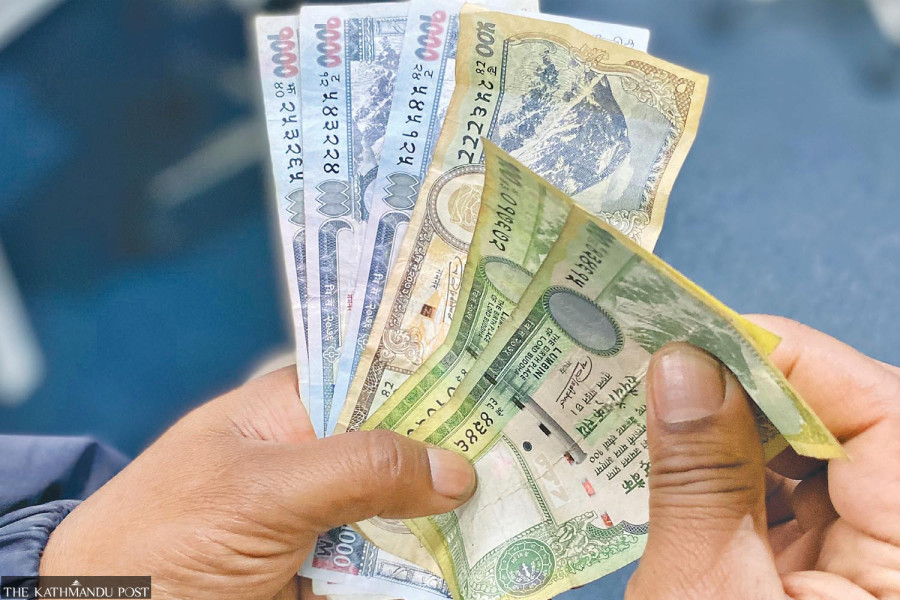
bookmark
Krishana Prasain
Published at : March 23, 2026
Updated at : March 23, 2026 07:02
Kathmandu
The Nepali rupee plunged to an all-time low, with Nepal’s central bank fixing the exchange rate at Rs150.24 per US dollar on Saturday.
The currency depreciated by Rs1.72 against the dollar in a single day, largely due to the weakening of the Indian rupee, to which Nepal’s currency is pegged. Any fluctuation in the Indian currency directly affects the Nepali rupee under the fixed exchange rate system.
A year ago, the Nepali rupee traded at around Rs137.86 per dollar. The greenback has since strengthened sharply, driven by global uncertainties, including escalating tensions in West Asia and the Middle East, as well as relatively strong economic performance in the United States.
According to international reports, high US interest rates and safe-haven demand during geopolitical conflicts have boosted the dollar. Higher yields continue to attract foreign investment, further strengthening the currency.
The Indian rupee has also fallen to a record low of around INR93 per dollar, amid concerns that prolonged conflict in the Middle East could push up oil prices and widen India’s import bill, Indian media reported.
Experts warn that Nepal, an import-driven economy, could face a sharp rise in inflation due to the strengthening dollar, as most global commodities are priced in the US currency.
Essential imports such as petroleum products, edible oil and food items are likely to become more expensive. Agricultural inputs like chemical fertiliser could also see significant price increases, adding pressure to the farming sector.
“In a country where the trade deficit is about 25 percent of the GDP, exports remain weak and remittances could decline due to tensions in the Middle East, a strong dollar will negatively impact the economy,” said Nara Bahadur Thapa, former executive director of Nepal Rastra Bank.
He warned that a weakening currency in a low-production economy would raise the cost of production and hit livelihoods. “Costs will rise across the board—from transportation and construction to education and healthcare—making life more expensive for ordinary people,” he said.
Nepal’s heavy reliance on remittances also makes it vulnerable. Around 40 percent of Nepali migrant workers are employed in the Middle East, and any economic slowdown in the region could significantly affect remittance inflows.
A decline in remittances would in turn weaken foreign exchange reserves and reduce Nepal’s bargaining capacity with international lenders and institutions, experts said.
According to a recent International Labour Organisation (ILO) report, Nepal could lose around 132,000 jobs—about half held by women—and incur nearly $1 billion in economic losses over five years after exiting the Least Developed Country (LDC) category in November 2026. Export losses are estimated at 2.5 percent to 4.3 percent, depending on markets and products.
“With intensifying conflict in West Asia and the Middle East and the US Federal Reserve maintaining high interest rates, foreign investors in India have started pulling out funds in recent days,” Thapa said.
Nepal is already seeing early signs of pressure. Although year-on-year consumer price inflation stood at 3.25 percent in mid-February—down from 4.16 percent a year ago—analysts say the weakening currency could reverse the trend.
Food and beverage inflation stood at 2.50 percent, while non-food and service inflation was 3.66 percent during the review period.
Guru Prasad Paudel, spokesperson for Nepal Rastra Bank, said the depreciation would primarily hurt Nepal’s import-based economy.
“Import costs will rise, putting pressure on foreign exchange reserves. External borrowing will also become more expensive, especially as foreign loans are equivalent to around 23 percent of the GDP,” he said.
Petroleum imports, which typically account for 15–18 percent of total imports, are expected to exert further pressure as global fuel prices rise. This could worsen the balance of payments and add to inflationary stress, Paudel said.
Nepal’s gross foreign exchange reserves stood at Rs3.3 trillion in the first seven months of the current fiscal year ending mid-February, sufficient to cover imports of goods and services for about 18 months, according to the central bank.
Experts say the dollar could strengthen further amid ongoing geopolitical uncertainty and rising oil prices.
“If the Reserve Bank of India intervenes, it could help stabilise the currency. Otherwise, the Indian rupee—and consequently the Nepali rupee—may weaken further,” Paudel said.
Krishana Prasain
Krishana Prasain is a business reporter for The Kathmandu Post covering markets. Before joining The Kathmandu Post in 2018, she spent 3 years in New Business Age magazine covering business.




Most Read from Money

Why does an hour long flight to Dhangadhi cost more than a flight to New Delhi?

Nepal travel agents threaten to stop selling Thailand trips over visa rules
Malaysia rejects Nepal’s demand to open recruitment to all manpower agencies

No school, but a graduation cap for women dairy farmers
Nepal arrests four medical service providers as Malaysia recruitment row deepens
Editor's Picks




E-PAPER | October 24, 2026

×