



 19.08°C Kathmandu

Mon, Oct 26, 2026
Kathmandu
Poor waste management turns Pashupati area parking lot into a mess
Trash from pilgrims’ cooking and washing piles up as the Pashupati Area Development Trust finds it hard to enforce rules.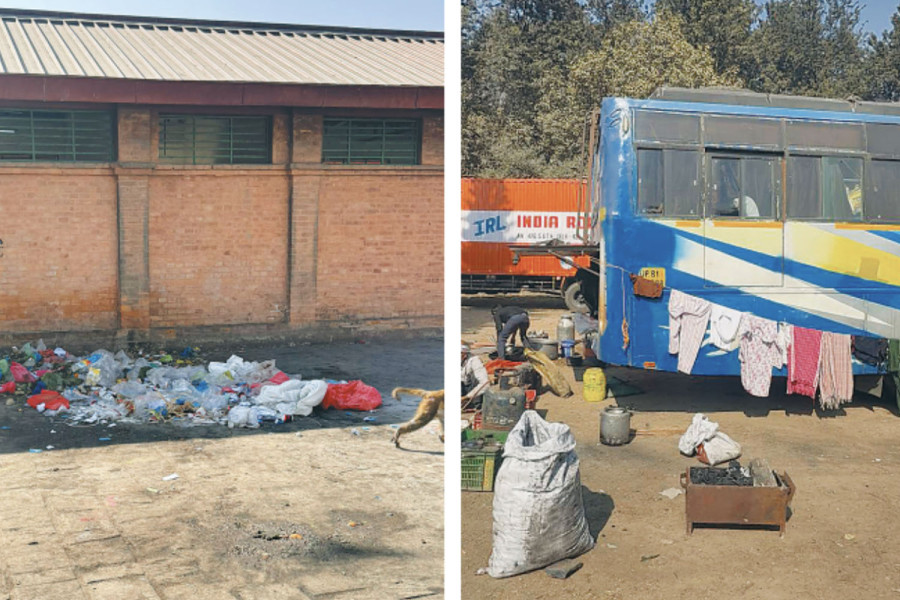
bookmark
Aarya Chand
Published at : January 27, 2026
Updated at : January 27, 2026 08:08
Kathmandu
The parking lot at Bankali in the Pashupati area is a mess. When the Post visited the site a week ago, plastic wrappers, vegetable peels, half-eaten food, and disposable plates and bottles lay strewn across the ground. The food waste drew stray dogs and birds.
The parking lot, located a short distance from the revered Pashupatinath temple complex in Kathmandu, appears more like an “informal campsite” than a regulated facility inside a World Heritage Site, said Prabin Khadka (name changed at request), a regular visitor to the area.
Every day, the Pashupatinath temple teems with thousands of pilgrims arriving from across South Asia. The steady flow of pilgrims puts constant pressure on surrounding infrastructure, particularly in areas designated for parking and transit. For many pilgrims, the parking lot is the entry point to the Pashupatinath temple, recognised as a UNESCO World Heritage Site in 1979. But as things stand, the polluted area is a blight on the majestic temple and points to poor oversight by the Pashupati Area Development Trust (PADT), under whose jurisdiction it falls.
Between 10am and 1pm, when most long-distance tourist buses arrive, the parking area becomes densely occupied. Pilgrims step out from buses after overnight journeys, rest briefly, and begin preparing food beside the vehicles.
The root of the pollution itself appears to be more of a ritual.
‘‘The issue is not that pilgrims cook and eat,’’ Khadka said. Carrying food is a long-standing pilgrimage tradition. ‘‘What is harder to ignore is what remains after the meals are done.’’
He pointed out that pilgrims also fetch water from nearby dharmashalas (charity resthouses) to wash clothes. They scrub them on the spot and leave them to dry on the fences, railings and bus bodies. In corners less visible from the main road, traces of open defecation can be found. Spitting, too, is common.
Speaking to the Post, Kumar Shah, who regularly drives a bus on the Delhi–Kathmandu–Delhi route, offered his take on the cause of the pollution.
‘‘We pay around IRs1,000 to obtain a parking permit here,’’ Shah said. ‘‘So people believe their right to clean up and eat at the site is earned.”
Many pilgrims prefer to prepare their own food rather than eat outside. “Most of them are strictly vegetarian,” he said. “They don’t know how food is prepared or whether utensils are used separately. They also don’t trust restaurants. Cooking with their own hands feels safest for them.”
Limited budgets often lead pilgrim groups to spend extended time in parking areas. However, he said the lack of basic amenities makes proper waste disposal difficult.
“The main problem is waste,” he said. “There are not enough dustbins, and there is no designated place for cooking or cleaning. If the authorities provided such a space, it would be easier for everyone.’’
According to PADT Executive Director Subash Chandra Joshi, the Trust is aware of the situation, particularly during peak pilgrimage season (December–March) and occasions such as Mahashivaratri when large numbers of visitors arrive.
Joshi said the Trust has made attempts to control the pollution.
“We have seen that pilgrims cook and live there,” Joshi said. “We have repeatedly tried to raise awareness and instructed the parking management to make it more organised.”
Joshi said PADT has recently decided to deploy its own staff at the site, increased cleaning shifts, and installed dustbins.
A task force has also been formed to coordinate cleaning staff, monitor waste, and respond to sanitation issues during peak hours. PADT officials said the measures are aimed at managing conditions as they arise rather than enforcing penalties.
When asked whether cooking or washing clothes are prohibited at the site, Joshi said there is no outright ban. “We cannot exactly say it is not allowed,” Joshi said. “Nepali pilgrims also carry their own supplies when they travel for tirtha yatra [pilgrimage]. But since this is a World Heritage Site, we are trying to organise it so it looks appropriate and maintains cleanliness and hygiene.”
For Deendayal Sharma, who oversees Bankali parking under a contract awarded by the PADT, day-to-day management depends largely on circumstances and PADT’s instruction rather than on clearly defined rules.
According to Sharma, there are no strict PADT directives on what is allowed and what is not. “We ask pilgrims to clean up, but compliance is inconsistent and if we push too hard, there is fear of complaints or police trouble.”
Sharma added that the parking management has separately hired two cleaners, arguing that PADT’s cleaning staff rarely work inside the parking area itself. PADT, he said, only sends vehicles to collect garbage once it has been gathered.
Others working nearby echo similar concerns. Yogendra Kunwar, who manages motorcycle parking, said the absence of basic amenities worsened the problem.
“There are no washrooms inside the parking area,” he said. Their requests to build toilets within the parking area have also been declined by the PADT, leaving workers and pilgrims with few options.
Nabina Yogi, who works at a nearby toilet facility, said pilgrims frequently request to bathe despite the toilets not being designed for that purpose. “Some even openly defecate outside,” she said. “We try to tell them to go to the Dharmashala. Some heed, some don’t.”
PADT officials say that facilities are being upgraded. Infrastructure improvements are underway, Joshi said. New toilets and shower rooms are being constructed in architecturally appropriate zones, following heritage and traditional Vastu guidelines, and that temporary facilities are installed during festivals.
Joshi also noted that Bankali parking is designated as “heritage parking” under the Pashupatinath master plan, which restricts blacktopping and concrete construction. While this preserves the area’s archaeological character, it also limits how easily it can be upgraded to handle the realities of mass pilgrimage.
Officials have also said that improving facilities alone may not be sufficient to address the issue. “At the end of the day, it is also about individual awareness,” Joshi said.
Interestingly, PADT has not received a significant number of formal complaints from nearby residents, officials said, adding this may be because the parking area is not directly adjacent to residential homes.
Local reactions are mixed. Shopkeeper Tula Lama said pollution has noticeably increased over the past six to seven months. Meanwhile, Shukra Raj, who cuts firewood nearby, said cooking in a religious area does not bother him as long as the space is cleaned.
Spokesperson for the Ministry of Culture, Tourism and Civil Aviation Jaya Narayan Acharya said no separate ministry-level directive is required to regulate pilgrim activities within the area. The existing PADT Act-1988 already empowers the Trust to regulate activities, set rules, and enforce penalties within the heritage zone, Acharya said.
“What remains in question,’’ he added, ‘‘is how effectively PADT officials translate that authority into enforcement and planning on the ground,” as pressure from rising pilgrim numbers continues to grow.
Aarya Chand
Aarya Chand is a reporter at The Kathmandu Post covering social issues. Before moving to the social beat, Chand was an intern covering culture and lifestyle for the Post.





Editor's Picks

What to know about the US trial over Mamta Kafle’s disappearance
NPL returns with bigger ambitions and global recognition
What’s new in the Nepal Premier League’s third season?

After Nepal’s recent disaster, it wants to test whether COP31 can deliver climate justice

Why does an hour long flight to Dhangadhi cost more than a flight to New Delhi?
E-PAPER | October 26, 2026

×