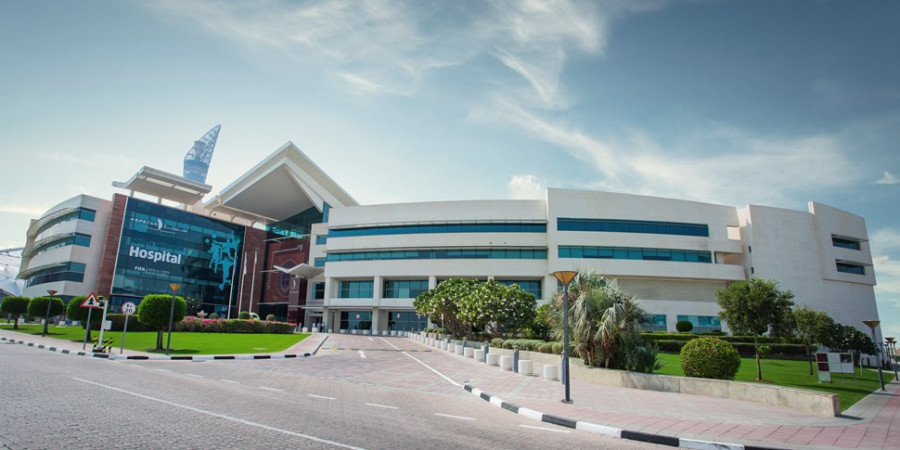
Experts weigh in on the athlete’s decision to seek cure at the Qatar-based hospital while facilities in Nepal had offered free treatment. A view of the Qatar-based Aspetar, a leading specialised orthopaedic and sports medicine hospital in the world, where the likes of Lionel Messi, Neymar and Kylian Mbappe have received treatment. Photo: Aspetar.com
Nepali football fans were left in dismay on Monday afternoon when Sabitra Bhandari ‘Samba’, the country’s most accomplished footballer, posted an unusually long status on Facebook, pleading for financial aid for her treatment.
Samba had ruptured her anterior cruciate ligament (ACL) in her right knee during her club Wellington Phoenix FC’s Ninja A-League fixture against Brisbane Roar on January 3. With the club announcing that Samba would be sidelined for almost a year for treatment, the fans were anticipating news about Samba’s successful surgery.
But instead, they were treated with Samba’s call for help. She had requested $80,000 in support after her insurance from the A-League, and minimal support from the All Nepal Football Association (ANFA) could not cover the cost.
Within 24 hours of her request, she received more than the necessary support from her fans worldwide.
By Tuesday afternoon, more than Rs10 million was deposited into Samba’s Nepali bank account, and around Rs4.5 million (NZ$52,000) was raised through international platforms.
“Institutions that sponsor me, along with many organisations in Nepal, have also pledged financial and logistical support,” Samba wrote on Facebook on Tuesday afternoon, while thanking the helping hands and requesting to stop sending any more support. “This appears to cover not only my medical expenses but also accommodation and transportation costs during my treatment in Qatar.”
Before that, several Nepali hospitals had stepped forward to perform the surgery for free for one of the country’s most beloved athletes.
But there were also skeptics. Concerns were raised over Samba’s decision to seek the expensive treatment in Aspetar, the Qatar-based orthopaedic and sports medicine hospital, amid cheaper options in New Zealand, Australia and Nepal.
The Post takes a look at the reasons Samba decided to choose Aspetar.
What is Aspetar?
“If Nasa has its Mission Control Center in Houston, Texas, the sports medicine world has Aspetar.” So said the BBC in a 2019 article titled ‘Aspetar: The ultra modern, elite sports hospital that imports body parts’.
That single sentence provides a snapshot of how big, and reputed, a medical institution Aspetar is.
Since opening in 2007, Aspetar has treated some of the world’s most accomplished athletes, the likes of Angel di Maria, Neymar, Yaya Toure, Sam Warburton, runner Mo Farah and boxer Amir Khan.
“It is incredible,” Kylian Mbappe, the France and Real Madrid phenom, said while he was receiving treatment at Aspetar as a Paris Saint-Germain player in December 2019. “The infrastructure is really perfect to work and recover, everything is optimised for the athletes at its best.”
According to the BBC, Aspetar has state-of-the-art facilities alongside the best surgeons, physiotherapists and other medical manpower.
“Until coming to Aspetar, I’d never been in a room where you can change the altitude,” Di Maria, who was crucial in Argentina’s 2022 FIFA World Cup winning campaign, was quoted in the BBC article.
Aspetar has also been recognised as the Medical Centre of Excellence by the Asian Football Confederation (AFC) and certified by FIFA.
Samba had undergone her first ACL surgery in 2021 with the support of the Qatar Football Association; she had recovered by 2022 to hit the field.
However, she ruptured the graft on January 3 while playing for Wellington Phoenix and has desired to go through the second surgery at the same hospital.
“In 2021, I underwent surgery for ACL, meniscus and lateral collateral ligament (LCL),” Samba said while defending her choice of selecting Aspetar in a video sent to Kantipur TV on Tuesday. “I ruptured the ACL graft after five years, and I want to go to Aspetar again. I do not want to take any risk, return to the field and play for the country in red and blue as soon as possible.”
Samba’s choice
When Samba received her MRI report after the injury at Wellington Phoenix, the club suggested getting the date for the surgery and told her they would do everything there by consulting with the best doctors and physios, Samba says in the video. “But since this is my second ACL surgery, I said I don’t want to take a risk,” she says. “So I said that I would move forward by consulting with the federation [ANFA] and do it in Aspetar.”
In an email response to the Post, Wellington Phoenix said that the club supported Samba’s decision to receive treatment in Aspetar.
Samba has informed that the club did its best to reimburse the insurance amount for receiving treatment outside Australia and New Zealand.
“The insurance from the A-League would have covered the treatment if I had been in Australia and New Zealand. But if I decided to go outside, some rules and regulations prohibited it,” she said. “But the club did its best, and some money has been reimbursed. However, it was insufficient for overseas treatment, which led me to seek funds with fans.”
Samba also believes that she will get the best treatment in Aspetar that will allow her to return to the field soon.
“Normally, it would take 12 to 13 months for my treatment in other hospitals,” Samba said. “But in Aspetar, it would take eight to nine months, or let’s say a maximum of 10 months, for me to return to the football field. Short time, best treatment.”
What do Nepali experts say?
From private medical institutions, like the Kathmandu Medical College, to the state-run National Trauma Centre, Nepali hospitals said they would provide the surgery for free to Samba.
With it, some fans started commenting that it was wrong for Samba to choose expensive health care. But experts say Samba made the best choice.
“There are two types of ACL surgery, with the second one to undergo if the first ACL graft gets ruptured. Samba has to do the second,” Dr Dipendra Pandey, consultant orthopaedic surgeon at the National Trauma Centre, told the Post.
While Dr Pandey stressed that Nepali hospitals and surgeons were more than capable of performing the surgery well, Samba would not get the post-surgery care in Nepal.
“Samba wants to play football again after the surgery. And it will not be possible without proper rehabilitation during her post-surgery period, which is not available in Nepal,” said Dr Pandey, who is also a member of the Nepal Medical Council. “It is always the right of the patient to choose where they want treatment.”
Dr Pandey also argued that it was essential to undergo surgery as soon as possible after the injury. “Waiting and wandering for long is not good for the injury,” he said.
Rehabilitation is a key component of the recovery process after an ACLR, says a research article titled ‘Criteria-based rehabilitation and return to sport testing after anterior cruciate ligament reconstruction’, published at Aspetar Sports Medicine Journal.
“Around 80% of ACL-reconstructed patients return to some kind of sporting activities, but only 65% return to their pre-injury level and 55% to competitive level sports,” the article states. “Aside from graft failure, short-term (e.g., muscle injuries) and long-term (e.g. knee-related quality of life, meniscal or chondral injuries and osteoarthritis) comorbidities of ACLR may also be negatively associated with an individual’s rehabilitation.”
NADA Performance and Rehabilitation Centre in Bansbari, Kathmandu, is the major go-to place for rehabilitation among Nepal’s top athletes. And while NADA’s founder Bibek Bikrant Adhikari claimed that his centre had quality manpower and resources, he said that Samba’s choice for Aspetar should be respected.
“Rehabilitation can be classified in phases, as when a student goes from nursery to graduation,” Adhikari, an athletic therapist, told the Post. “Neither we nor any other centres in Nepal have facilities up to graduation, which Samba can get in Aspetar.”
Both Pandey and Adhikari stressed that Nepal needed a specialised sports medicine centre if the country wanted its best athletes to receive the best treatment at home.
Specialised sports hospital in Nepal?
It is not that steps have not been taken to establish a specialised sports hospital in the country.
Around three months ago, the National Sports Council and the Ministry of Youth and Sports formed a three-member committee to study the prospects and necessities of a sports hospital in the country.
With Dr Abhishekh Singh as the coordinator, the committee comprised Dr Ghanashyam Pandey and Mingma Sherpa. They were given a 90-day period to submit a report.
“We handed the report to Prime Minister Sushila Karki within 46 working days on February 10,” Dr Singh told the Post. “Currently, the NSC has a 15-bed hospital on the Dasharath Stadium premises for primary-level cases, with a lack of resources. And we have recommended that the country needs a bigger and well-equipped sports hospital.”
The Dr Singh-led committee has listed several recommendations in the report—from keeping sports-related dedicated surgeons and physiotherapists, using them during national and international tournaments across all sports, to constructing a dedicated rehabilitation centre and anti-doping lab.
Dr Singh said that during the study, they also found that previous medical reports of injured players were not kept safely. “There is more to be done,” he said. “Samba’s case has highlighted this gap in Nepali sports once again.”
Nayak Paudel covers sports for The Kathmandu Post. He previously worked at the Post (2018–19) and spent over five years at The Rising Nepal. His reporting spans crime, health, education, and social issues.




 21.12°C Kathmandu