Nepal’s 42-year presence in South Asian football under threat as dispute deepens
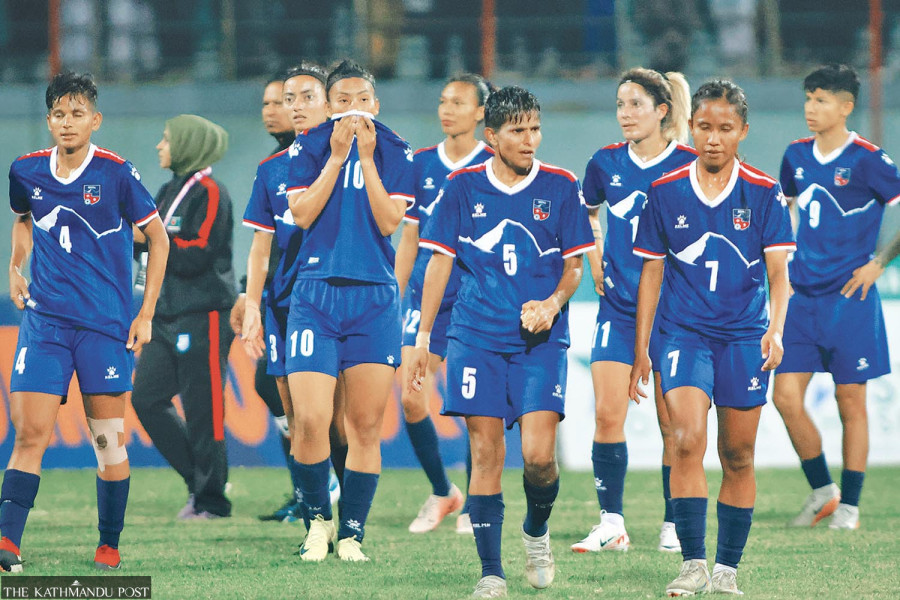
Nepal women’s team, a six-time runner-up, could miss the SAFF Championship for the first time amid the ANFA-NSC dispute, putting the country’s four-decade-long uninterrupted South Asian football legacy under threat.Nepal women take a lap of honour to thank the fans for their support after losing to Bangladesh in the final of the SAFF Women’s Championship at Dasharath Stadium in Tripureshwar, Kathmandu, in October 2024. Post file photo
Nepal could miss a South Asian football tournament for the first time in over four decades—that too by the country’s most-loved football team: Nepal women’s senior team.
With the National Sports Council (NSC) and the All Nepal Football Association (ANFA) glued at opposite ends, Nepal women’s team, a six-time runner-up in the past seven editions, are uncertain if they can attempt for their maiden international title once again—at the 8th SAFF Championship in Goa, India, from May 25.
This eerie silence stands in stark contrast to a 42-year-old legacy of noise and triumph.
Alongside the senior men’s and women’s tournaments, SAFF organises underage tournaments in both categories as well. Nepal have participated in all of them—the U15, U16, U17, U18, U19 and U20 tournaments since the inaugural SAFF U16 Championship in 2011.
Nepal even hosted the first SAFF Club Championship in the women’s category last year while participating in the inaugural SAFF Futsal Championship in both categories in Thailand in January this year.
However, for the first time since the South Asian regional football tournament began, a Nepali national team is on the verge of being a ‘ghost’ in the fixtures.
While the men’s team has its own long history, it is the women’s team that has truly defined Nepal’s presence in the SAFF era. Nepal aren’t just a participant, they are the tournament’s most consistent powerhouse.
To understand the gravity of this potential absence, one must look back at the bedrock of South Asian football. For over forty years, the red and blue jersey hasn’t just been a participant in the South Asian tournament. It has left a legacy.
The Post looks at Nepal’s journey in the premier South Asian football tournaments.
Beginning with men’s football
Nepal’s men’s national football team played their first international match against China in Beijing in October 1972. It was in 1984, during the first South Asian Games (SAG), that the men’s team of Nepal and other South Asian nations participated in the regional football tournament for the first time.
Hosted at Dasharath Stadium, the inaugural edition saw Nepal clinch the gold medal in football, defeating Bangladesh 4-2 in the final on September 23, 1984.
Nepal won their second gold in SAG football in the sixth edition in Dhaka, Bangladesh, in 1993, defeating India in penalties. When SAG returned to Kathmandu in the eighth edition in 1999, Bangladesh defeated Nepal 1-0, and the hosts had to settle for silver.
In the ninth edition of SAG, in Pakistan in 2004, men’s football saw participation from U23 teams. Nepal U23 won gold in SAG football in the 12th and 13th editions in India and Nepal in 2016 and 2019, respectively.
The decision to field U23 teams in SAG football was a result of another primary South Asian football tournament underway since 1993.
The inaugural edition was organised in 1993 by the South Asian Association for Regional Cooperation (SAARC) as the SAARC Gold Cup. Four nations—Nepal, India, hosts Pakistan and Sri Lanka—took part in the contest that India won.
The tournament was rebranded as SAFF Gold Cup from the third edition in 1997, the year when the South Asian Football Federation (SAFF) was established, when it was hosted by Nepal.
The first time that the SAFF tournament saw the then eight SAARC countries, including Afghanistan, participate was in the fifth edition in Bangladesh in 2003.
The last time the eight teams participated was in the tenth edition of the SAFF Men’s Championship hosted by Nepal in 2013. The SAFF Gold Cup was renamed to the SAFF Championship from the seventh edition in 2008.
Though four titles in SAG football, Nepal have yet to lift the SAFF Men’s Championship. Their best performance in SAFF was in the Maldives in 2021 when they entered the final for the first time and finished as the runner-up under the Qatari coach Abdullah Al Mutairi.
The last time Nepal’s men’s team participated in the SAFF Championship was in India in 2023. Eight teams participated then, including invitees Kuwait and Lebanon. Nepal were knocked out of the group stage.
The premier men’s football tournament of South Asia is returning in 2026 in Bangladesh. It is expected to begin after the conclusion of the FIFA World Cup in the US, Canada and Mexico, most probably in September.
“The upcoming SAFF Men’s Championship would most likely be played with the video assistant referee (VAR) system for the first time in South Asia,” SAFF General Secretary Purushottam Kattel told the Post. “We are coordinating with FIFA and AFC for it to happen.”
Kattel said that stadiums in Bangladesh will not be equipped fully with the VAR system. “We can install a necessary number of cameras in the required location, and the feed can be utilised by the remote VAR system in Thailand,” he added. “We are looking forward to making it happen.”
Meanwhile, if ANFA is suspended or banned by FIFA any time soon, the men’s team will also lose a major opportunity for their maiden SAFF title. The title is also the main responsibility of Guglielmo Arena, who was appointed as Nepal’s head coach in March.
However, Arena has not returned to Nepal after he travelled to Laos for the AFC Asian Cup Qualification-Third Round fixture on March 31. Arena told the Post last month that he would soon be in Kathmandu. He was at a football forum in Budapest, Hungary, in mid April.
The team that won the inaugural gold in SAG football in 1984 is said to be the golden generation of Nepali men’s football. Now, 42 years later, the men’s team are a shell of their former self. Of late, it is the women’s team where Nepalis have showered most of their love.
Women’s football’s coup in Nepal
The first time women’s football was included in SAG was in the 11th edition in the early months (January-February) of 2010. Nepal lost to India in the final in 2010, 2016 and 2019.
While only five countries—India, Nepal, Bangladesh, Pakistan and Sri Lanka—participated in the inaugural women’s football in SAG, all eight SAARC countries were there in the inaugural SAFF Women’s Championship, which also debuted in 2010, but in the last month.
And Nepal lost to India in the final of the first SAFF Women’s Championship as well.
India as winners and Nepal as runners-up continued for the next two editions of SAFF in Sri Lanka and Pakistan in 2012 and 2014, respectively.
But the fourth edition in 2016 was different for Nepal. They defeated India, who then ranked 54th in the world, in the semi-finals and announced that Nepali women’s football had now entered a new era. Nepal women then ranked 105th in the world.
However, the first win over India in the regional tournament did not guarantee Nepal women’s first international title. They lost to Bangladesh in the final this time.
Still, the 4th SAFF Women’s Championship was the beginning of a new Nepali women's football. It is because it was the same event where Sabitra Bhandari ‘Samba’ scored 12 goals in a single edition, including a double hat-trick against Bhutan and a five-goal haul against the Maldives.
Samba had also made her debut through the SAFF Women’s Championship. She was 17 when she scored a goal in her international debut—during the 8-0 win over Bhutan in the 3rd edition in 2014.
With Samba, Nepal women’s football started rising to prominence. After 12 years, Samba is one of the most accomplished footballers in Nepal. She is currently the leading women’s goalscorer across South Asia and the first Nepal-based player to play in European club football.
Alongside Samba, players like Preeti Rai, Renuka Nagarkote, Rekha Poudel and Puja Rana, among others, have played a huge role in attracting more and more fans to women’s football over the years.
But the squad, filled with a golden generation of women footballers, could not lift the SAFF title. They also settled as runner-up, losing to India in 2019 and Bangladesh in 2022 and 2024; these three editions were regularly hosted by Nepal.
Though Nepal’s women’s team has failed to win an international title despite entering the final over a dozen times, they are the ones who have the biggest support in the country.
Of late, women’s football tournaments attract way larger crowds than men’s tournaments across the country.
“The love for women’s football in Nepal is unparalleled in South Asia,” Kattel told journalists when he was in Kathmandu for the inaugural SAFF Women’s Club Championship in December last year. “It is why the tournament has been initiated from here.”
In another instance last month, Kattel said that Nepal are the biggest crowd-magnet in South Asian football. “Nepal are also one of the best destinations for SAFF to organise tournaments,” he added.
Nepal are also the one to have played the most number of matches in the SAFF Women’s Championship—32 matches in seven editions—followed by India (30 matches in seven editions) and Bangladesh (27 matches in seven editions).
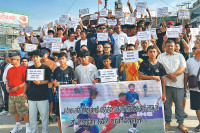
And it is specifically why fans are criticising the tussle between ANFA and NSC. Fans want to cheer for them—even when the goalmachine and fan-favourite Samba has been sidelined with injury—when they play for the title in Goa within a few weeks.
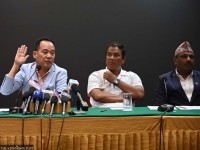
However, the expectations of players and fans could end in a few days when the ANFA-NSC dispute reaches its peak, with FIFA intervening with an international suspension on Nepali football.
Nayak Paudel covers sports for The Kathmandu Post. He previously worked at the Post (2018–19) and spent over five years at The Rising Nepal. His reporting spans crime, health, education, and social issues.




 18.18°C Kathmandu