



 17.81°C Kathmandu

Thu, Oct 22, 2026
Fiction Park
A marriage gone cold in the Swedish winter
The Himalayas pulled Sarita one way, the Baltic Sea the other, leaving her torn in between.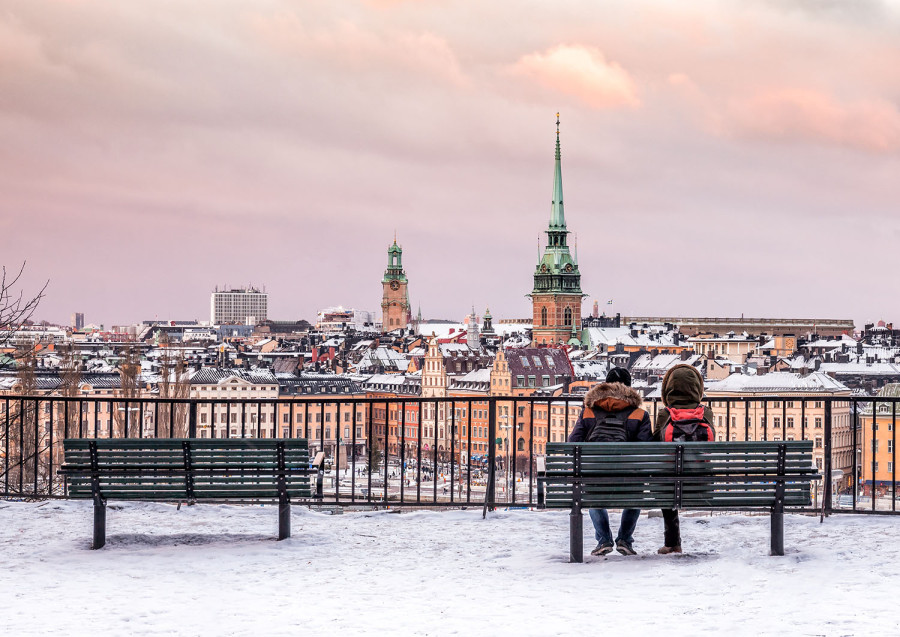
bookmark
Santosh Kalwar
Published at : January 4, 2026
Updated at : January 4, 2026 07:29
The grey Swedish twilight filtered through the triple-paned windows of their Solna apartment, casting a sterile blue light over the IKEA furniture Sarita had lugged up three flights of stairs herself. Outside, the Stockholm winter tightened its grip. Inside, a quieter frost had settled between them.
Bishal was in the kitchen, and there was the perfume of overcooked lentils clinging to his sweater. He looked at Sarita. She was at the dining table, watching a corner of the wall where a framed photo of their wedding in Bhaktapur hung. Three weeks earlier, she had removed it, saying their smiling faces were “too loud”.
“Sarita, the food is cold,” Bishal said. Sarita didn’t think twice. She traced the grain of wood. “I don't want to eat,” she whispered. The familiar itch of annoyance prickled under his skin. “You know it hurts me when you do that.” Her dark hair, matted from days spent against a pillow, clung to her neck. “It’s dark here, Bishal. Can’t you see?”
“Quit it,” he snapped, his wooden spoon falling into the sink. “I am tired. I've been cleaning the hospital floors for ten hours, so we’ll live in this frozen country. Please tell me so I understand.”
Before she could answer, the door to the children’s rooms opened. Lukas, eight and Maya, six, erupted, their cheeks flushed from playing. They were yelling in quick Swedish—a sing-song to everyone around them and an obstacle to Bishal. “Mom, look! Lukas took my charger!” Maya cried, tablet in one hand. Sarita’s face changed.
The room was empty, and there was a sharp, jagged-edged strength to her voice. “Leave her alone, Lukas! Go to your room now!” she screamed. The children froze. Bishal gazed from his wife to his children, seeming like a ghost in his own home.
“What happened? Lukas, what did you do?” Lukas looked at his father, looking somewhere between pity and annoyance. “Nothing, Dad. It's just Mom. She’s angry again.”
“Don't talk about your mother like that,” Bishal said.
“She’s not just angry, Bishal,” Sarita cut in, her voice trembling. “She’s disappearing. Can't you see the walls are moving? The Swedish winter is eating this house.”
“You are feeling sad because of the weather,” said Bishal, eager to further simplify what the monster is doing. “The doctor gave you the pills, you know. Did you take them today?” Sarita stood up, her chair clanging against the ground.
“The pills make the world taste like metal. I want to feel the sun in Nagarkot. I want to hear the danphe’s call. Here, there’s only silence—and your breathing. It sounds like judgment.”
“I am not judging you! I am holding us together!” Bishal shouted. Widening their eyes, the children withdrew to their room.
“Mom, are you sick?” Maya inquired softly, reaching for her mother’s hand. Sarita withdrew as if the child’s touch were a hot coal to be burned.
“Don’t touch me! I can’t... I don’t. I can’t do this!”
She stood and began pacing the narrow hallway, breath coming in short gasps. Bishal caught up and gripped her shoulders—but she shoved him back with startling strength.
“Talk to me!” he begged, the walls falling on him in his mind. “What the hell is wrong with you since we fell in love fifteen years ago?”
“Because that woman died at Arlanda airport years ago. This woman—it is your shell—speaks the tongue of the ice. I’m not your woman anymore,” Sarita said.
“What is she saying?” His voice cracked with her command. Bishal looked at Lukas. Lukas stared down at the floor, fists balled up in little hands. “She told me she no longer belongs to you.”
The silence that followed was thicker than any fall of snow around his balcony. There was a deep sense of failure as he had, and as he articulated, brought them here for a better life, for the Swedish dream of equality and education, to live happily ever after. In doing so, he became an immigrant in his own living room. A provider who could not offer comfort, a father who could not broker a solution, and a husband married to a stranger.
“I'll serve you a cup of chiya (tea),” Bishal said, and the coldness of his voice said it out loud. That was the only ritual remaining for him. “Do not bother,” Sarita said, her voice sinking deeply into his flat, fearful voice.
She rose to face the glass and rubbed her forehead over it. “The ice is inside now. Even the tea will freeze.”
“Mom, go read a picture to us,” Maya said from the doorway, holding a picture book in Swedish. Sarita didn’t turn around. “Read it yourself. You are Swedes now. You don’t need me.”
There, Bishal sat down at the table with four plates of dal bhat he had served. The steam had stopped rising. He thought of his mother in Chitwan, who lit incense and spoke with a priest to ward off the ‘evil eye’. He was reminded of Solna’s psychiatric clinic, where the receptionist looked kindly at him, unaware, when he attempted to describe Sarita’s ‘ghosts’.
It wasn’t just that he was fighting Sarita; it was a war of geographies. The Himalayas drew her one way, the Baltic Sea the other, and she was splintered into pieces halfway.
“We could just return,” Bishal said in an uncertain tone. “We could go back to Kathmandu if we set aside that money for six months. Just for a visit.” Sarita turned. Still, there was never any slight hope in her look—and only absolute clarity.
“And then what, Bishal? We come back here? Or stay, and you discover there and then that I'm crushed here too? And did you discover I’m broken? And it’s not geography that’s the problem. The sky is the same anywhere else. All that’s left is that here, the sky is honest about how little it cares.”
She walked to the bedroom and closed the door. The clanking of the lock sounded like a gunshot. Lukas went to the table and sat in his mother’s chair. He picked up a spoon and started to eat the cold lentils.
“Dad,” Lukas said, looking at his father, eyes much too old for an 8-year-old. “Yes, son?”
“So, are we staying here forever?” Bishal gazed at the door of the sealed bedroom, closed behind him, then at his daughter, lying by a bookcase with tearful eyes, and then at his son, who looked up into his eyes. He wanted a prayer, a vow, a plan.
“Eat,” Bishal said gently, his hand stretching to pat Lukas’s hair.
From the other room, the stuttering wail of Sarita’s sad, rhythmic weeping began to drop down, in blissful rhythm with Sarita’s wail—a mournful tune so ethereal; it fell along with a whistle blowing outside.
Then darkness descended on him, the darkness. Bishal sat through most of it, in the centre of a language he couldn't speak and a sorrow he couldn’t cure, awaiting a morning that stretched forever and a morning his body would never awaken.
Outside, the snow fell, pale and indifferent, erasing every trace of departure—or return. Soon the fireworks would split the sky to mark the New Year—another calendar turning in a world that moved on. At the same time, they stayed frozen, together and alone, in the hush before midnight.
Santosh Kalwar
Kalwar is a writer from Chitwan.



Editor's Picks





E-PAPER | October 22, 2026

×