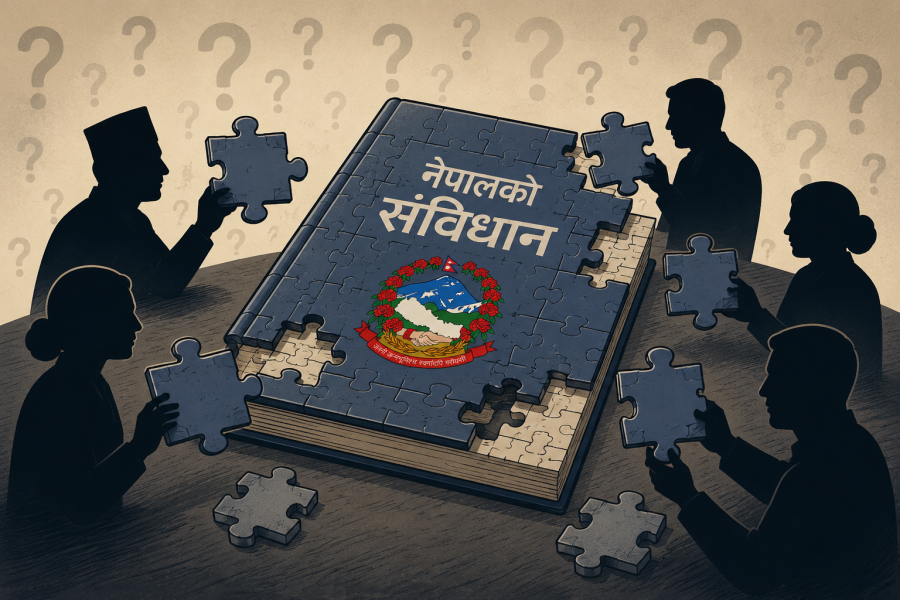
Political parties big and small have of late been calling for an amendment of the national charter. The incumbent government even formed a panel to prepare a discussion paper on the matter. Chaired by Asim Shah, political advisor to Prime Minister Balendra Shah, the panel initially brought together representatives from most parties represented in the federal parliament. Yet the Nepali Congress, the second biggest party in parliament, withdrew from the process and constituted a team led by senior advocate and former National Assembly member Radheshyam Adhikari to prepare its own agenda for constitutional amendment. So did the CPN-UML, the third biggest party. The other four political forces—the Nepali Communist Party, the Loktantrik Samajbadi Party, the Janata Samajbadi Party and the Rastriya Janamorcha—remained part of the process and contributed to the preparation of the discussion paper.
However, as the panel began preparing its report, these parties also announced their dissociation from the process. They accused Shah’s panel of seeking to rewrite the constitution rather than just amending it. The dissenting parties questioned the panel’s jurisdiction and objected to its decision to bring the constitution’s preamble and its fundamental structure into the amendment debate. They also argued that the present government and the ruling parties have no mandate to overhaul the constitution. Instead, they have urged the government to convene a meeting of parliamentary forces to build national consensus by clearly identifying the specific provisions that needed to be amended as well as the reasons for the proposed amendments.
As demanded by the four parties, the constitutional amendment process would have enjoyed greater ownership had the initiative for it been taken from inside the parliament. However, raising such a demand after participating in the panel’s deliberations for nearly three months does not seem justified. The parties are suspicious of the government’s commitment to core features of federalism and inclusion as it engages in the amendment process. But walking away from the report-writing process is not the solution. On the contrary, their continued participation is even more important to ensure that the panel does not propose changes that could undercut the hard-won achievements made though years of deliberations in the Constituent Assembly.
The Rastriya Swatantra Party’s political and economic dossiers adopted at its recent general convention suggest that it wants to scrap the provincial assemblies and make the National Assembly and local governments apolitical has alarmed parties that have long championed federalism. The Shah government and the RSP should understand that the decade-long Maoist insurgency, the 2006 People's Movement and the subsequent Madhesh uprising laid the foundation for the Constitution of Nepal, promulgated in 2015. The constitution is ultimately a document of compromise that emerged from seven years of deliberations.
Even though Article 274 allows for amendments of all constitutional provisions except those relating to Nepal’s sovereignty, territorial integrity, independence and the sovereignty vested in the people, tampering with the charter’s fundamentals like federalism, republicanism and inclusion is certain to provoke those who fought for and contributed to these historic changes. While the report by the Shah-led panel is only the starting point for deliberations on constitutional amendment, it would be prudent to address such concerns and dispel suspicions at the outset.
It is therefore the responsibility of the government and the ruling parties to bring all key stakeholders on board before proceeding with something as sensitive as a constitutional amendment. The opposition parties, for their part, should also not dissociate themselves from the process altogether. Their responsibility is to stay engaged, defend the constitution’s fundamental principles and ensure that any amendments strengthen rather than weaken Nepal’s hard-won democratic and constitutional gains.




 15.26°C Kathmandu