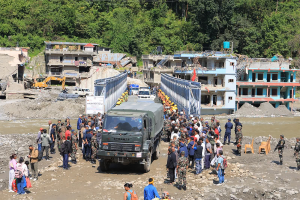
This past week has not been easy for riverside squatters in the Kathmandu Valley. What was framed as a drive to remove encroachment of public land, restore the rivers’ purity and protect ‘genuine’ squatters from seasonal flooding—though logical—raised significant concerns about the basic human rights of the landless people. As the Balendra Shah-led government bypassed the due process of resettlement and rehabilitation, thousands of families became homeless overnight. In a matter of hours, the sick and elderly people had no roof to shelter under; children lost their books in the rubble and mourned the loss of their long-time friends and the schools; pregnant women were hit hard; and countless animals that relied on these settlements were abandoned. Two people reportedly died by suicide as they felt hopeless seeing their houses being demolished.
Following mass evictions, displaced squatters were given temporary accommodation. Some families have also been asked to stay with relatives or in alternative accommodation. According to the Ministry of Urban Development, 635 individuals who registered as homeless after the demolitions were placed in various facilities, including holding centres and hotels. Now, the displaced are left wondering when they will be permanently resettled, or if that will happen at all. The government has provided them with food, health services and psychological counselling, but such measures are unsustainable. Hoteliers catering to displaced families claim they have not been informed about payment arrangements, which could even lead to hatred and hostility towards the displaced families. Amid these challenges, concerns remain about how long the government can keep thousands of people in temporary settlements and what its long-term plans are.
Temporary shelter is not a solution for landless squatters; rather, it intensifies the trauma they have long endured. For instance, as reported in this paper, of the 143 families living in the Thapathali squatter settlement, six had been residing there since 1978, two since 2003, and 135 since 2006. These families, already familiar with displacement, are now forced to undergo renewed trauma. Worse, as children have not been able to go to school, their future remains uncertain, leaving parents even more worried.
Nepal has long grappled with landlessness. Despite constitutional rights to housing and social protection, over 1.2 million people don’t have land or housing in the country. To address this problem, more than a dozen committees have been formed over the years. Successive governments have pledged to resolve it, yet have often fallen short. This raises an important question: If these people had viable options, why would they choose to stay along riverbanks, where raging rivers sweep their makeshift homes every monsoon?
The entire eviction plan ought to have followed due process, which it did not. Had resettlement preceded eviction, the process wouldn’t have been so disorganised and inhumane. But the government still has the opportunity to correct its course. Taking a cue from experts, it can mobilise resources for planned settlement with urgency or provide a clearly defined and transparent rental support system. On the other hand, if authorities continue with a haphazard approach, displaced squatters will be trapped in a cycle of uncertainty.
In times of crisis, assurances through government channels can significantly reduce uncertainty. The prime minister has once again made this clear on Facebook: “Steps taken to remove squatter settlements are not aimed at evicting citizens, but to find a permanent solution to the problem by ensuring their right to housing”. He should be held accountable to his words.




 14.69°C Kathmandu