More than 1.2 million landless remain without secure land or shelter in Nepal
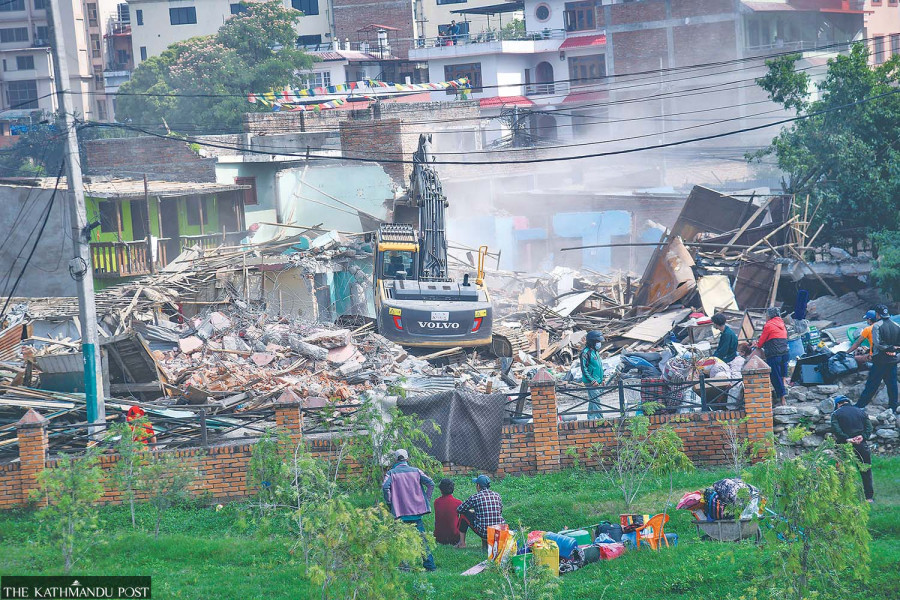
Thousands displaced as authorities clear settlements despite constitutional guarantees.Demolition of a squatter settlement in Bansighat, Teku, Kathmandu, Friday. Landless families in Nepal have settled wherever space is available. Deepak KC/TKP
They have spent years waiting for land to live on and cultivate. Instead, they are facing hardship as squatters. A nationwide campaign to clear public land has further deepened their struggles. Homes have been demolished, property destroyed, and families displaced into makeshift shelters. Women, children and the sick have been hit hardest, and the approaching monsoon is set to worsen already dire conditions.
Despite constitutional guarantees designed to ensure housing and social protection, more than 1.2 million landless people remain without secure land or shelter. Successive governments have acknowledged the scale of the problem. Since 1990, nearly one and a half dozen commissions and committees have been formed to address landlessness. Yet the issue persists amid frequent government changes, weak implementation of related laws and competing interests over land use.
In the absence of formal solutions, landless families have settled wherever space is available. They live on public and government land, in forest areas, along riverbanks, on barren plots and unstable slopes. These locations often lack basic infrastructure such as clean water, sanitation and electricity. Many are also prone to natural hazards, particularly flooding during the monsoon.
The Landless Issue Resolution Commission, tasked with identifying and addressing the needs of landless populations and informal settlers, has received an overwhelming number of applications. The volume reflects both the scale of the crisis and expectations among affected communities that the state will eventually deliver on its promises.
Commission chair Hari Prasad Rijal said more than 1.2 million applications have been registered. These include 98,851 applications from landless Dalits, 181,378 from landless squatters, and 9,335,583 from informal settlers seeking legal recognition and land ownership. The figures highlight the complexity of the issue, with overlapping categories and varying degrees of vulnerability.
Under agreements with local governments across the country, municipalities have been responsible for collecting and verifying data on landless individuals and informal settlers. This decentralised approach is intended to improve accuracy and ensure that local realities are reflected in the data. Applications have been gathered through ward offices and municipal authorities.
Most of Nepal’s 753 local governments have submitted data to the commission. However, Lalitpur Metropolitan City and Bhaktapur Municipality have yet to do so, raising concerns about gaps in the national database. Among provinces, Lumbini has recorded the highest number of applications at 318,985. Koshi follows with 252,000 applicants, Sudurpaschim with 231,000, Bagmati with 135,000, Madhesh with 124,000, Gandaki with 92,800 and Karnali with 58,000.
Land rights activist Biswas Nepali said the actual number of landless people is likely higher than official estimates. According to him, more than 1.5 million individuals are without land, and the broader housing crisis affects around 1.5 million families. He said this could translate to between 5 and 6 million people experiencing some form of housing insecurity, although data collection is still ongoing and figures continue to be revised.
The legal framework governing landlessness is outlined in the Lands Act, 1964, which was amended for the eighth time in 2019. The law defines a landless squatter as an individual who does not own land anywhere in Nepal, either personally or through family, and who cannot acquire land through income, resources or effort. The definition extends to dependants, including spouses, parents and children, effectively recognising entire households as landless units.
Those identified as Dalits by the National Dalit Commission are categorised separately as landless Dalits, reflecting their historical marginalisation and additional vulnerabilities. Nationwide, the number of people without any land, including landless Dalits, stands at 280,229.
The law also distinguishes informal settlers from landless squatters. Informal settlers are defined as those who have occupied public, fallow or forest-designated land for an extended period, building homes and making productive use of the land. While they may not have legal ownership, their long-term presence and investment in the land are recognised.
Section 52(C) of the Act provides a potential pathway to regularisation. It allows the government, as a one-time measure, to allocate land to informal settlers who have occupied and used it continuously for at least 10 years, subject to specified limits. This provision, introduced through an amendment on February 11, 2020, prompted a surge in applications, as many saw it as an opportunity to secure tenure.
However, activists argue that there remains a gap between legal provisions and actual practice. Nepali said the state’s recent actions contradict its own laws. “The government is effectively rendering people homeless despite legal provisions that entitle them to land and housing,” he said.
Nepal’s Constitution contains several clauses that directly address the rights of landless and marginalised communities. Article 37 guarantees every citizen the right to housing. Article 40(5) obliges the state to provide land to landless Dalits in accordance with the law. Article 42 enshrines the right to social justice, while Article 51(J)(6) calls for the identification and rehabilitation of historically marginalised groups, including Mukta Kamaiyas, Kamalari, Haliya, Harawa-Charawa, landless people and squatters, through housing and livelihood support.
Yet the current eviction drive appears to run counter to these commitments. Since last Saturday, authorities have moved to clear what they describe as “squatter and unmanaged settlements”, targeting structures on public land and riverbanks. The operation has resulted in thousands of people losing their homes within days.
Land rights activist Jagat Deuja described the approach as counterproductive and legally questionable. He said authorities should have first identified genuine squatters and provided viable alternatives before proceeding with demolitions. “Homes of both landless squatters and informal settlers have been destroyed in Kathmandu,” he said. “This has caused clear injustice.”
Deuja, who served as an expert member of the Land Issue Resolution Commission in 2020, pointed to structural problems that have hindered progress. Frequent changes in government have led to repeated dissolutions and reconstitutions of commissions. Policy continuity has suffered, and necessary laws and regulations have often not been finalised.
He acknowledged that recent efforts of the commission to systematise data collection represent a step forward. “Without reliable data, land ownership certificates cannot be distributed,” he said. “Data collection itself is a major and necessary task.”
Historical efforts have produced limited results. Before the promulgation of the Constitution, earlier commissions distributed land ownership certificates to around 142,000 squatters. In more recent years, 9,012 families have received land titles. While significant for those beneficiaries, these numbers fall far short of the scale of need.
Nepali said political commitments to resolve landlessness have rarely translated into action. He criticised the practice of appointing political cadres to commissions instead of area experts, arguing that this undermines institutional effectiveness. Political instability, he said, remains a central obstacle.
He stressed that evictions without alternatives violate both legal and moral obligations. “Landless people and informal settlers are citizens with constitutional rights,” he said. “Removing them from their homes without providing options is unjust. Women and children are especially affected, and many families have lost their livelihoods along with their homes.”
Recent demolitions have taken place in several parts of the Kathmandu valley, including Thapathali, Sinamangal, Jadibuti and the Manohara corridors, affecting communities in both Kathmandu and Bhaktapur. The prospect of further evictions has heightened anxiety among residents who fear they could be next.
Land and women’s rights activist Bhagawati Adhikari described the situation as a serious human rights concern. She said conditions in temporary shelters are extremely poor, particularly for women and children. According to her estimates, the demolition of 1,900 households in Kathmandu has affected more than 10,000 people from around 3,500 families. She added that there are approximately 6,000 squatter households in the Capital alone.
Adhikari warned that if the current approach continues, the impact could extend far beyond the Capital. She said as many as 5 million people nationwide could be affected directly or indirectly by policies that fail to address housing needs. She called on the government to halt demolitions and align its actions with constitutional provisions and existing laws.
Despite earlier assurances that evictions would proceed only after proper identification and management of squatters, demolition equipment was again deployed in Kalimati and Balkhu in Kathmandu on Friday. The move has raised questions about policy consistency and coordination among agencies.
The government has defended its actions by citing safety concerns. Officials said settlements located in high-risk riverbank areas, particularly those vulnerable to monsoon flooding, have been cleared to prevent potential disasters. In other areas, they said evictions will be paused until identification and management plans are completed.
Authorities have also stated that priority will be given to identifying “genuine squatters” and ensuring their proper management, while safeguarding public and government land from encroachment.
In an effort to formalise the approach, the Ministry of Federal Affairs and General Administration has issued a circular to all 753 local governments, instructing them to complete the identification and management of squatters before undertaking clearance operations.
The ministry said the decision was made at the secretary level on April 30, 2026, in line with point 92 of the Cabinet’s 100-point action plan. Under the directive, local governments must coordinate with district administration offices to verify the status of individuals occupying public land and to distinguish genuine squatters from other encroachers. They are also required to prepare concrete relocation plans for those identified as eligible.
Citing Section 97 of the Local Government Operation Act, 2017, the ministry emphasised that the protection of public property falls primarily within the jurisdiction of municipalities and rural municipalities. Where evictions present security challenges, local authorities may seek support from district administration offices.
Local leaders, however, have expressed reservations about the federal government’s approach. Naru Lal Chaudhary, mayor of Ghorahi Sub-Metropolitan City and general secretary of the Municipal Association of Nepal, said the current strategy is flawed and lacks coherence.
He said local governments are already mandated to protect public and government land, including unregistered and barren areas, and are actively working to identify landless populations and develop housing solutions. “Local governments will fulfil their responsibilities,” he said. “Data collection and management efforts are ongoing across municipalities.”
Chaudhary argued that demolishing settlements without first ensuring relocation and support undermines these efforts. “Clearing settlements and then directing the management is not a solution,” he said.
For the families affected, the policy debate offers little in immediate relief. Many now face the monsoon season without secure shelter, uncertain about where they will go or how they will rebuild.




 15.33°C Kathmandu