Nepal is currently navigating a complex political landscape. The March 5 snap polls gave the country a new federal government dominated by the Rastriya Swatantra Party, which has a near two-thirds majority in the federal lower house. However, the provinces remain under the leaders of old parties, mainly the Nepali Congress, the CPN-UML, and the Nepali Communist Party (formerly the Maoist Centre and CPN (Unified Socialist), against whose incompetence Gen Z-ers protested last September. The federal government promises sweeping governance reform, and the public eye is on provincial governments, wondering if they too have reform plans. Clearly, the provinces, whose very existence has often been questioned, lag far behind the federal political change. The provinces thus need to be ready to embrace the recent political change.
Provinces are the backbone of Nepal’s federalism. They were envisioned as indispensable intermediaries for tailoring policies to regional needs and assisting the federal government and local units in bringing governance closer to the people. However, they couldn’t function as expected, not only because of feckless provincial governments but also because of the federal government’s overly centralised approach. It’s already been a decade since Nepal embraced federalism, yet the provinces still lack key legal and administrative frameworks necessary for smooth functioning, which has created confusion, overlapping authority, as well as inconsistent policies across different government levels. Their predicament is so bad that these supposedly autonomous units are still completely dependent on Singha Durbar, all the while being reprimanded for poor service delivery.
Now, the stakes are even higher for the provinces, given the federal government’s pledge to enact sweeping reforms. If they don’t go the federal way, they risk being entirely out of touch with people and their overwhelming desire for change. To take just one example, although the Constitution allows for a 25-member Cabinet, the Balendra Shah-led government has limited it to 16, with the aim of doing away with years of inefficiency and patronage politics. Most crucially, the Cabinet introduced a 100-point governance reform roadmap at its very first meeting.
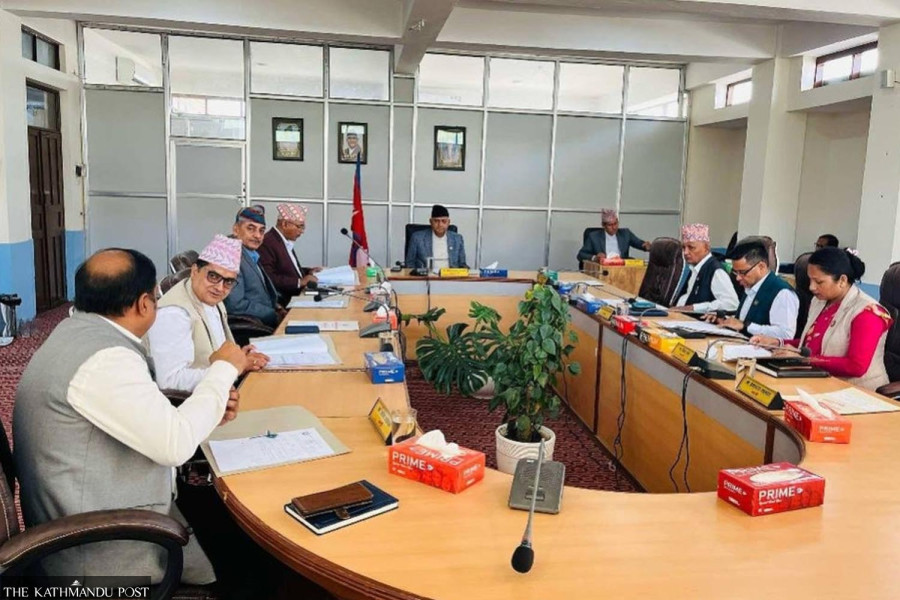
The provincial governments have too many ministries and ministers, unnecessarily adding administrative costs. The political positions were randomly distributed in the name of coalition culture, especially after 2020, flouting the constitutional mandate that the number of provincial ministers be up to 20 percent of assembly members. Despite repeated calls from experts to reduce the number of their ministries to five to seven, they haven’t complied. The provinces’ grievances with the federal government are genuine; but so is their egregious failure to justify their own existence.
Traditional parties, which lost the bulk of their previous support in the March 5 polls, risk being rejected in the next provincial elections as well, and thus putting their very existence in question if they don’t lay the groundwork for urgent reforms. The Congress is at the helm of provincial governments in Madhesh, Bagmati, Gandaki and Sudurpaschim, while the UML is in charge of Koshi, Karnali and Lumbini. These parties should realise that provinces are not centres for recruiting party cronies. They are rather an important and indispensable tier in the three-tier federal model. If the provinces don’t function well, the federal project itself will come into jeopardy. And if this happens, under the current scenario, it will again be the traditional parties that stand to lose the most.




 14.82°C Kathmandu