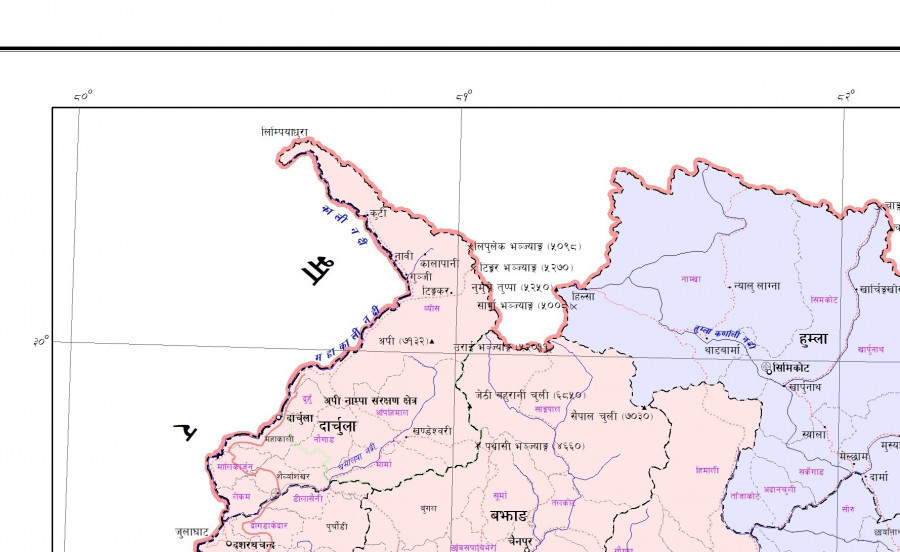
The old controversy over Lipulekh refuses to die down. Nepal has in the past repeatedly written to New Delhi and Beijing, asking them to be mindful of its traditional claim over the territory in the Kalapani area. Yet neither India nor China seems to have ever seriously entertained Nepal’s concern. India maintains that its border trade with China through Lipulkeh pass “has been going on for decades” and that Nepal’s claims on the territory are “neither justified nor based on historical facts and evidence.” China for its part has tried to distance itself from the issue by terming Lipulekh a “bilateral issue” to be settled between Nepal and India. The dispute has again come to a head following a report in the Press Trust of India that India-China border trade through Lipulekh is set to resume this June after a six-year hiatus.
Both our big neighbours are doing the country precariously wedged between them great injustice. India cannot so easily dismiss Nepal’s claim on the region, given the wealth of evidence at the latter’s disposal to support its position. India says it remains open to “constructive interaction” with Nepal on boundary issues yet by completely rejecting Nepal’s claim on Lipulekh, it seems to be deliberately ditching such a constructive path of dispute resolution. On the other hand, China seems intent on benefitting from the status quo while shunning any responsibility for the dispute’s resolution. As we wrote in this space last year when India and China agreed, in principle, to reopen Lipulekh for bilateral trade, their agreement could have included a simple rider like “in consultations with Nepal”. Such a symbolism is meaningful in diplomacy, especially for precariously situated smaller states like Nepal that are always afraid of big powers undermining their sovereignty. It would show that these two fast-rising powers are responsible international actors and will be mindful of the concerns of their smaller neighbours as they march ahead on the path of development and prosperity.
That is how we would like our neighbours to behave. But what should our own government do? The incoming Rastriya Swatantra Party government has no option but to continue to publicly reiterate Nepal’s stand on the matter. Yet that is not enough. Nepal has in the past dispatched many diplomatic notes towards this end, to both north and south. The new RSP government should be able to raise the issue at the highest levels in New Delhi and Beijing. Particularly in the case of India, if it can convince New Delhi to entertain the idea of a ‘tripatriate’ rather than ‘bilateral’ trade deal through Lipulekh, it would be a big coup for new Prime Minister Balendra Shah as well as the RSP. (China has already suggested its readiness to accept a bilateral Nepal-India understanding on Lipulekh.) Although India might be worried about the precedent such a concession sets, it is also unlikely to fundamentally upset India’s broader strategic calculus over its China border. The perceived anti-India bias of previous governments led by KP Oli had made it difficult for India to make any such concessions. The Shah government will be starting with a clean slate.




 14.82°C Kathmandu