



 14.83°C Kathmandu

Sun, Oct 18, 2026
Columns
Can Nepal walk the talk on green investment?
Climate change is no longer just about emissions. It is the sum of blatant disrespect for the planet’s natural resources and their overuse.
bookmark
Sophia L Pandé
Published at : September 27, 2026
Updated at : September 27, 2026 12:12
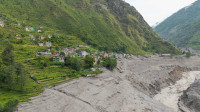
Nepal is still processing the flood of August 26. Like the 2015 earthquake, it has left a scar on the national psyche. While most of the world’s media has already moved on, barring a few publications that are making a concerted effort to report beyond sensationalising the destruction, our civil society, government and the Fourth Estate must not forget what happened, and ensure that our future is re-imagined, factoring in the horror of the past few weeks so that, going forward, we are prepared.
Much has been said in an endless loop about Nepal being a victim, having contributed only 0.09 percent to global carbon emissions. Living at the Third Pole, we are most vulnerable to apocalyptic climate events that are outside of our control. However, climate change is no longer just about emissions.
It is the sum of human behaviour that is the blatant disrespect for the planet’s natural resources and the overuse of these finite resources. While Nepal is owed its due for a gross imbalance created by other nations, humankind’s extractiveness continues to put an immense burden on our planet.
In Nepal, our own history of natural resource exploitation, starting from the unchecked mining and depletion of the Chure hills, to the attempted felling of 2.4 million trees across 8,000 hectares of Nijgadh forest to make room for an airport that can be built on less than one-eighth of that area, and the rivers full of plastic and garbage, show how little we care for our own footprints, personal and public.
An entire way of being must change for humanity to survive. We must evolve towards a more sustainable future. The environment and community must be placed front and centre. The educated must use their agency, a current and terrible lapse that must be rectified. Advocacy and education are essential (this is the State’s responsibility along with civil society) to balance progress and conservation.
Nepal’s education system is finally giving attention to indigenous knowledge, but will that shift include working with the diversity of cultures across Nepal, all of whom prioritise nature as part of their tangible and intangible cultural heritage? How can we enrich our communities without snatching away our traditions? This is the vital question we must ask ourselves as we form our policies. Development economics looks at these vital factors, but social and natural resilience is still sidelined in favour of economic gain, when all can be had with careful planning.
Recently, The New York Times covered Indonesia’s battle with microplastics in the air and water, due to rampant plastic dumping in landfills and burning in the open air. As a result, microplastics have pervaded and are now a public health hazard. Do we really, as a human race, have to dread our demise via either climate-related disasters or blind abuse of resources?
The recent Central Bank FDI survey indicates a complex FDI landscape of the past fiscal year. While FDI stocks crossed Rs340 billion, the dividends being repatriated, though smooth repatriation mechanisms are essential, exceeded new investments, and investor interest is not being sufficiently converted into viable capital. Even as the country does its best to talk the talk regarding welcoming investors, it cannot quite walk the walk. Any potential investor would be scared away by the multiple procedural hurdles, not to mention the thinly veiled xenophobia emanating from Nepali officials.
In the aftermath of the 2015 earthquake, we said we would ‘Build Back Better’. While that slogan sounded well enough, much was left to be desired, with many still homeless more than a decade later. However, now, with the collapse of a glacier, like something out of science fiction in a tone-deaf Hollywood apocalypse film, we have no choice but to invest in better systems and infrastructure, and for that we need to look towards the best financial and physical models.
In the Italian Dolomites, and across Northern Europe, there are tried and tested dam systems that are attenuated for flood management. The Rasuwa flood came without warning, with water and debris rushing down at a peak average speed of 188km per hour. An unimaginable amount, between 12,000-15,000 cubic metres of water and debris per second, inundated the narrow gorges. Very few, if any, infrastructure systems can withstand that kind of force. However, with early warning systems and proper studies of hydrology and GLOF behaviours in place, civil infrastructure can be built to mitigate floods of huge proportions.
The main problem is the cost. The Dudhkoshi dam, in Koshi Province, is projected at a staggering $2.3 billion, including financial costs, over a construction period of seven years. The project has flood risk management factored in, though it is built primarily for hydropower, with an average annual energy production of 3377 GWh, mainly during the dry season. The required investment amount, structured as 20 percent equity (government) and 80 percent debt (multi-agency), is daunting and requires multiple types of foreign investment for viability.
For the sake of the entire Himalayan region and the rivers that originate here, infrastructure projects that integrate electricity generation and water management, thereby provisioning for natural disasters and therefore much broader economic benefits, are now vital for dealing with the inevitable effects of climate change.
In order to plan rapidly for them, and to finance them, Nepal needs FDI in addition to state or local private equity. The new government has pledged to streamline land procurement as well as procedural hurdles for large infrastructure projects, but land procurement itself rings alarm bells for communities in project areas, particularly indigenous peoples tied to the land.
Tulsi Rauniyar’s recent, grim article outlines with evidence how some hydropower projects can come with serious implications for indigenous communities, particularly when EIA’s are mercilessly forged by people who care more about profit than people.
Nepal cannot continue to rely on remittances for LDC graduation and beyond. Carefully vetted FDI and infrastructure projects will bring in both expertise and much-needed income, but these projects must evolve so that future iterations integrate social and environmental impact as a priority, in addition to economic benefits, by transitioning towards ethically designed multi-purpose electricity generation and storage system dams that are designed for flood attenuation and water security.
Such behemoth projects will require equally huge investor confidence alongside scrutiny from watchdogs regarding their impact on the environment and land use. The Nepal government must step up in every way, and their work is cut out for them. Gone, also, are the days when developers told off environmentalists, calling them anti-development. In the wake of what has happened, it is clear how incredibly outrageous that argument always was.
Sophia L Pandé
Pandé is a writer, art-historian and filmmaker advising on the economic and social potential of the Cultural and Creative Industries, Education Outreach, and Sustainable, Strategic Planning. She has consulted for IFC and UNESCO. She is Director of Development at the Kathmandu Valley Preservation Trust, and Founding Director of The Kalā Salon, a non-profit space for the arts. In the past, she has been a long-running columnist for The Kathmandu Post and the Nepali Times.




Most Read from Columns
Before you take credit for Khula Manch, read its history

Shah went to the UN to speak for Nepal, then left before he could make the most of it

Bhotekoshi flood wasn’t a freak event. It’s the Himalaya doing what it does
Lesson learned after the death of Ronaldo
Why passive neutrality won’t take Nepal anywhere
Editor's Picks

Dashain paints the country in festive colours
Buying a goat for Dashain? Look for the green mark

Explained: Why does an hour long flight to Dhangadhi cost more than a flight to New Delhi?
Bhotekoshi flood wasn’t a freak event. It’s the Himalaya doing what it does

How Tenzing Sherpa became Nepal’s breakout star at the Asian Games
E-PAPER | October 18, 2026

×