Nepal wants to be a clean-energy powerhouse. The indigenous people are paying the price
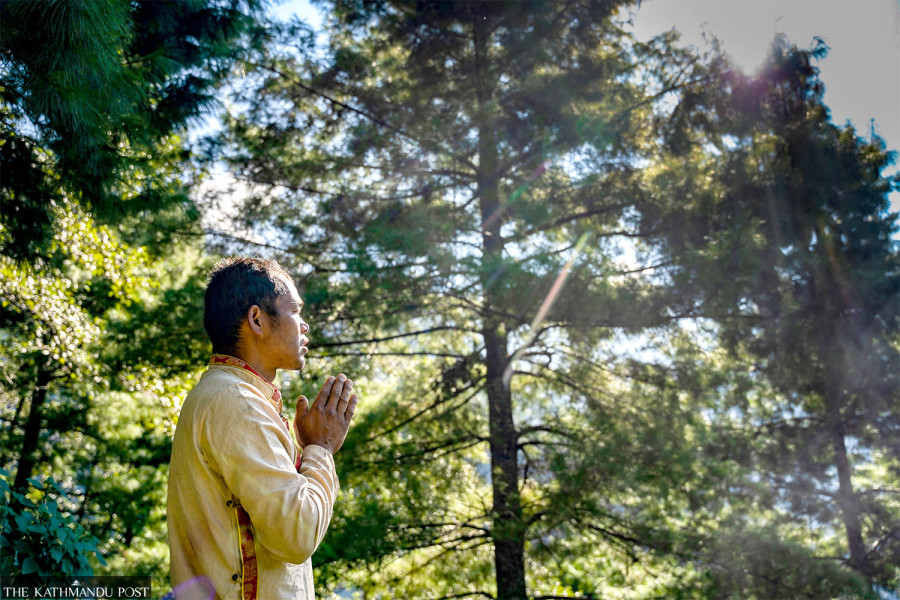
A hydropower boom backed by billions in financing is colliding with local communities who say they were never really asked. Uchhen Bhote, a bijuwa, prays in a forest in Chyamtang, Sankhuwasabha. In Bon, rivers, mountains and forests are regarded as living beings inhabited by protective spirits. Post Photo
On a winter night in 2023, Jojo Bhote drifted off to the gushing Chhujung river, a sound that had carried him into sleep for over three decades. Around midnight, he felt the rumble of distant thuds. Jojo, whose family has tended these mountain pastures for generations, sprang from his bed, corralled his family, and stepped outside to find bulldozers tearing through stone walls that marked the community’s ancestral land. When he and his neighbours approached the workers, a company supervisor pulled a sheaf of papers bearing official seals and signatures, Jojo recalls — his own name among them.
“This is not mine,” he told them.
The man shrugged and continued. At dawn, Jojo and other villagers followed the tracks into the forest, where the slopes he had known since boyhood now lay gouged open. This was where he had once learned to gather Satuwa, a wild herb that his mother boiled to prepare a tonic when fever swept through the village. Nearby stood Lothsalla, the Himalayan yew his elders protected because it yielded compounds used in anti-cancer medicines. “The forest was always our pharmacy,” he says. “As much as our home.”
The bulldozers were clearing ground for the Chhujung Khola Hydropower Project, one of dozens of projects reshaping Sankhuwasabha into a frontier of Nepal’s clean-energy ambitions.
Nepal, water-rich and fossil-poor, is in the middle of one of Asia’s most aggressive hydropower expansions. For generations, hydropower has been presented as the engine that would transform Nepal’s economy. The transformation has been slower and more uneven than promised. Yet the government's ambitions have only grown: an energy roadmap targeting 28,500 MW over the next decade, backed by $46.5 billion in investment, has unleashed a building frenzy. As of July 2026, more than 197 plants are operating, 262 have received construction licenses, and 244 hold survey licenses. Increasingly, Nepal's rivers are being transformed into power corridors, carrying electricity across borders to India and, more recently, Bangladesh. In places like Chyamtang, many Indigenous communities question who the power is ultimately for.
The warning arrived last week when a flash flood tore through the Bhotekoshi river in Rasuwa — a different Himalayan watershed several hundred kilometres west — killing at least 1,342 people and leaving nearly 5,000 unaccounted for as of Saturday. Hundreds are believed still trapped in flooded hydropower tunnels as rescue teams searched the wreckage days later. The disaster is a reminder of how little separates the mountains’ promise from their risk — and how much is still unknown about what Nepal’s hydropower expansion is building on.
Nowhere is that ambition more concentrated than in Sankhuwasabha, cut through by the Arun river basin, where dozens of hydropower projects are operating, under construction, or in various stages of licensing. For the Bhote Singsa community, who have lived along these slopes for generations, the project that feeds into a tributary of the Arun marks the beginning of a long tug-of-war over the land itself, one that would eventually pull Jojo and his neighbours into courtrooms, government offices and, ultimately, in front of a bulldozer that refuses to move.
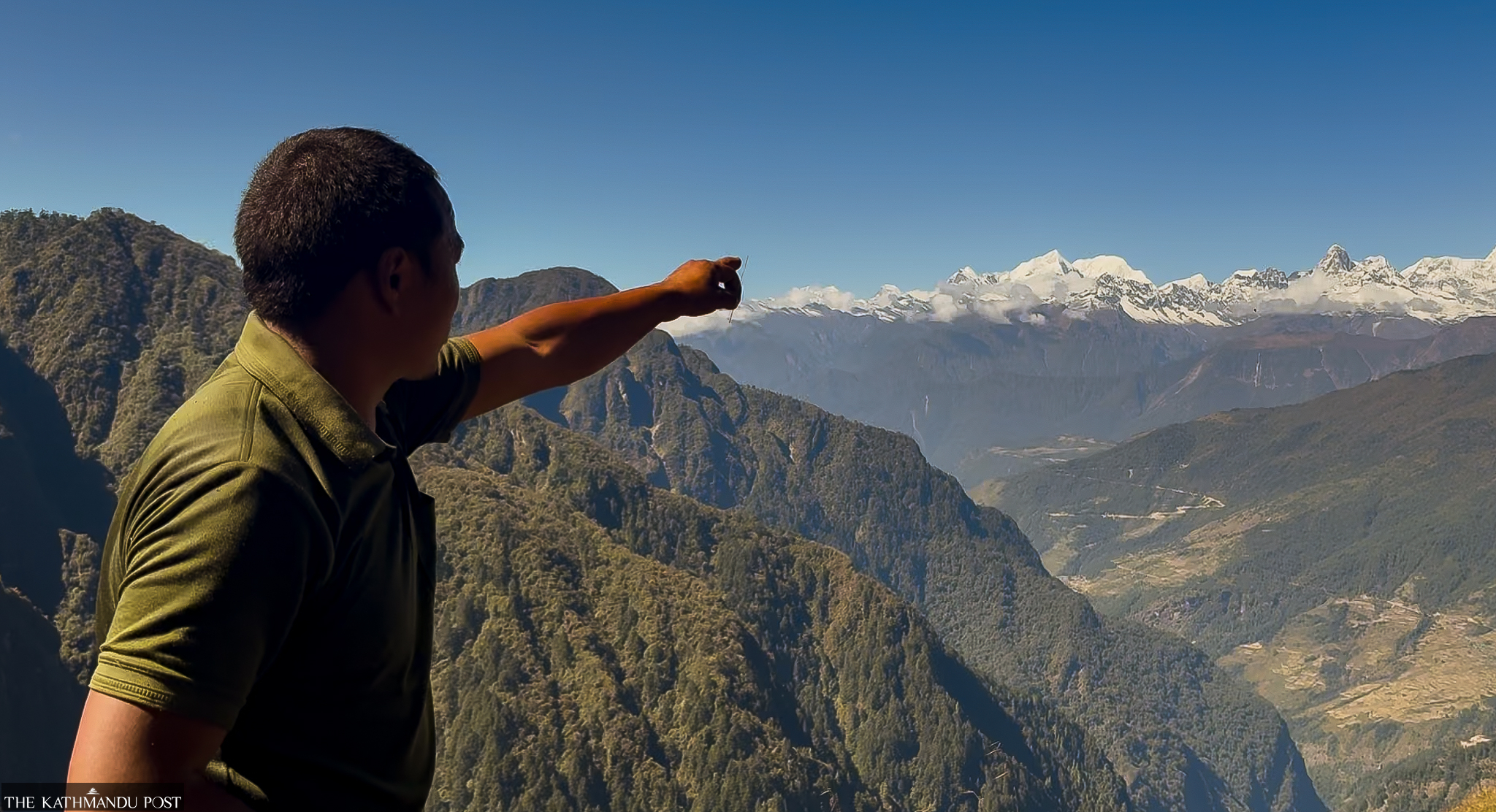
Jojo Bhote points towards the mountain landscape around Chyamtang, where hydropower construction is transforming land used by Indigenous communities for generations. Post Photo
The Promise
Months before bulldozers entered the valley, the first sign of change arrived as promises.
One afternoon, word spread through Chyamtang that villagers were to gather on the porch of a house in the southern part of the settlement. Company representatives had come to introduce a hydropower project they said would transform the valley. The meeting did not last long. As questions mounted and tempers rose, villagers told them they did not want a hydropower project on the Chhujung river. The visitors left that day.
They returned a year later.
On March 19, 2022, Sangrila Urja, the company behind the project, held an official public hearing at the ward office. The thud of helicopter blades announced their arrival, carrying company officials, environmental consultants and local authorities into a village otherwise reached only after days of walking. But the hearing took place during the winter migration period, when many families had already moved to lower, warmer settlements. According to Kija Manjhiya Bhote, who served as the village headman for over four decades, only about 25 men attended. Kami Rijek Bhote, head of Bal Kalyan Krishak Aama Samuha, the local women’s group, says not a single woman attended the hearing. Nor did any member of the community forest user group responsible for managing the forests the project would affect attend. They say they received no invitation.
Under ILO Convention 169, which Nepal ratified in 2007, Indigenous peoples must be consulted through their representative institutions, in good faith and to achieve agreement or consent on measures that affect them. Residents say what unfolded in Chyamtang bore little resemblance to that standard.
Inside the ward office, company representatives spoke of roads, jobs, development — along with shares in the project itself — in a region that had long sat at the far edge of the state’s attention. The promise of shares echoed a familiar practice in Nepal’s hydropower sector, where companies have offered communities equity stakes as part of consent negotiations, sometimes as a legal requirement, though rarely with clear terms or timelines attached. For families who spent days carrying sacks of rice, roofing sheets and medicine across mountain trails, the promises were difficult to ignore.
Long before any hydropower company appeared, however, the community had already built its own answer to that neglect: a micro-hydropower plant that still supplies electricity to more than 300 households.
“We already had electricity,” recalls Kija Manjhiya. “What compelled most people wasn’t just power. It was the road. They believed a road would bring jobs, let their children reach better schools, help pregnant women get to hospitals in time, and spare families the backbreaking labour of carrying every sack of rice, sheet of tin and other supplies for days over mountain trails. That’s what people saw as development.”
As the meeting drew to a close, company representatives circulated documents written in formal, technical Nepali. Many villagers said they could neither read the papers nor understand what they were being asked to approve. Some signed their names. Others pressed inked thumbprints onto documents whose contents, they said, were never fully explained.
The project’s Environmental Impact Assessment, submitted to Nepal's Ministry of Forest and Environment, shows the company collected just 61 signatures from Chyamtang, despite the project affecting 232 households across the three villages of Chyamtang, Ridak and Thudam. Residents of Ridak and Thudam say they were never consulted. In some cases, as many as three signatures came from a single household, so even the 61 names on the sheet overstate how many families actually had a say. Among the signatories was Yompang Bhote, whom I met and interviewed in the field. He says he was around 15 at the time.
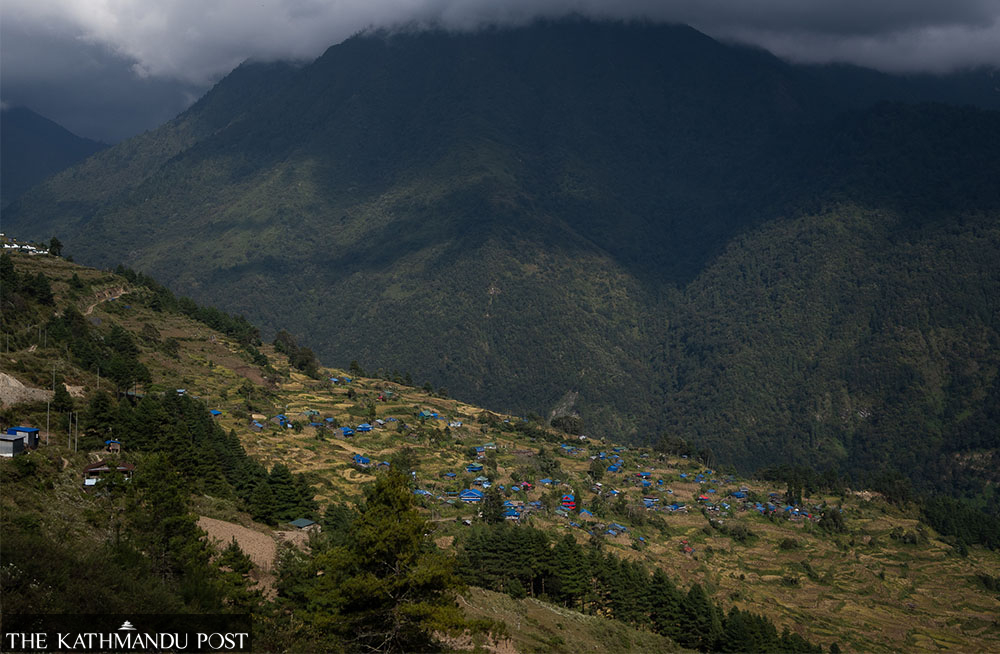
For the Bhote Singsa community, which has lived along these slopes for generations, the project that feeds into a tributary of the Arun marked the start of a long struggle over the land itself. Post Photo
The Prayer
At the edge of the forest, hidden behind a stand of alder and rhododendron, the Arun thundered somewhere below, its current ricocheting off the walls of the gorge. Uchhen Bhote, a bijuwa — as shamans like him who conduct Bon rituals are known here — knelt at a flat stone in Chyamtang to lay out his offerings: grains of rice, a cluster of rocks daubed with red pigment, a brass bowl darkened by years of ritual. Beside him, another man cradled a rooster beneath his arm.
The ceremony had been called after construction pushed deeper into the valley, cutting into forests and sacred sites the community believes are protected by the spirits Uchhen was invoking. Uchhen lit the juniper incense, whose wisps drifted through the trees. Then he turned toward the unseen river, closed his eyes, and began to chant.
O Arun Raja, king of rivers, you who came from the snows of Tibet, you who pierced thirty-two ridges when drought held the mountains in its grip.
For a few moments, the prayer and the river answered one another.
The chant faded. The rooster was offered in sacrifice, a faint smear of blood staining the frayed cuff of the bijuwa’s homespun tunic. He barely looked at it. Instead, he lowered himself onto a smooth boulder overlooking the gorge. The smell of juniper lingered in the cold mountain air.
“That is Kachowk,” he said, pointing across the river. “One of our spiritual forests.”
Across the valley, a broad brown scar cut through the uninterrupted green of the hillside.
For the Bhote Singsa, the Arun is more than a river. Through Bon, rivers, mountains and forests are living beings, inhabited by protective spirits. Respect shown to the Arun, Uchhen said, is believed to be returned through protection from floods, avalanches and glacial lake outburst floods.
“We perform this ritual whenever the community feels the need to honour the Arun,” he said. “Not because we fear the river, but because we owe it respect.”
His eyes left the brown scar across the valley.
“Prayer cannot mend what is broken,” he said. “It only eases the pain for a time.”
The Lakes Above
Two or three days’ walk further upriver, beyond where Uchhen had stood, the glaciers that feed the Arun give way to twenty-six glacial lakes scattered across the Chhujung watershed. The watershed sits within the Lungba Samba Biocultural Heritage Special Conservation Zone — a legally protected corridor between the Kanchenjunga and Makalu Barun conservation areas, established specifically to safeguard the Chhujung, Chhunjam and Bakhang rivers.
Many of those lakes are held back by fragile moraine dams, natural embankments of loose rock and sediment left behind as glaciers retreat. As the climate warms, the lakes expand while the dams holding them back grow weaker. If one fails, whether triggered by an earthquake, a landslide or another disturbance, an entire lake can empty within minutes, sending torrents of water, boulders and debris crashing through the valleys below in what scientists call a glacial lake outburst flood.
Sudeep Thakuri, a glaciologist at Tribhuvan University who has studied the Mahalangur-Makalu Barun region, said the area has grown less stable in recent decades. “Some of these lakes have expanded and become more unstable,” he said. Any infrastructure entering these catchments, he said, is entering “a naturally dynamic and risk-prone system.”
It is into this landscape that the Chhujung Khola Hydropower Project plans to blast. According to the project’s EIA, approved by the Ministry of Forests and Environment, a copy of which was reviewed by the Kathmandu Post, construction would require approximately 192,000 tonnes of explosives and 188,000 detonators. The tunnels are planned within five kilometres of all twenty-six glacial lakes, with three lying less than two kilometres from the proposed works. None of the residents I interviewed recalled being told that blasting on this scale formed part of the project.
“People often assume the impacts of blasting stop where construction ends,” Thakuri said, adding that the mountain systems are all connected and that effects can travel downstream for tens of kilometres, potentially as far as 50 kilometres in some mountain environments. “That is why cumulative, watershed-scale assessments are essential.”
Residents say they have already begun to see what those risks look like. Landslides have grown more frequent since construction began — three major slides and over 15 smaller ones in the past two years alone.
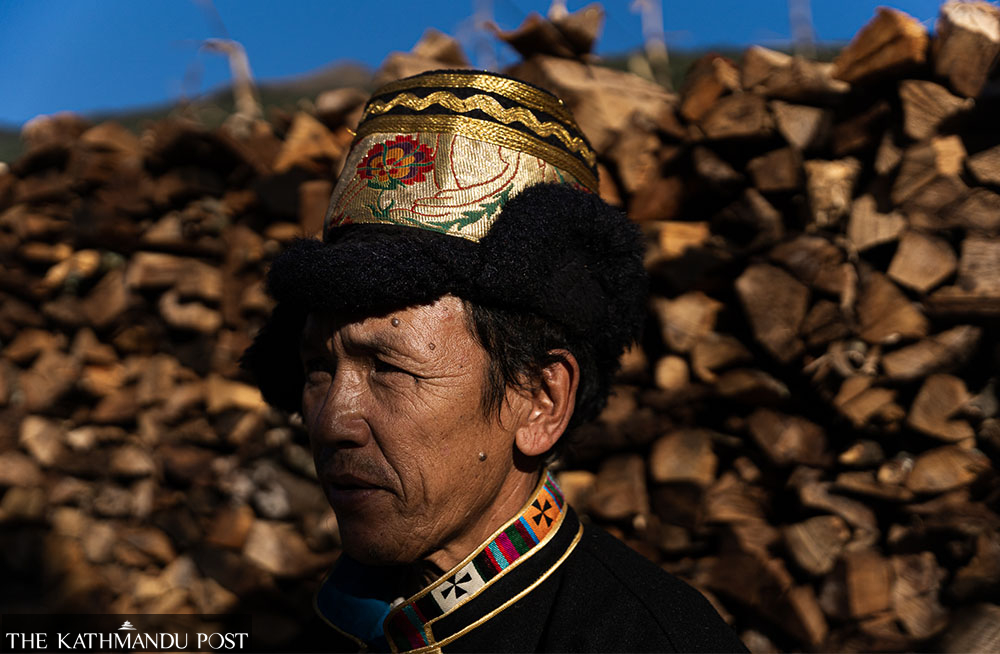
Kija Manjhiya Bhote, who served as the village headman for over four decades, said that only a small number of stakeholders attended the public hearing conducted on short notice. Post Photo
The Protest
Throughout his life, Jojo says his community has always lived with natural dangers — extreme weather, landslides, avalanches, flash floods — the bargain of living in such remote wilderness. But he acknowledges that the greatest threat to his land is not natural calamities. It is the people who came with bulldozers, uninvited. Confrontations have become routine, caught increasingly on phones and shared online; machines halted mid-slope while landowners and company men argue over signatures no one can agree on.
The community has pressed its case through the courts twice, with little to show for it so far. The Chyamtang-Kathmandu Welfare Society filed the first writ petition in October 2023, arguing the project's consent process was fundamentally flawed.
While some fought from the ground, others were fighting the same battle through the courts, building the evidentiary case one document at a time. By the time I met Karma Bhutia at the Chyamtang-Kathmandu Welfare Society office, where he serves as an adviser, his desk had become its own kind of terrain, stacks of government reports rising like scree, topographic maps folded into ridgelines, photocopied EIAs spread out like a valley floor, nearly every page scored in black and red ink.
He pulled one report toward him and tapped a line with his finger. “This tree doesn’t grow here.” Further down the page, another mark. “Neither does this one.” Then the rivers. The wildlife. “It was like reading about another place,” he told me.
Bhutia, 52, wears many hats — conservationist, activist and educator — but is perhaps best known as one of the most vocal opponents of the hydropower projects threatening Sankhuwasabha’s glacial lakes and sacred rivers. He is thin, his shoulders sharp beneath a half-sleeved shirt. “This fight has taken a toll,” he says, with a wry smile. “I've lost weight. I look stressed, and I am.”
Where the courts had stayed silent, Bhutia had kept building his own case. He pulled out a second document. “The EIA authorised the felling of 952 trees,” he says. “A field verification documented 8,886 mature trees already cut.” The document recorded more than 6,000 stems of malingo bamboo cut and hauled from the forest. Yet the EIA never gave a species-specific estimate for how much could be cut, even though it acknowledged the bamboo was present throughout the project area. He closed the document. “Malingo isn’t just bamboo. It’s the primary food source for the red panda. You don’t have to cut the animal to destroy its habitat. You only have to remove what keeps it alive.”
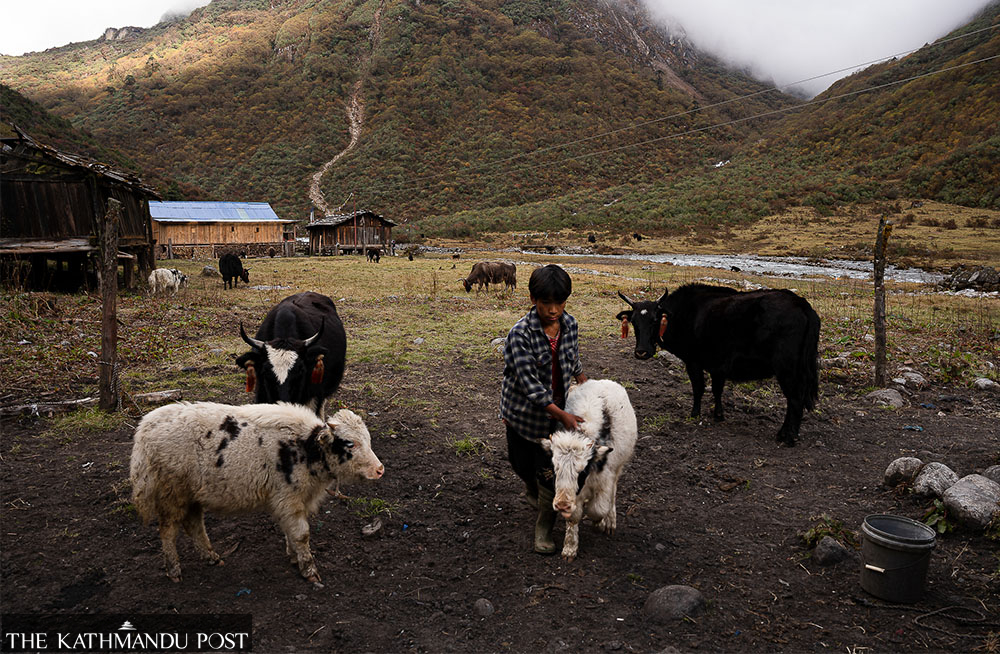
Animals he’d seen himself in these forests: red pandas, blue sheep, Himalayan monals, snow leopards, were absent from the report entirely. The EIA said nothing, either, about the yaks. Herders at Yak Kharka, a high-altitude pasture above Chyamtang where families have grazed their herds for generations, say their animals have changed migration patterns entirely since construction disturbed the land, some refusing old routes, others simply not returning.
Bhutia reached for a folded map. The EIA's text put the project's footprint at just twenty hectares. But the map included in the same document, Bhutia said, was reviewed with help from several GIS specialists he consulted, and showed something far larger: nearly 1,800 hectares, ninety times the EIA's stated figure. Mongabay independently georeferenced the same map against satellite data and reached a comparable finding. That expanded footprint reached forests and rivers, including the Chhunjam river, that the environmental assessment never mentioned.
“We tried discussing with them, reaching out to people for help,” he says. “We sent attention letters to the Ministry of Energy and Water Resources, and the Ministry of Forest. No response. Pending. The National Human Rights Commission, the ward office, door to door, the member of parliament.” Officials repeatedly told him they would try, but nothing came of it. The Nepal Electricity Authority, too, was approached without result.
A second writ followed in late 2025, filed by residents on environmental grounds, its threat to farmland, grazing pastures, and the region's wildlife and vegetation, and the EIA's inaccuracies underpinning all of it. Senior Advocate Padam Bahadur Shrestha represents them. He is, at the moment, a kind of one-man tally of Nepal's hydropower disputes, half a dozen cases on his desk, in various stages of being drafted, filed, or fought. His office tells a similar story to Bhutia's, though the terrain there is colour-coded: case files stacked in red and green folders, each labelled with a different project's name, Super Trishuli, Upper Chhujung, Thudam, Bhotekoshi-5, enough of them that he sometimes checks a label twice before remembering which fight he’s looking at. For Chhujung, his case leans on the precautionary principle, a standard the Supreme Court has recognised in a string of environmental rulings, including a landmark 2025 decision banning development in protected areas: where an activity risks serious or irreversible harm, the burden falls on preventing it, not proving it after the fact.
Case after case, he says, the underlying pattern repeats: EIAs copied wholesale from other projects, signatures forged, consent bypassed, environmental review ignored. Portions of Chhujung Khola's own EIA, he said, appeared lifted from assessments prepared for other hydropower projects entirely, though he hasn't been able to pin down the source.
Under Nepal's Environment Protection Act, it is the company proposing a project, not the government, that is legally empowered to hire whoever assesses its environmental impact. For Chhujung Khola, that meant Sangrila Urja commissioning Nepal Environment and Development Consultant Pvt. Ltd., the same firm now named as a defendant in the community’s legal challenge to the report it produced. The government’s role starts only after the report is finished: it reviews, and it approves.
Herders say their animals have changed migration patterns entirely since the dam construction disturbed the land, with some refusing old routes and others simply not returning. Post Photo
Neither the Ministry of Forests and Environment, which approved the project’s EIA, nor the Ministry of Energy, Water Resources and Irrigation, which processed its license, had much specific knowledge of Chhujung Hydropower itself when asked. Maheshwor Dhakal, spokesperson for the Ministry of Forests, acknowledged the broader pattern. EIA discrepancies happen, he suggested; that’s simply how these things go. Nature itself is always shifting, he said, species moving, forests changing. Pressed on the legal boundaries of an approved EIA, he was more direct: “No one has the authority to go beyond what’s been approved in an EIA. If they do, it has to be dealt with within the legal framework.”
Dhakal said, since 1996, somewhere between 500 and 600 EIAs have been approved, and there's never been a perfect one. If mistakes are identified, alternatives have to be considered, and the EIA gets updated. There's never been a case where an EIA was simply rejected altogether." Nepal's Environment Protection Act of 2019 bears this out: it gives regulators no mechanism to reject a flawed EIA outright, only to revise it, a provision called a Supplementary EIA. In the nearly three decades since Nepal's environmental assessment system began, hundreds of EIAs have been approved. Not one, by the ministry's own account, has ever been rejected.
Over three years into the fight, the resolve of Bhutia and the others who brought the case has not petered out.
Chyamtang is small enough that most households are connected through marriage or kinship, and the dispute has cut through those ties as much as it has divided the village from the company. Karma’s own nephew works for Sangrila Urja, he told me. The two no longer interact, their fight having pulled them onto opposite sides of the same dispute. Some residents went further, alleging that certain locals, along with a few officials in the ward and district forest offices, had been paid to look the other way, in cash, they said, or in kind: a truck, a favour, whatever the moment called for. I asked those named about it. Some wouldn't answer. Others denied it flatly.
“It’s very common,” Shrestha said. “These projects come with international financing, and that means a lot of money moving through very few hands. Buying off a few locals is cheap, compared to the cost of actually getting consent properly. I see it case after case, not just in Chhujung.”
Sangrila Urja rejects the allegations. I met Kishor Subedi at a café beside his company office in Anamnagar, Kathmandu. He had walked the project’s grounds himself many times, he said, and in his own survey, they’d found relatively little flora or fauna in the area. He said he hadn’t even seen a deer during the trip.
The claim didn’t hold up against my own observations. On treks through the same region, I had seen wildlife more than once, deer among them, including one picking its way across a bulldozed road near Yak Kharka.
Subedi’s defence of the project rested less on what might be lost than on what, in his account, the area had never had. The region was remote, he said, and development wasn’t simply an environmental calculation.
“We would not have gone ahead without local support,” he told me. The project, in his telling, was building that support by bringing economic opportunity to communities the state had long neglected. He expects the construction to finish in about three and a half years. Roughly 18 percent of it, he said, was already complete.
At one point in our conversation, he called someone over: Anup Pejaba Bhote, from Chyamtang, a local supervisor on the project who has been with the team since the beginning.
To Pejaba Bhote, the language of environmental activism felt beside the point. In his account, support for the project runs deep among locals. “Activists could say what they wanted,” he told me. Life on the ground was a different matter entirely, and to explain what he meant, he went back to his own childhood.
He lost his mother young, to an illness that a health post, had one existed nearby, might have caught in time. His father had carried his two younger sisters in a woven bamboo basket slung across the back, while working the fields alone. Life, as he described it, had always been this way: long walks, no health post nearby, roads that vanished into the landscape half the year, work that broke the body down slowly.
For him, the question was never abstract: development against conservation, EIAs against ecosystems. It was whether the road this project promised would make an ordinary life a little less brutal. He talked about what that road would change: how people travelled, how they reached a doctor, how they moved goods to market, how they lived, full stop.
Bhutia doesn’t see it that way. Roads and wages, he argues, are not the same as fair consent. A few years of jobs and a road, he says, is a short-term trade against damage that will outlast it. Forests, glacial lakes, a way of life — none of which come back once they're gone. “In the relentless pursuit of energy, whether these projects ultimately serve communities or corporate profits, Indigenous people like us have once again found ourselves in the eye of the storm,” he says.
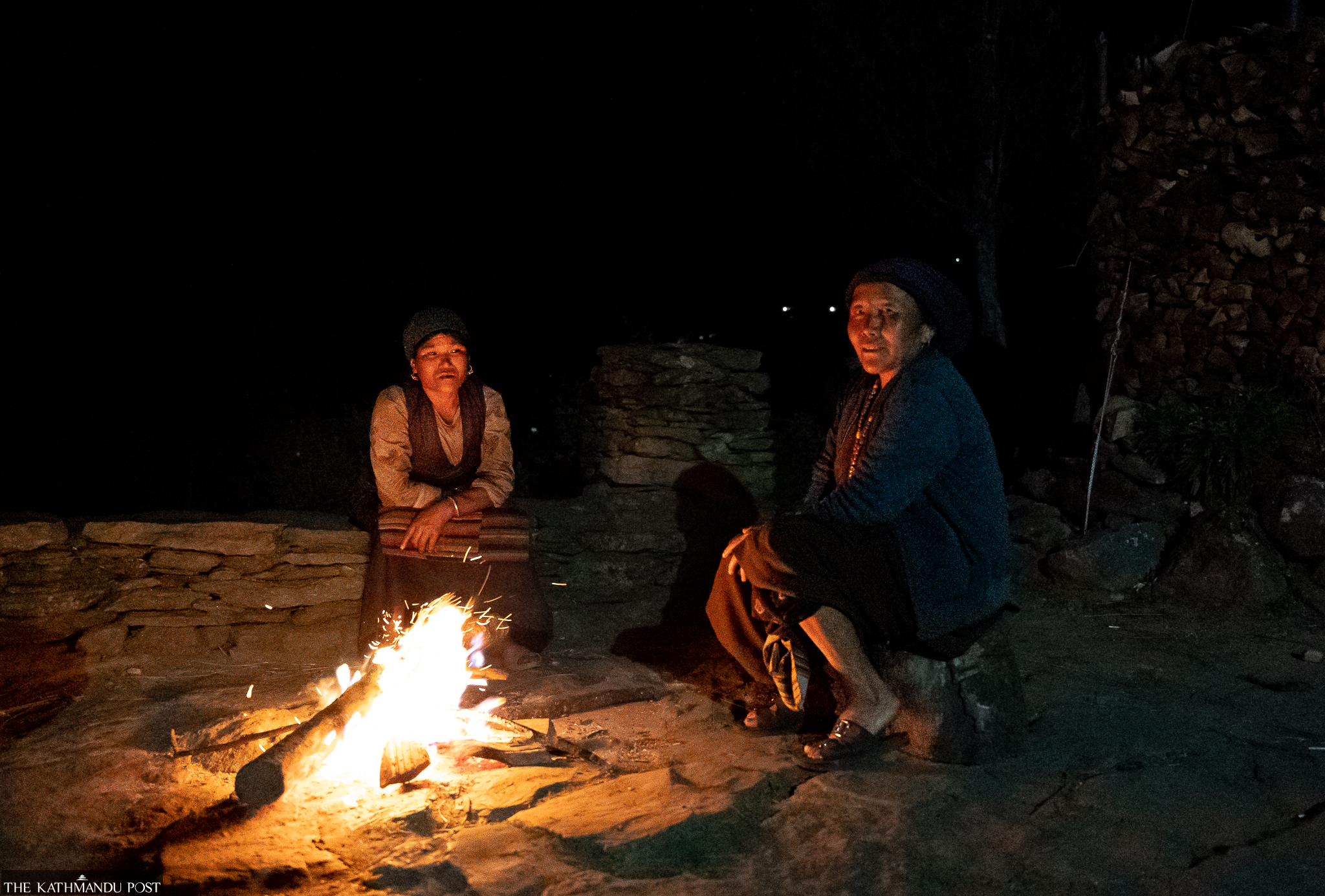
Chyamtang is small enough that most households are connected through marriage or kinship, and the dispute has cut through those ties as much as it has divided the village from the company. Post Photo
Familiar Ground
The pattern extends beyond Chhujung, and beyond Sangrila Urja. In nearby Thudam, villagers told me they unanimously rejected a separate hydropower project proposed by White Flower Energy in 2024, only to be asked afterwards to sign a consultation document that made no mention of Free, Prior and Informed Consent.
A 2025 investigation by Lawyers’ Association for Human Rights of Nepalese Indigenous Peoples (LAHURNIP), an advocacy group for Nepal’s Indigenous peoples, and Accountability Counsel examined four major hydropower projects financed or regulated by the Nepal Electricity Authority. It found the same failures recurring almost word for word. At the Upper Trishuli-1 project, financed partly by the International Finance Corporation, consent was gathered through an ad hoc council rather than the Tamang community’s customary governance institutions; the assessment found that the council had no mandate from the community at large to make decisions on its behalf.
Asked about this, the Asian Development Bank confirmed that the requirement for Indigenous consent was triggered at the project and said it had verified compliance during the project's appraisal — a stage that relied on, and came after, the ad hoc council process that LAHURNIP later found had no community mandate.
At Likhu, communities said “consent” was obtained under police presence, and development funds meant for them were instead routed through local government officials who distributed them arbitrarily.
At Tanahu, a $505 million dam in Central Nepal, nearly complete and due to be commissioned this year, the timeline tells its own story. Magar families facing inundation of their ancestral land filed a formal complaint against the project's financiers, the Asian Development Bank and the European Investment Bank, in 2020, demanding land-for-land compensation and genuine consent rather than cash payouts. That dispute resolution process, run through the banks' own grievance mechanisms, is still open six years later. The dam, meanwhile, is essentially finished.
The Post reached out to the IFC, ADB and EIB for comment. The IFC and EIB did not respond. The ADB confirmed the 2020 complaint remains open and is being processed through its Accountability Mechanism. When asked what has caused the six-year delay, it did not answer.
The same pattern reaches Upper Arun, a 1,063 MW dam just kilometres from Chyamtang. The Nepal Electricity Authority has publicly cited 22 households as facing displacement since 2022. The World Bank’s own environmental and social impact assessment, published in January 2024, documents 335 households affected in total, roughly 1,614 people, the 22 requiring physical relocation, the rest facing economic displacement: loss of land or livelihood without being physically moved. "Until and unless the project addresses the problems of the community, they can't ensure livelihoods and survival of the community members," one Upper Arun community leader told the authors of the LAHURNIP report. "We don't need any project there."
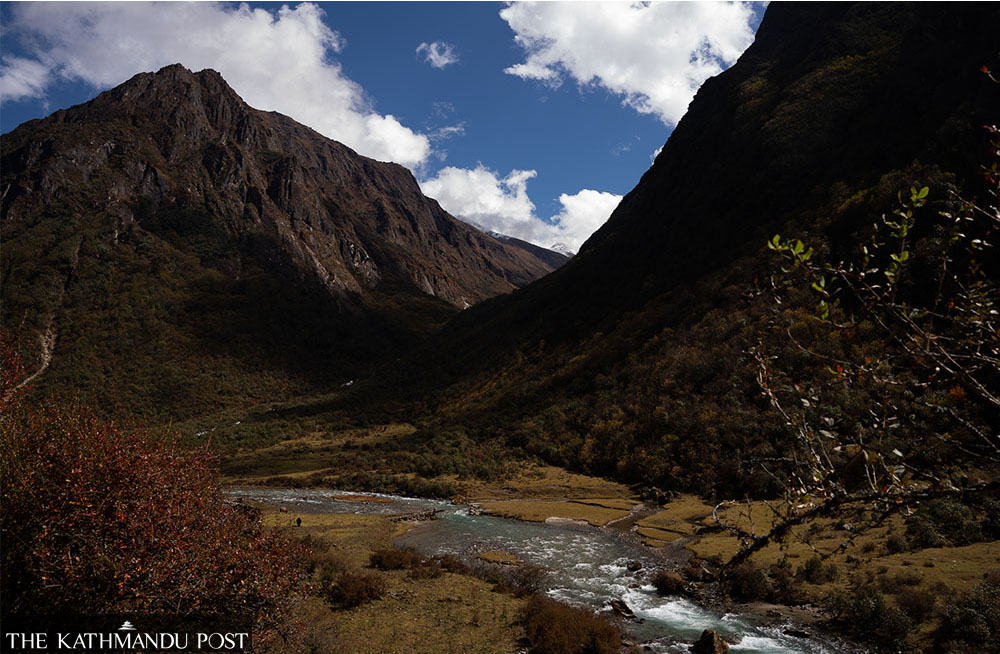
Yak pastures in the Lumbasamba zone. Tulsi Rauniyar/TKP
Questioned on how those consultations were verified, David Sislen, the World Bank’s Division Director for Nepal, said the Bank’s review “was not limited to documentation alone,” pointing to site visits and meetings with local government, community representatives, and civil society organisations. Based on that engagement, he said, the Bank found the consultation processes “adequate for appraisal purposes.” The Bank, he added, was “not in a position to comment on developments beyond what was consulted upon and disclosed.”
In Nepal’s case, the Bank withdrew Upper Arun from its financing pipeline in the second half of 2024, citing unresolved questions about transboundary impact; the dam sits downstream from glacial lakes shared with China, and feeds waters that continue on into India. It has since encouraged Nepal to engage directly with those riparian states and explore other financing models, including public-private partnerships, while it waits on the sidelines. Sislen said the Bank remains open to reengaging “once outstanding matters are resolved.”
It isn’t the first time the Bank has backed away from this river. In the 1990s, it withdrew from financing the nearby Arun III project, with concerns over environmental, social, and financial management, a decision still cited as a cautionary tale in development finance. Decades later, after a wave of massive, contested dam projects worldwide, the Bank returned to the same river for a different dam, part of what critics described as a broader wave of banks betting that the climate case for renewable energy outweighed the costs that once made them retreat. For now, the government has been left to search for financing elsewhere.
Financiers have kept re-upping their bets regardless. The Nepal Electricity Authority alone has faced at least nine formal complaints over its project conduct going back to 1989, yet multilateral banks have continued financing it for at least twenty other projects since, totalling roughly $1.8 billion. Upper Arun and Arun III are only two entries on a much longer list: the World Bank’s own project documents count five more hydropower projects proposed along the Arun's main stem, and thirty-two more on its tributaries.
“These are not isolated lapses,” says Indigenous rights advocate Durga Mani Rai, from LAHURNIP. “They reflect a pattern of sidelining Indigenous communities and bypassing the safeguards that multilateral banks all claim to uphold. The story is becoming painfully familiar. Hydropower is expanding faster than our institutions are learning to uphold Indigenous rights. Unless that changes, what happened here will not remain an exception.”
The Wait
Jojo says he has learned to wait for a date, the day the Supreme Court would finally rule. “The date would come, and nothing would happen,” he says.
Even as the case sat unresolved, the company has kept moving. Last month, the local municipality urged residents to buy founder shares in Sangrila Urja, a company facing two pending Supreme Court challenges that could shut the project down entirely. Two Indigenous welfare organisations objected formally, in writing, calling the notice “against public interest” and warning it was encouraging “plain, simple local citizens” to invest in a company whose legal fate remained undecided.
These days, when Jojo isn’t waiting for a court date, he is often here, kneeling beside a half-built wall on the ridge above Chyamtang, packing wet mortar between stones with his bare hands. Around him, neighbours pass buckets of water and rock, rebuilding, by hand, the same kind of stone walls the bulldozers tore through that first winter.
The river no longer sings him to sleep alone.
“The strange thing is that even in my sleep I hear the machines now,” he says. “I wake up thinking maybe it was only a dream. Then I go outside. They’re still there.”




 14.5°C Kathmandu