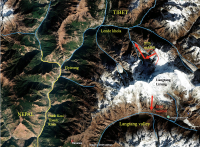
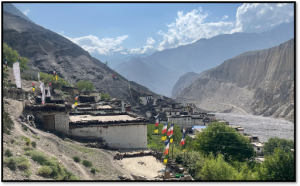
On the morning of August 26, the sky over Rasuwa was clear with no monsoon rain. No agencies were alarmed about any potential catastrophic flood, and people were busy going about their day as usual. Within minutes, a giant torrent of water, ice and debris surged through hundreds of kilometres down the Bhotekoshi and Trishuli Rivers. It destroyed the China-Nepal border port complex, swept away the long-settled villages, destroyed infrastructure and killed hundreds of people while leaving thousands more missing.
Scientists were unable to classify this event in real time. Days later, the debate continued over its exact cause. Researchers have cautiously described it as a cascading effect, with the primary event triggering a chain of interconnected hazards that amplified impacts across social, environmental, physical and economic systems. The flood exposed the limits of anticipatory risk management, revealing the challenges of building resilience under uncertainty.
How we frame a disaster determines how we respond to it. Treating a flood as an isolated disaster event diverts attention from prediction systems, risk monitoring technologies and warning systems. Such framing can obscure broader questions about governance, institutional capacity and social vulnerability.
A social-ecological system thinking offers a holistic view. Rather than treating the disaster as a standalone event, it defines it as an outcome of interactions between people, infrastructure, institutions and environmental processes. This perspective encourages questioning how risk is understood, how resources are mobilised, how responsibilities are distributed, and whether institutions are capable of responding to emerging challenges. This framing expands accountability beyond technical experts and draws attention to governance systems and institutions that shape both vulnerability and resilience.
Studies on resilience view uncertainty as an inherent feature of the social-ecological system rather than a problem to be addressed through an accurate prediction. This distinction matters because even if experts had accurately predicted a low-probability, high-consequence event in the complex mountain terrain of Rasuwa and Trishuli, an effective response may still not have been possible. If a warning arrives only minutes before a hazard requiring immediate evacuation, the technical system may still have succeeded in predicting it, but the social system fails. In such cases, the accountability quietly shifts to people for failing to act on it, rather than to the system that never provided enough time, trust and comprehension.
Resilience is less about defending against a known threat and more about preparing for the unknown. Researchers have identified several characteristics of resilient systems, such as redundancy, diversity, self-organisation, institutional learning, flexibility and adaptive governance. The Bhotekoshi flood illustrates the importance of each.
Redundancy refers to the presence of multiple components capable of performing the same functions, so that failure of one doesn’t collapse the entire system. The downstream warning system heavily relied on upstream monitoring. But as this flood originated from a glacier collapse followed by a cascading mountain effect, two challenges emerged simultaneously: no monitoring systems were built to detect such an event and the upstream monitoring station at Syabrubesi was reportedly destroyed before any communication could reach downstream communities. A failure of a single monitoring point collapsed the entire warning ecosystem.
A more redundant system would include multiple forms of monitoring such as seismic monitoring, satellite observations, community-based monitoring networks, cross-border information sharing and effective upstream-downstream coordination, ensuring that failure of one component wouldn’t collapse the entire warning ecosystem.
But even a redundant warning system may not have guaranteed an effective response. Some early reports suggest that emergency SMS were sent to people, but not everyone could act in time because risk comprehension wouldn’t rely on information alone. The anticipatory actions of people alongside Trishuli and Bhotekoshi would have drawn on experience of monsoon-driven floods, which are characterised by a gradual water rise and observable warning signs. Most people lack the experience to anticipate such a catastrophic flood under clear skies, as they have no living memory of such an event in their lifetime. Warnings are usually filtered through different stages of comprehension, such as trust, experience, perceived vulnerability and confirmation through social and environmental cues, before taking any action. Therefore, community comprehension needs to be developed in advance.
Another critical aspect of resilience is diversity. Resilient systems rely on multiple actors with various capacities, resources and authority. One affected actor doesn’t undermine the system’s capacity, as others can continue functioning. Field reports suggest that the current responses have largely drawn on centralised state disaster agencies rather than a diverse ecosystem of institutions and actors. The response to the 2015 Earthquake demonstrated the value of diverse actors, contributing knowledge, resources and networks facilitating rescue and recovery.
Self-organisation is the capacity of a system to respond to disturbance, without relying on direction from higher authorities. Studies on disaster management consistently show that systems supporting autonomous responses at the local level are often better adapted to disturbance. Reports from Rasuwa suggest that response efforts were constrained by dependence on centralised decision-making and resource mobilisation. The challenge was further compounded by collapsed roads and bridges that physically isolated affected communities.
A self-organising system does not mean communities are left to cope on their own, but a deliberately built system in advance with devolved authority, allocated resources and decision-making rights. The Rasuwa case raised questions about whether the capacity of local government has been sufficiently developed to respond under conditions of uncertainty.
Perhaps the most important characteristic of resilience is learning. Cases of past floods across Nepal suggest that unprecedented flood events are becoming a recurring hazard. A resilient system would treat each event as evidence to improve preparedness, adapt governance arrangements and strengthen institutional capacity. However, each flood event appears to generate an event-specific response rather than broader systemic change. When lessons remain localised rather than institutionalised, opportunities for adaptation are missed.
Understanding social-ecological complexity also requires acknowledging social vulnerability. Disasters do not affect everyone equally. The ability to evacuate at short notice is influenced by factors such as age, health, mobility, resources and access to support. Children, elderly people and other vulnerable groups often face disproportionate risks.
Settlements along riversides are rarely random, as poor and marginalised households often have few alternatives for where they live. Infrastructure development along the rivers has often prioritised economic benefits over downstream safety. This reflects a pattern close to widely discussed climate injustice, where those least responsible for creating risk are often the most exposed to its consequences.
The transboundary nature of Rasuwa floods adds yet another layer of complexity. Originating upstream in Tibet, crossing into Nepal and extending impacts to India, the floods demonstrated that disasters do not respect jurisdictional boundaries. While better monitoring and improved forecasting systems remain critical, prediction alone doesn’t ensure a resilient system. Equally important are diversification, strengthened institutions, self-organisation, institutional memory and recognition of underlying social vulnerabilities.




 14.77°C Kathmandu
.PNG&w=200&height=120)