



 24.79°C Kathmandu
Sun, Oct 11, 2026
Columns
The case for Indigenous political thought
It has always existed and profoundly shaped global trade, politics, economics and science for centuries.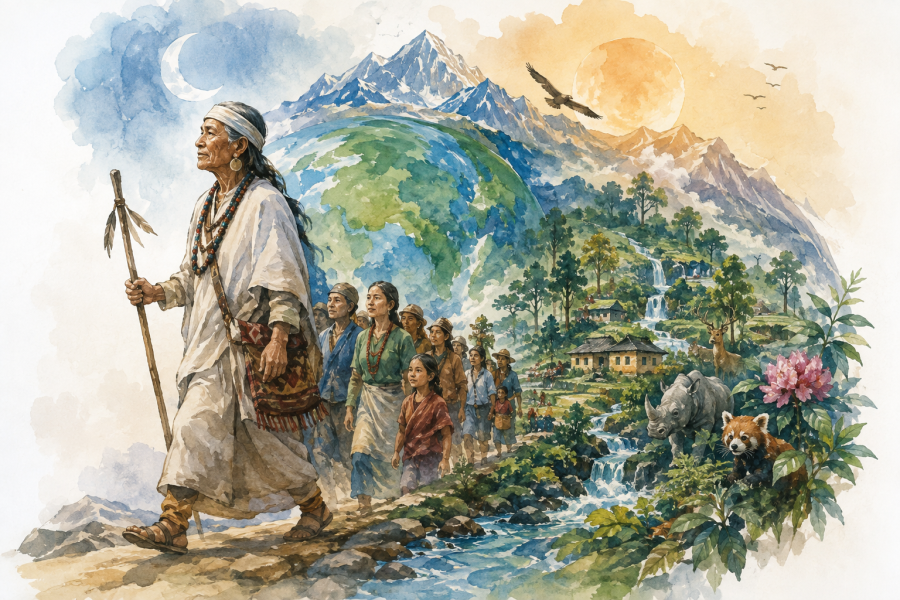
bookmark
Dhirendra Nalbo
Published at : August 8, 2026
Updated at : August 8, 2026 21:20
“A child of the Earth goes back to the Earth.
A child of the Sun goes back to the Sun.
A child of the Moon goes back to the Moon.”
This sacred passage from the Mundhum is recited in dialogic form by Tutu-tumyahangs—learned elders and keepers of Indigenous wisdom—during Limbu Indigenous death ceremonies. At first glance, these lines speak of human mortality. Read more closely, however, they express a profound Indigenous political thought: Human existence is inseparable from the Earth and the wider cosmos, and life is sustained through relationships of reciprocity rather than domination. Embedded within this brief passage is a political philosophy that understands nature not as property to be possessed or exploited, but as the source of life to which all beings ultimately return.
As Nepal marks its 31st Indigenous Peoples’ Day, the government, policymakers and those engaged in the country’s development would do well to pay closer attention to the dozens of Indigenous communities whose diverse political traditions and philosophies have long sustained their societies. These Indigenous political thoughts are living intellectual traditions that offer vital insights for reimagining Nepal’s development, deepening its democracy, and building a more just peace as the country confronts profound political and environmental challenges.
It is useful to consider what political thought is, and how Indigenous political thought might help us reimagine our present and future by recognising the diversity of thinking and being.
In The Rights of War and Peace, historian Richard Tuck divides political thought into the ancient and the modern—the former being collectivistic and the latter individualistic. More broadly, he explains that such thought emerges and evolves in response to defining historical and contemporary political, economic and social crises. The emergence of the liberal order in the post-World War II period, its gradual demise, and the rise of China shaping the world order are examples of such dynamics. Another historian, Richard Whatmore, conceives of political thought—whether Western or ‘Oriental’—as full of complexities and paradoxes: sacred, tragic, nationalistic and utopian, shaped by time and space. Today, we witness such complexities: People are wealthier than in the 1900s, yet inequality is stark; societies are more technologically sophisticated, yet these advances have deepened—or will deepen—divisions; and while some countries are better able to withstand escalating climate harms, others face existential threats. At this crossroads, Indigenous political thought offers a space to reimagine the future.
To be sure, Indigenous political thought has not only always existed, but has also profoundly shaped global trade, world politics, economics and science for centuries. The idea of egalitarianism, interdependence and autonomy—some key tenets of liberalism—is said to be drawn from North American Indigenous thought.
In Asia, as James Scott states, most Indigenous communities maintained political autonomy and self-governance guided by their own philosophical traditions, away from modern states, including by resisting colonial subjugation up until the late 19th century. This is certainly the case for various Indigenous communities in Nepal and many other South and Southeast Asian countries that lived under their own governance structures. Like (non-Indigenous) political thought, Indigenous political thought also evolved in response to colonial contexts. At its core, the thought is not a set of abstract political theories centred on modern-state sovereignty and its sanctioned legal order; rather, it is grounded in the right to self-determination, governance based on reciprocity, legal pluralism, collectivity, forgiveness, reconciliation rooted in history, place (land), relationship and spirituality.
To understand Indigenous political thought, one need not be Indigenous. Nor is discussing it an attempt to dismiss or displace non-Indigenous political thought. Rather, it broadens the intellectual terrain of political inquiry and at times helps explore impossibilities. While the former has endured through centuries of colonial violence and continues to evolve, the latter has generated diverse, often competing traditions—some associated with empire, colonialism, fascism, Nazism, communism and capitalism; others with democracy, constitutionalism, human rights and emancipation. Political thought, be it Indigenous or non-Indigenous, has never been singular; it has always emerged from particular histories, places and struggles.
Unfortunately, academic discussion, including policymaking spaces, often approaches political thought through a reductive framework of right and wrong, celebrating some traditions while dismissing others. Such an approach forecloses dialogue and obscures the historical conditions from which political ideas and new policy interventions emerge. The task of engaging Indigenous political thought, therefore, is neither to talk back to the canon nor merely to look back at history. Rather, it is to move the conversation forward while remaining attentive to the legacies of historical violence, dispossession and injustice, as well as to moments of political innovation and transformation.
Addressing climate crises and advancing justice, forgiveness and reconciliation—at least from legal and humanistic perspectives—are grounded in principles long articulated within Indigenous political thought. In 2021, United Nations Secretary-General António Guterres urged humanity to end its “senseless and suicidal war with nature.” Building on this call, the 2024 UN Biodiversity Conference (COP16) called humanity to live “in balance and in harmony with Mother Earth” while recognising the knowledge, innovations and practices of Indigenous Peoples as indispensable to restoring that relationship.
Meeting today’s ecological, social, economic and political crises demands the courage to move beyond familiar theories, policies and practices—to embrace different ways of knowing, deliberate across worldviews, and take seriously the ideas that are too often dismissed. In that sense, Indigenous political thought has much to offer for confronting these crises and reorienting governance. Yet no enduring transformation in governance is possible without first transforming how we understand ourselves, our responsibilities to others, and our place within the living world.
Ultimately, our common future will not be secured by material accumulation, economic growth or technological innovation alone. Nor will our emotional well-being and harmonious relationships with one another and nature depend on wealth. What is needed is the courage to imagine political possibilities that today may seem improbable. That requires asking deeper questions—questions Indigenous political thought has long posed: What separates us more than unites us? How do we wish to be remembered? What principles guide our actions? Where do we position ourselves in relation to other beings? As the Mundhum reminds us in the three sacred lines above: Life comes from the earth, dwells upon it briefly, and ultimately returns to where it began. How we choose to spend that brief time, however, is entirely up to us.
Dhirendra Nalbo
Nalbo is Co-Founder and Assistant Professor at The Open Institute for Social Science.



Most Read from Columns

Before you take credit for Khula Manch, read its history

Shah went to the UN to speak for Nepal, then left before he could make the most of it
Why Nepal’s latest disaster needs a local name—not just a scientific label
Balendra Shah should prepare for the worst
Lesson learned after the death of Ronaldo
Editor's Picks

Constitutional Bench caught in seniority, ‘pick and choose’ dispute

A Dom boy’s long road to becoming a doctor

From blankets to handmade dolls, two foreign women bring comfort to flood survivors

News Analysis: When institutional defence exposes institutional fault lines

It’s a bird … it’s a plane … it’s the Indian ambassador’s farewell tweets
E-PAPER | October 11, 2026

×