



 14.7°C Kathmandu
Fri, Oct 23, 2026
Columns
Nepal’s left’s theatre of survival
What precisely would a unified left stand for that it does not stand for now, divided?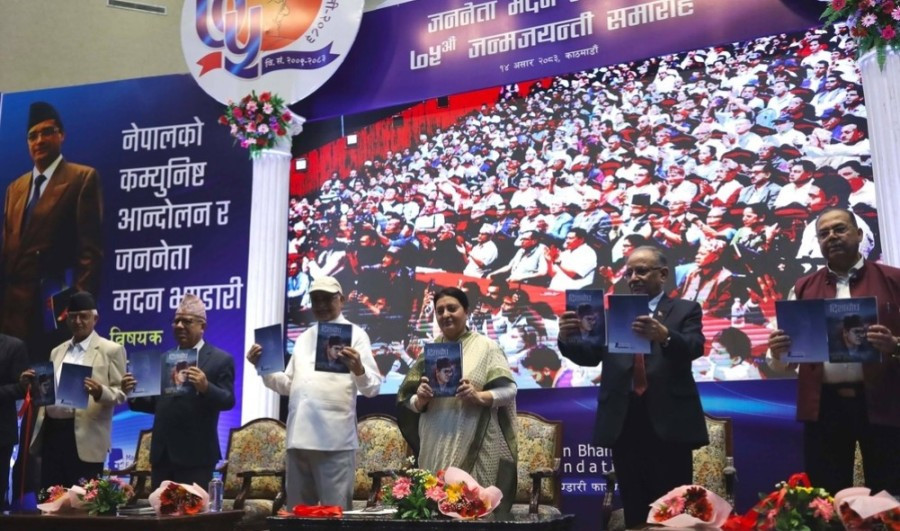
bookmark
Aaditya Karna
Published at : July 6, 2026
Updated at : July 6, 2026 21:44
On June 28, in the dignified premises of the Rastriya Sabha Griha Hall in Kathmandu, four former prime ministers sat on the same stage: KP Sharma Oli, Pushpa Kamal Dahal, Madhav Kumar Nepal and Jhalanath Khanal. Beside them, as chief guest, sat former President Bidhya Devi Bhandari. The occasion was the 75th birth anniversary of the late Madan Bhandari, organised by the Madan Bhandari Foundation, titled ‘Nepal’s Communist Movement and Madan Bhandari’. It was, on the surface, an act of remembrance. Beneath it, as with most things in Nepali communist politics, ran a current far murkier than tribute.
Madan Bhandari, who gave the left the enduring political philosophy of People's Multiparty Democracy and died in a jeep accident at Dasdhunga in 1993 under circumstances that have never been fully resolved, deserved better than to have his anniversary become a backdrop for old men calculating their relevance. And yet, here we are. Nepal's communist movement, which Bhandari spent his shortened life trying to ground in principled democratic thought, is once again circling the old drain: Unification talk, heavy with ambiguity and light on ideology.
The landmark moment that most Nepalis still recall with a mixture of hope and bitterness was the unification of May 2018, when the CPN-UML and CPN (Maoist Centre) dissolved their central committees and merged into the Nepal Communist Party (NCP). The joint press conference at Rastriya Sabha Griha was theatrical in the best sense: Oli and Dahal calling it a ‘historical necessity’ that would bring political stability and economic transformation. The promise, however, was already broken before it was fully made. The agreement between Oli and Dahal had included a critical provision. Dahal would assume the prime ministership after two and a half years, at the halfway point of the five-year term. Oli, who has never been inclined toward sharing power unless compelled to, chose a different path. When the internal arithmetic of the party shifted against him, he opted to dissolve parliament rather than transfer the chair. The Supreme Court eventually overturned the dissolution, but the damage had been done. By March 2021, the same Supreme Court declared the merger itself void ab initio, on a procedural technicality involving the name of the party, and the NCP disappeared as quickly as it had appeared. The two parties reverted to their pre-merger forms. Madhav Kumar Nepal and Jhalanath Khanal, who had sided with Dahal against Oli during the internal conflict, split from the UML to form the CPN (Unified Socialist). Nepal's communist movement had fragmented again, precisely as it always had before.
What followed was predictable and dispiriting. Coalition governments formed and collapsed. Oli led, Dahal led, Deuba led, each in rotating turns, each unable to govern effectively, each managing the art of political survival while the state continued to haemorrhage credibility and the young continued to leave the country at a rate of over 2,000 a day. Youth unemployment hovered around 20 percent. Corruption investigations revealed, year after year, the accumulated wealth of men who had entered politics as idealists and exited each term considerably more prosperous.
Then came September 2025. The Gen Z uprising, triggered initially by the Oli government's social media ban, became the release valve for years of compressed frustration. People were killed, the parliament building was torched, Oli had to flee, and the former Chief Justice appointed the interim prime minister. The country had arrived at something genuinely new and frightening for the old political establishment: The possibility that voters had had enough.
The March 5 elections confirmed what the streets had been saying. Communist parties suffered the worst blow, with a handful of seats to their name. The Rastriya Swatantra Party swept 182 of 275 seats, a result that would have seemed fantastical even six months earlier. The verdict was a generational rejection of the faces that had monopolised Nepali politics for three decades.
It is in this context that the June 28 gathering acquires its true meaning. When Dahal told the assembled audience that “leftist and patriotic forces should get united without delay” and warned that “any further delay would be a mistake,” he was not speaking the language of ideology, but of institutional fear. Oli was channelling the same fear when he said the ‘primary requirement at present is to unite all democratic and leftist forces to defeat active regressive elements.” What both men share, beyond the red flags and the Marxist-Leninist preambles, is a political mortality that neither is ready to accept.
The investigations sweeping through both camps make this even clearer. The Balendra Shah-led government's commission probing the assets of high-level officials since 2005/06 threatens to reach into the financial histories of leaders from both the UML and the NCP. Oli himself faces legal jeopardy over his role when he was leader of the government involved in the killing of youths during the Gen Z crackdown. Bishnu Poudel, UML vice-chairman, was arrested in connection with an asset probe. The arrests, predictably, became a rallying cry within the left, framed as a political vendetta rather than accountability. A political analyst noted, with the brutal economy, that the current push for unification is “not rooted in ideology or a shared long-term vision; rather, it is largely driven by political survival amid declining influence.”
Globally, the left has been confronting a crisis of purpose. Left parties have oscillated between electoral victory and ideological incoherence, often winning on the promise of redistribution and losing on the delivery of governance. Nepal's communists are not unique in this failure, but they are unusually brazen in their reluctance to acknowledge it. Bhandari herself, in her address at the June 28 event, offered the most honest assessment from within the fold: “The leadership and its policies must be consistent with the changing expectations of the public and national requirements. It's not enough to just remember past achievements.” Even the cadres of the UML, those who know the internal dynamics best, have reportedly opposed unity talks, arguing that unity without ideological clarity is destined to collapse, as the NCP of 2018 to 2021 demonstrated so vividly.
The question that the people of Nepal, particularly the young who marched last September and voted this March, deserve an answer to is a simple one: What precisely would a unified left stand for that it does not stand for now, divided? If the answer involves Marxist-Leninist principles, scientific socialism and federalism, those positions already exist in the manifestos of both parties. If the answer involves good governance and anti-corruption, those are the very grounds on which both parties have been repudiated. If the answer is, in honest terms, that Oli and Dahal, and Nepal and Khanal would rather face the future together than separately, because together they might control 42 seats in the 275-member House against an RSP with 182, then the people deserve to hear that too.
Madan Bhandari understood something that his successors have evidently forgotten: That political thought must precede political power, not follow it in search of cover. Reunification without reckoning is not renewal. It is the same red carpet, rolled out again, for the same tired theatre.
Aaditya Karna
Karna is an engineer and civic activist.



Most Read from Columns


Editor's Picks





E-PAPER | October 23, 2026

×