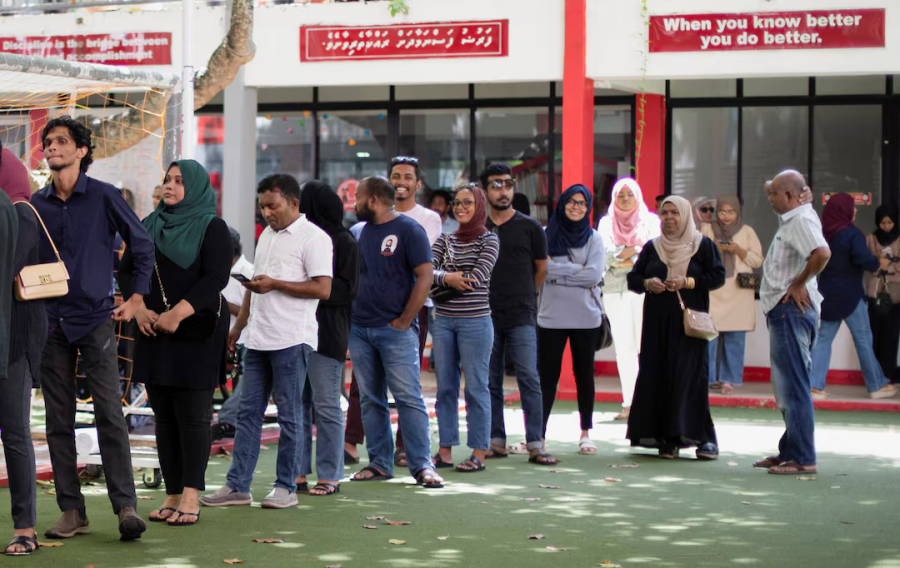
On April 4, the Maldives held three concurrent elections: an election to local bodies, a first-time direct election to the Women’s Development Committee (WDC) and a constitutional referendum on holding simultaneous elections to elect President and Parliament (People’s Majlis). In December 2025, the Maldivian government abolished the atoll Councils and replaced them with a population-based structure in which the number of council members would be determined by the population strength in each of the 21 administrative constituencies, excluding city councils. In the new legislation, the work of the Councils will be supervised by the Local Government Authority, appointed by the government.
The referendum
What is most important is the referendum on holding both the presidential and parliamentary elections in 2028. Public consultation on some of these legislations were opened only for 24 to 48 hours. The Parliament (Majlis) is not required to submit any documents in favour of or against any legislation, but the President is empowered to present such arguments. In spite of critics pointing out that the voters were not adequately informed and the government only publicised information that was positive about holding simultaneous elections, people voted against this referendum by 68.73 percent to 31.27 percent.
Interestingly, the government’s main argument is that it would save the state exchequer $5.2 million. Justifying the rationale for holding the referendum and Local Council elections on the same day, parliamentary group leader Ibrahim Falah from the ruling People’s National Congress (PNC) said that the concurrent elections would save on expenses and that voter turnout would be high.
The government ignored the fact that such voting would be governed by a single emotion, dictating people’s choice to vote in favour of or against the government. The Maldivian Democratic Party (MDP) was critical of the proposed referendum, arguing that the claim that it would save money is totally false, citing the government’s politically motivated recruitment drive, which puts pressure on the state’s exchequer. Political parties and civil society campaigned against the referendum.
Interestingly, buying votes in the election is widely prevalent in the Maldives, which increases the expenditure of individual candidates. Sometimes, voters are rewarded with jobs in State-Owned Enterprises (SOEs). As a result, voters in the country sometimes form groups to bargain collectively for political benefit if the candidate they vote for wins the election.
Adjusting to the electoral debacle
Despite the government’s efforts, the referendum failed to muster people’s support in the nationwide referendum. In a severe blow to the government, the opposition MDP won 247 seats, while the ruling PNC won only 246. Independent candidates also did well by winning 81 seats. The MDP Mayors not only retained their positions, but the party also secured a majority on all five City Councils. However, the PNC secured a majority on the Women’s Development Committee. The election debacle saw a massive cabinet reshuffle announced on April 14, reducing the number of ministries from 22, which was the largest cabinet in the country’s history, to 15 to enhance administrative efficiency.
In a bid to reduce political appointments that have been part of purchasing votes through a cliental system, President Muizzu also said, “Hereafter, there should not be any individual in any position in any of the companies who is hired through a political route or based on a political motivation or because someone said so.” The Constitution of the Maldives under Article 115(f) authorises the President to make political appointments for the smooth functioning of the Presidency.
As a cost-cutting measure, Finance Minister Moosa Zameer announced that 33 percent of jobs across the SOEs will be cut. Reportedly, the republic has approximately 87,000 government-dependent employees, which ‘represents nearly one-third of the Maldives’ working population of 270,000.’ Such proposed layoffs would add to people’s dissatisfaction unless the government finds other avenues for gainful employment.
Economy under stress
Reducing government expenditure would be a significant step to address the economic crisis. According to reports, public debt has risen to between 110 percent and 122 percent of GDP. To overcome the crisis, the Maldives has requested a currency swap facility from India, which has already been rolled over twice. However, any such consideration would require a minimum cooling period of six months. In October 2024, India also ‘rolled over two interest-free $50 million treasury bills in May and September 2025 for an additional year’.
As the energy crisis exacerbated by the Iran war is having a cascading effect on the economy, the Maldives has appealed to India to supply it with petroleum products. Already, the former has reduced petrol subsidies due to the looming economic crisis linked to the war and debt payments. Due to the rise in petroleum product prices, government subsidies to the power sector grew sixfold as the country spends an average of $443.6 million per year to import diesel for power generation.
Like other countries in this region, the war in Iran has hampered the country’s tourism industry and raised inflation, adding to popular discontent, as reflected in the local body elections. According to an estimate, roughly 30 to 35 percent of tourists arrived in the Maldives on flights coming to the country from West Asia. About 54 percent of the country’s total remittances originated from the same in 2025.
A setback to Muizzu?
Politically fractured MDP may not pose a significant challenge to the ruling PNC at the moment, but it is apparent in this election that the opposition has still managed to put up a good show. Differences between former presidents Mohamed Naseed and Ibrahim Mohamed Solih had resulted in the MDP’s loss in the previous presidential and parliamentary elections held in 2023 and 2024, respectively. During the local council election, however, all the factions worked together for the party’s victory. Faction aligned with Nasheed, however, accused the party’s interim chairperson, Abdul Ghafoor Moosa, of not allowing him to speak at the victory rally organised to celebrate MDP’s electoral performance in the local election. This rift has been addressed.
Although this vote is not a mandate in favour of the opposition, it is definitely a report card on PNC’s performance. While the ruling party has taken steps to address this popular disenchantment, it has a long way to go. The economic crisis still hovers; it will determine the party’s political fortunes in the next election.




 14.77°C Kathmandu
.PNG&w=200&height=120)