



 15.34°C Kathmandu

Wed, Oct 21, 2026
Columns
Wealth, professionalism and political responsibility in Bikram Sambat 2082
The nationwide celebration of a young Madheshi woman as Deputy Speaker of HoR offers hope.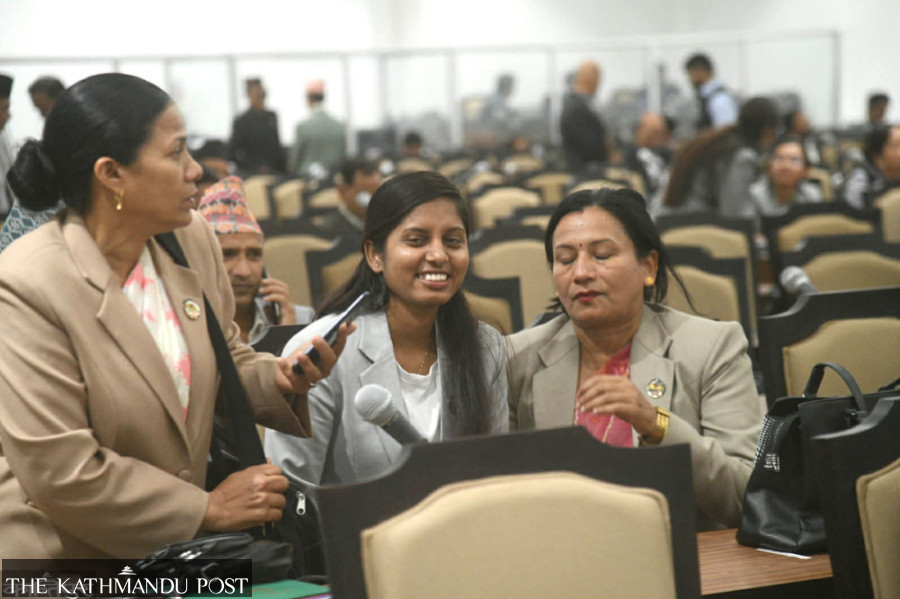
bookmark
Deepak Thapa
Published at : April 16, 2026
Updated at : April 17, 2026 06:06
The last major story of Bikram Sambat 2082 was how collectively wealthy our new cabinet is. The ensuing furore—albeit confined mostly to social media, the preferred venue nowadays for debates and discussions—focused on the fact that almost all the ministers have done pretty well for themselves. Questions were raised about how it was possible for these relative youngsters to have accumulated so much; insinuations made that something somewhere does not sound right; and there were calls for the ministers to prove their wealth was all kosher.
It is easy to understand the source of such angst. Having long been socialised to view politicians as folks who do nothing but politick their whole life, we idealise leaders like the late Bhim Bahadur Tamang, who, as reported, lived in a small room at the end of his life with nothing ‘beyond bare necessities’, and Krishna Prasad Bhattarai, who famously entered the prime minister’s residence in 1990 with equally bare necessities and left a year later with the same items. But the world has long moved on from those antiquated Gandhian notions of a politician, and that is the reality we now see in our government ministers today.
For the first time, we have a Cabinet full of not career politicians but professionals with careers backing them. The variety and volume of wealth disclosed by the ministers are substantial enough to raise eyebrows. Not, by the way, in terms of presuming some sort of nefarious dealings by them but in learning it is possible to make more than a decent living (mostly) in Nepal. Kudos to them. There are also new sources of income that were unknown in the past such as through social media accounts, most notably, Prime Minister Balendra Shah’s, or the share market in which every other young person seems to be invested, materially and mentally.
It was quite unfair to target the ministers for being well to do. Unless one can prove criminality on their part, the fact that the government decided to publicly disclose everything is to be appreciated. That is more than what can be said for some of the earlier governments. The law requires ministers (and other public officials) to only submit details of their property to the proper authority, which, presumably, in the case of the cabinet, is their collective selves; disclosure is at the discretion of the said authority. Now that the government is aiming to amend many laws wholesale, including mandatory disclosure in the Prevention of Corruption Act is something that should be considered as well. There will be privacy and associated security concerns, but the need to rekindle the nation’s trust would far outweigh personal considerations.
Another glaring lacuna in need of plugging in the said Act is its silence on the requirement to collect and publish property details at the time of demitting office as well. Only with a before and after picture can we be assured that public officials stayed true to their oath to serve the nation honestly.
It is a measure of what an impact our political transition has had beyond Nepal that Time magazine decided to include Prime Minister Shah in this year’s list of 100 most influential people. As the write-up in his entry noted: “‘All politicians, new and old, are thieves,’ Balen once posted on social media. Nepalis will hope he proves himself wrong.” I am sure all of us could not agree more with that sentiment.
Class disconnect
One fallout of the property disclosure fracas has been the lowering of the estimation of Home Minister Sudan Gurung. In the slowly emerging true to form of his, Gurung made the rather crude and tactless comment that being poor is no one’s fault but to die poor certainly is. The outcry over its implicit insensitivity forced him to remove his post but not before it had left a bitter aftertaste.
If personal wealth is a proxy to measuring success in life, the cabinet appears to be a club of the accomplished. The worrisome part of having a set of such high-achievers in charge of the country is that they could easily begin to believe that individual effort is the sole virtue—and the words of Home Minister Gurung only reinforce such a perception.
The next logical step for such a group would be to turn a blind eye to the structural constraints facing the vast majority of Nepalis, resulting in inequities stemming from being on the wrong side of the divide defined by class, gender, caste/ethnicity, language, religion, region, or physical and/or mental ability. That is where our focus should be, instead of fruitlessly squabbling over how much money these people made before entering politics.
Historic win
The other big news at the end of last year was the election of Ruby Kumari Thakur to the esteemed position of Deputy Speaker of the House of Representatives (HoR). Due credit must be given to Harka Sampang, Chair of her Shram Sanskriti Party, who first picked up Thakur to become an MP, the youngest this time around, then having the courage and insight to put her up as the party’s candidate for Deputy Speakership despite having just seven seats in parliament, and, finally, in managing to bring on board the ruling party. Credit is also due to the Nepali Congress and the Nepali Communist Party for standing behind Thakur.
As for the other party in the HoR, the CPN-UML, all it deserves is a big boo. Where it could have joined hands with the others in celebrating the victory an upcoming leader who has persevered against multiple forms of exclusion, most prominently of class and gender, someone who represents their supposed natural constituency, the UML chose to abstain from the vote for no reason. And, yet the party leadership continues to wonder why their defeat was so absolute in the last elections…
What was most encouraging was the positive vibes Thakur generated overall. Apart from a few who questioned her youth, social media was full of good wishes for Thakur and also general delight in her victory. Everyone around me exuded similar feelings as well—and my friends and family cannot have been an aberration. It surely was not only the heart-tugging interviews with her and her migrant worker father that aroused such positive emotions. Neither could it have been the painfully beautiful smile of hers and her genuine humility that did the trick. I believe Nepal has collectively recognised the historic nature of her election and wished her all the success. There are problems galore in how the state and pahadis view and deal with Madheshis, but the enthusiastic celebration across the country of a young Madheshi woman gives us plenty of hope.
Around the time the first president of a republic Nepal was being elected back in 2008, anthropologist Rajendra Pradhan had mused only half in jest that to send the message of us being well on the way to an inclusive, New Nepal, all the political parties should join hands to elect a poor Madheshi Dalit widow to Nepal’s presidency? That did not happen, of course. But, two decades later, we have taken one firm step in that direction, with the elevation of an economically disadvantaged woman from the Madheshi pichhada barga (backward class) community to a high constitutional post.
It does make one proud, doesn’t it?
Deepak Thapa
Deepak Thapa has been a fortnightly columnist with The Kathmandu Post since 2009, writing on a range of topical social and political issues.



Most Read from Columns




Editor's Picks




E-PAPER | October 21, 2026

×