



 15.68°C Kathmandu


Fri, Oct 23, 2026
Columns
‘New party’ trap
It’s one thing to win elections. Turning public frustration into lasting political power is quite another.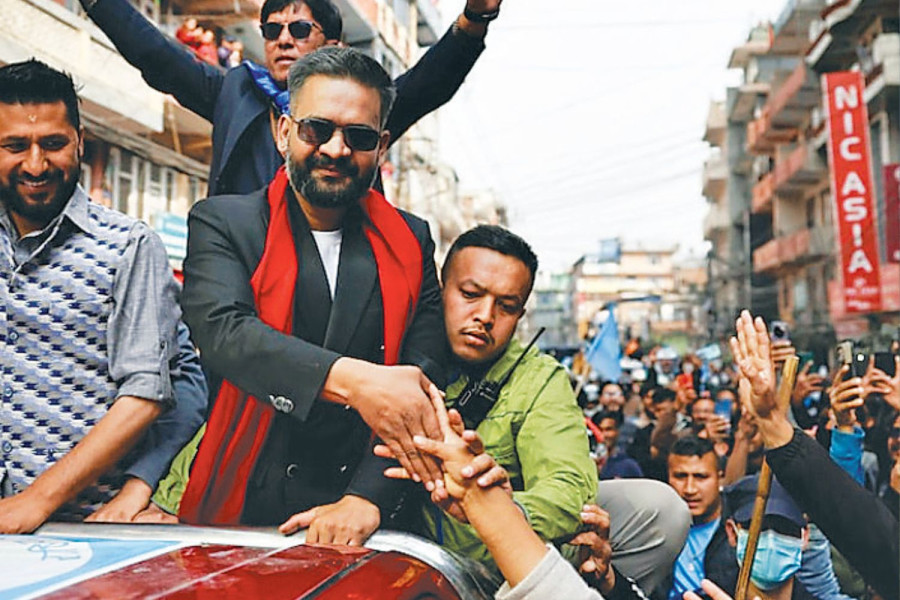
bookmark
Gauri Shankar Gautam & Ojaswi Pandey
Published at : March 17, 2026
Updated at : March 17, 2026 07:20
Nepalis have a habit of embracing new political parties with enormous hope, only to abandon them just as quickly. The dramatic rise of the Rastriya Swatantra Party (RSP) may yet break that cycle. Or it may become its latest example. That all depends on what it does once the excitement of victory fades.
Established only months before the 2022 House of Representatives (HoR) election, the RSP surprised nearly everyone. Emerging as the fourth-largest force in Parliament, the party quickly became a major player in national politics. For a party in its infancy, that level of support was unprecedented. The result disrupted the longstanding dominance of Nepal’s traditional political actors and signalled rising voter dissatisfaction with the governance record of established parties.
The political signals had been building for some time, evident in the emergence of movements such as ‘Enough is Enough’ and ‘No, Not Again’. The surprise victory of independent candidate Balendra Shah in Kathmandu’s mayoral race fuelled the changing political mood. The RSP’s breakthrough in the 2022 HoR election translated that sentiment into national politics, sparking a surge of public enthusiasm.
Yet the excitement surrounding new political forces masks a deeper challenge: Sustaining political momentum over time. Nepal’s political history suggests that the real test for new parties begins after their initial breakthrough.
Consider the experience of the Communist Party of Nepal (Maoist). In the 2008 Constituent Assembly election, the party entered mainstream electoral politics after a decade-long insurgency and quickly became the largest force in the assembly, winning 120 of the 240 directly elected seats. Riding the momentum of the 2006 People’s Movement, Nepali politics appeared to enter a transformative new phase.
But that momentum proved difficult to sustain. In the next election, the Maoists’ directly elected seats dropped sharply from 120 to just 26. Their vote share declined, and the party that once seemed poised to reshape Nepali politics gradually lost its dominant position.
The Madhesh-based parties followed a similar trajectory. Their movements created powerful political momentum by demanding representation and federal restructuring. In the 2008 Constituent Assembly election, Madhesh-based parties together secured more than 80 seats in the Assembly, a remarkable achievement for regional political forces. But internal rivalries, leadership disputes and repeated factional splits gradually weakened their influence. Over time, the energy that once mobilised the movement dissipated into fragmented party politics.
New parties often struggle to sustain these foundations once the initial momentum fades. This becomes visible when they attempt to carry early electoral success into subsequent elections. Meanwhile, established parties like the Nepali Congress and the CPN-UML built dense networks of affiliated organisations, including student unions, labour groups, teachers’ associations and local party committees. These networks allow parties to remain connected to voters even when they are out of power and have helped them survive political setbacks for decades.
Nepal is not alone in this pattern. Comparative research on party systems in Central and Eastern Europe shows that many new parties rise quickly on waves of anti-establishment sentiment but collapse within a few electoral cycles. Only about one-third of new parties survived beyond that.
If the RSP hopes to avoid Nepal’s recurring ‘new party trap’, it will need to confront several foundational challenges early.
First, the party must build a durable organisational structure. Parties that endure usually develop strong grassroots networks that keep them connected to their constituencies. Without such networks, it becomes difficult to maintain political visibility once the excitement of electoral victory fades.
Even parties that once commanded strong grassroots mobilisation have struggled to sustain momentum over time. The Maoists’ decline despite vast wartime networks and the fragmentation of Madheshi parties with strong regional bases show how quickly political strength can erode.
Second, the party will need to cultivate leadership beyond a small group of prominent figures. Parties that revolve too heavily around a few individuals often struggle with internal cohesion and leadership succession.
The CPN-UML offers a cautionary tale, where years of ‘Oli-fication’ entrenched one-man dominance while steadily eroding the party’s leadership depth. Developing a credible second tier of leaders beyond high-profile figures, such as Rabi Lamichhane and Balen Shah, will therefore be essential if the RSP hopes to remain a long-term political force.
Third, the party must develop a clearer ideological identity. Anti-corruption and anti-establishment messaging can mobilise voters during moments of frustration, but it rarely provides a durable political anchor. The quick rise and fall of the Bibeksheel Sajha Party illustrates this dilemma. Early urban enthusiasm alone proved insufficient without a clear ideological spine. As the party matures, voters will expect clearer positions on economic policy, governance reforms, and Nepal’s place in an increasingly complex international environment.
None of this diminishes the significance of the RSP’s rise. In many ways, its success reflects a healthy democratic impulse. Nepali voters remain willing to challenge entrenched political actors and reward alternatives.
The real test still lies ahead. Nepali voters have shown they are ready to reward new political alternatives. If the RSP hopes to avoid the fate of many new parties before it, it must transform public frustration into organisation, leadership and ideas that can endure beyond a single electoral moment.
Gauri Shankar Gautam
Gautam is a PhD Candidate in Economics and Public Policy at Tufts University, with a focus on development economics.
Ojaswi Pandey
Pandey is a Master’s in Public Policy candidate and a John F Kennedy Fellow at Harvard Kennedy School.





Most Read from Columns




Editor's Picks





E-PAPER | October 23, 2026

×