



 28.33°C Kathmandu

Tue, Sep 29, 2026
Columns
Putin’s signal to the West
India’s steadfastness in its relationship with Russia should shape the latter’s approach.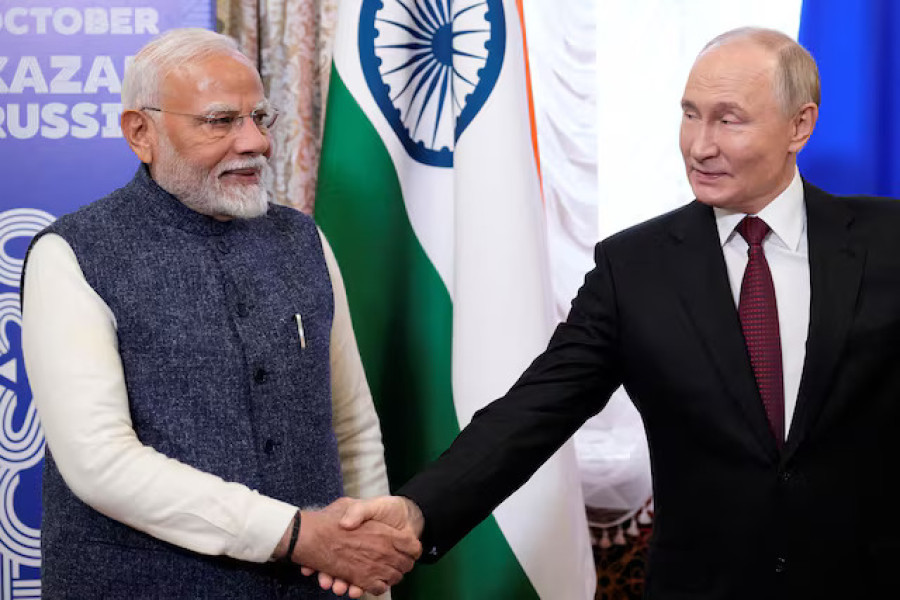
bookmark
Smruti S Pattanaik
Published at : December 3, 2025
Updated at : December 4, 2025 07:33
Russian President Vladimir Putin will visit India on December 4-5 to attend the 23rd annual bilateral summit, which was instituted in 2000. The two countries elevated their relationship to a ‘Special and Privileged Strategic Partnership’ in 2010. It is Putin’s first visit to India after the Ukraine war. This visit is notably significant as it is taking place at a time when India’s relationship with the United States is seeing a downturn.
Western countries have long criticised India for purchasing Russian oil, and White House deputy chief Stephen Miller even went so far as to accuse India of funding the war in Ukraine, as Trump imposed 50 percent tariffs in August this year. Yet India has maintained that it retains strategic autonomy and will follow policies dictated by its national interests. Due to pressure from the US, India has stopped buying oil from Iran. Russian oil has emerged as a major energy source for India because it is cheaper and supports India’s growing economy. In 2024-25, imports of Russian oil shot up to 35.8 percent, up from 2 percent in 2022.
The larger geopolitics
The Soviet Union as a reliable partner is etched in India’s public memory and continues to shape public opinion, especially in the context of the Trump administration’s transactional relationship. Especially after Operation Sindoor, Trump’s cosying up to Pakistan is a powerful reminder of the US’s problematic relationship with India during the Cold War. India and the US, to a very large extent, have institutionalised their relationship as symbolised by their 2+2 dialogues, partners in Indo-Pacific, technology transfer and defence purchases. US tariff measures and public extortion on India’s relationship with Russia and the quick embrace of Asif Munir, Pakistan’s Field Marshal, have not escaped the notice of the new generation that knows little about the Soviet Union and its successor state, Russia’s relationship with India. India’s External Affairs Minister S Jaishankar described this relationship as ‘one constant in world politics’ which is constantly in flux.
India’s rapprochement with China, in spite of major divergences on border issues, reflects New Delhi’s realistic approach, which does not align with how the US projects both Russia and China. India continues its policy of multialignment, which provides it with elbow room to pursue its national interest seamlessly. Its participation in the BRICS and the SCO, which is seen as ‘anti-West’ institutional arrangements by the Western world, demonstrates how India leverages its participation as part of its ‘strategic autonomy’ in foreign policy practice.
In this apparent geopolitical flux, Putin’s visit is significant and can drive the bilateral relationship by overcoming obstacles in trade and defence supplies. The trade has long been in Russia’s favour. For example, bilateral trade, which stood at $1.4 billion in 1995, increased to $68.7 billion in the Fiscal Year 2024-25, with India’s export standing at $4.88 billion. Due to sanctions, the trade is taking place in national currencies. The Reserve Bank of India, to facilitate trade settlements, has simplified the process to enhance this trade in national currencies by allowing banks to open Rupees-Vostro accounts in their corresponding foreign banks and permitting funds in these accounts to be invested freely in government securities and treasury bills.
Aligning interests
The surge in bilateral trade is largely due to the import of Russian oil, which lubricated the Indian economy as global oil prices rose significantly. However, both Reliance Industries and Nayara Energy have stopped buying Russian oil due to US sanctions on Russia’s largest oil companies, Rosneft and Lukoil, which will take effect from November this year. Addressing India’s concerns on the trade deficit would be important. India has listed 65 non-tariff measures that hamper India’s trade with Russia. Energy trade is likely to take shape during this visit. As part of civil nuclear cooperation, a proposal is for the Russian company Rosatom to develop small modular nuclear reactors, which will help India advance its green energy transition objectives.
India has diversified its defence procurement, keeping in mind its defence needs of acquiring a modern, advanced platform, but Russia continues to remain a major supplier. Defence Minister Rajnath Singh and his Russian counterpart Andrey Belousov met on June 26 on the sidelines of the SCO meet in Qingdao. They discussed the supply of S-400 systems (which have been delayed due to the Ukraine war), upgrading Su-30 MKIs, procuring critical military hardware and upgrading air platforms. Both countries are jointly producing BrahMos, which was used during Operation Sindoor. In the recent past, there were news reports, denied by Russia, which indicated that Russia would sell RD-93 MA jet engines to Pakistan for upgrading its JF-17 fighter jets. But there are concerns about selling the same engines to China, which would upgrade its JF-17 and sell it to Pakistan.
This will remain a major concern for India as Russia expands its arms export markets. There are some indications that Russia is mindful of India’s concerns. The manner in which India has remained steadfast in its relationship with Russia despite US pressure should shape Russia’s approach. India and Russia held the first 2+2 dialogue in 2021.
Despite Pakistan’s reservations, Moscow has engaged India in Afghanistan within the Moscow format established in 2017. India participated in the meeting at the ‘non-official level’, and it officially attended the Moscow Format Meeting on Afghanistan in 2021 alongside the Taliban. India was also part of the troika, comprising Iran and Russia, to protect its interests in Afghanistan after the US withdrawal.
This visit also comes at a crucial time when Moscow is discussing the US peace plan for Ukraine. India, which shares close relationships with Russia and Ukraine and has navigated its relationship with both countries carefully, will be closely watching this development. The peace plan will have a significant impact on Europe, the expansion of NATO and also the future of Ukraine. There will likely be discussion on this, along with several other geopolitical issues concerning the two countries.
Smruti S Pattanaik
Pattanaik is a research fellow at the Manohar Parrikar Institute for Defence Studies and Analyses, New Delhi, India.
.jpg&w=200&height=120)

Most Read from Columns
Editor's Picks

What triggered the Rasuwa flood? Scientists piece together a complex chain of events

The floods keep coming. Nepal keeps starting over

In a settlement destroyed by the Bhotekoshi flood, a disabled couple offer strangers the little they have

Nepal working on detailed assessment as Bhotekoshi flood reconstruction could cost up to $5 billion

Rabindra Dhant gave Nepal a reason to smile. Now his camp wants real action behind the praise
E-PAPER | September 29, 2026

×