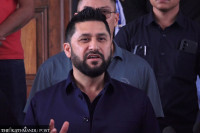
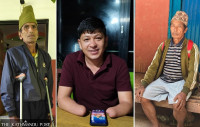
On Thursday, some polling stations introduced priority lines and assistance, but many voters still found it hard to navigate the voting process. A man is in the process of casting his vote, in Shankhamul, Kathmandu on Thursday. Hemanta Shrestha/TKP
They walked for hours through rugged hills and navigated narrow voting spaces. On Thursday, many persons with disabilities across Nepal made determined efforts to cast their ballots in the snap parliamentary elections, triggered by the deadly anti-government protests last September.
The enthusiastic participation of Nepalis with disabilities hints at some improvements, but many obstacles still make it difficult for them to vote.
About 2.2 percent of the country’s population is disabled, according to the 2021 census. Around 650,000 people live with some form of disability, with slightly higher prevalence among men (2.5 percent) than women (2 percent).
Despite constitutional guarantees of equal participation, however, many voters with disabilities are still struggling to exercise their franchise with dignity and confidentiality, disability rights advocates say. Physical infrastructure, transport limitations and the lack of independent voting mechanisms continue to hold them back.
Jaldeep Sapkota, a 22-year old visually impaired voter from Butwal, said casting his ballot in this election was smoother than he expected. It, however, was not without challenges.
“At the polling centre, the voting officers were very cooperative and we didn’t have to stay in line,” Sapkota said after voting at a centre in Butwal’s ward 8. “I was also allowed to take along a visual guide. I didn’t face any attitudinal barriers.”
But Sapkota says physical accessibility still needs improvement.
The place was too crowded and the spaces were too narrow for wheelchairs to navigate, Sapkota said. “The voting table was also quite high, which could be difficult for shorter people or those with physical disabilities,” he said. ‘‘Overall, the system was better managed compared to last time, but there’s still more to do.”
Sapkota said electronic voting machines could have helped the visually impaired vote independently without relying on guides.
“If we use electronic voting machines in the future, we won’t need a visual guide,” he said. “That would make the process much better.”
At many polling stations, officials say efforts were made to ease the process for elderly and disabled voters but in crowded centres, practical challenges remained.
Ramesh Khatiwada, an assistant polling officer at a centre in Kathmandu’s ward 32, said he and his team had created separate paths for wheelchairs and prioritised elderly and disabled voters to avoid waiting in line. Family members could assist voters if needed, or polling officers stepped in to follow the voter’s instructions.
However, Khatiwada acknowledged that the polling centre itself had significant limitations.
“This centre was very crowded—we had nearly 4,900 voters in five booths, and the space was narrow,” he said. “It was difficult to create dedicated areas for differently-abled voters. We were unable to build the ‘model’ polling station as instructed, though we adjusted as much as we could.”
He said using alternative spaces, such as a nearby field of the Mahadevsthan temple, would have allowed better accessibility arrangements. ‘‘But we didn’t have that permission, so we had to stick with the school premises,” he said.
Despite the challenges, however, disabled voters turned up to vote in encouraging numbers.
In Kavre district, Sunil Shrestha accompanied his tenant, Bishnu Magar, a 27-year-old voter with autism, on a nearly five-hour walk through the rugged hills to cast his ballot.
He said Magar had already decided which party he wanted to support.
“When it was his turn, I guided him through the process so he could cast his vote,” Shrestha said. “He was very happy to exercise his right like everyone else.”
Disability rights advocates say such experiences point at both the determination of voters and the gaps that remain in ensuring accessible elections.
Nir Shrestha, director at the Blind Association Nepal, said preliminary reports from across the country suggest that while there is greater sensitivity towards disabled voters, accessibility has not improved much compared to previous elections.
“Polling stations were set up at the same places—hospitals, public areas or temples—where there are various obstacles,” Shrestha said. “Complete accessibility doesn’t exist anywhere, though there seemed to be an effort for minimum accessibility.”
He added that physical infrastructure still remains the most common challenge. ‘‘Reaching the station and moving around independently once inside is often not possible,” he said.
Shrestha also raised concerns about the confidentiality of votes for people who require assistance.
“When a person cannot vote independently and must rely on a helper, be it a family member, there is always a doubt about whether they can cast their vote confidentially,” he said.
Rights advocates say the state should explore alternative voting systems, including electronic voting machines and options such as postal or cross-constituency voting for people unable to travel to their registered voting locations.
“Polling centres should also be on the ground floor without stairs or steep inclines,” Shrestha said.
For voters like Sapkota, the progress made so far is encouraging, but accessibility must be improved.
“My experience was wonderful overall,” he said. “But when it comes to accessibility, there is still more to do.”
Aarya Chand is a reporter at The Kathmandu Post covering social issues. Before moving to the social beat, Chand was an intern covering culture and lifestyle for the Post.




 14.82°C Kathmandu