



 14.21°C Kathmandu

Fri, Oct 23, 2026
Columns
What Nepal must do to break the cycle of instability
Expecting socio-economic transformation without changing political culture is pointless.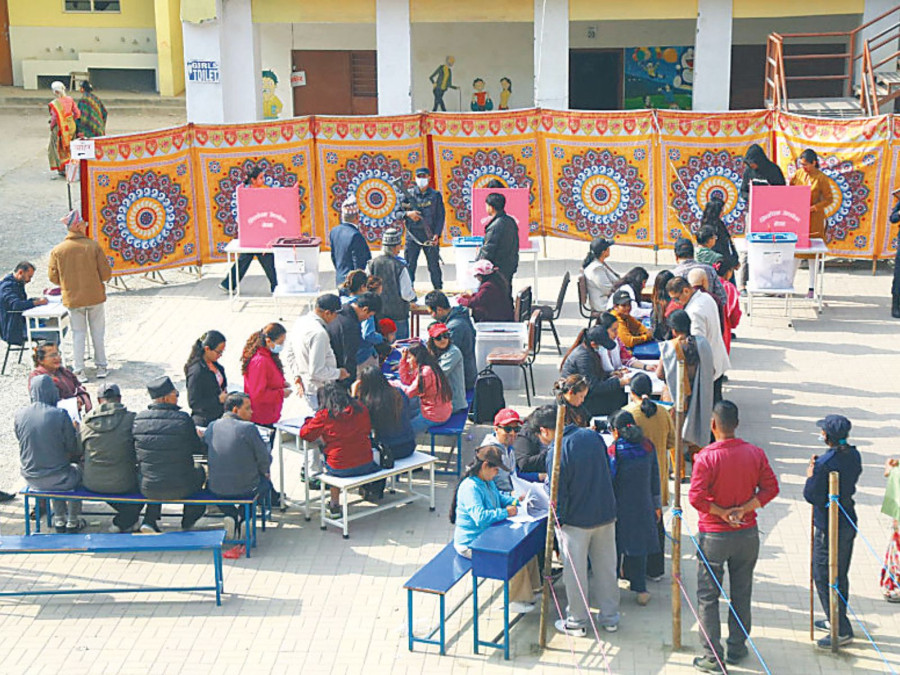
bookmark
Raju Prasad Chapagai
Published at : March 6, 2026
Updated at : March 6, 2026 15:03
On Thursday, doubts about whether the election would be held on time were over. This development is definitely a matter of satisfaction for Nepalis. However, many stakeholders, including common citizens, seem concerned about whether the election will bring stability and pave the way for good governance and equitable prosperity. It is valid to doubt the election’s outcome against the backdrop of protracted instability since the 1990s.
Elections alone do not guarantee democratic stability. Regardless of several elections held in the past, political instability, in our context, has often become more predictable than stability itself. Governments have changed, coalitions have shifted intermittently, but the underlying causes of political instability have persisted. This pattern must end.
What Nepal needs after the elections is therefore not merely a new parliament and a new government, but a new political understanding and culture. A different resolve, a different mindset and a different level of integrity in political leadership must emerge, especially among those parties and leaders who represent people in the federal House of Representatives.
Given the structural features of the electoral system that we have adopted, the probability of a single party securing an outright majority remains slim, though not impossible. In case such a majority is secured, it would naturally lead to a single-party government. However, history offers disturbing lessons. Even majority governments couldn’t sustain themselves due to the infighting, factionalism and leadership rivalry. The instability experienced by the Nepali Congress in the mid-1990s and by the then Nepal Communist Party in 2020 stands as profound evidence that a numerical majority alone cannot ensure stability.
If a party secures a majority in this election, it must internalise the lessons from the past and demonstrate intraparty democracy and democratic culture. A majority government should not become a victim of unhealthy intra-party competition. Nor should the country be pushed towards crisis despite a clear mandate from the people. The parties aspiring to form the government must awaken and embrace this collective wisdom.
If no party obtains a decisive majority, a thoughtful and principled approach to coalition-building would be essential. The largest party in the House of Representatives should be entrusted with leading the government, seeking support from other parliamentary parties, with the exception of the second-largest party, which must assume the role of major opposition.
Unlike past precedents, such a coalition must be clearly defined in terms of the purpose as well as duration. It should prioritise national interest above short-term partisan gains. The discredited practice of rotational prime-ministership, which has previously undermined governance and public trust, should be abandoned. The coalition should be built on a full five-year term commitment. The supporting parties must refrain from employing destabilising tactics such as withdrawing a vote of confidence on the prime minister on petty grounds for partition or other interests.
At the same time, the second-largest party should consciously and formally commit to functioning as a stable and constructive opposition for the full parliamentary term. It is an undeniable fact that a mature parliamentary democracy requires not only a responsible government but also a responsible and vibrant opposition. Unfortunately, almost all political parties in our context since 1990 have strived to be in the government; rarely has any political party outright declared its intention to remain in the opposition for the entire parliamentary term. Such a situation has fueled the rapid erosion of public trust in Parliament.
At least the major opposition parties in the future parliament therefore must not perceive their role as obstruction for their own sake, nor should they aspire to enter government through opportunistic realignments. Instead, it should actively represent the voices and grievances of citizens, communities, minorities and marginalised and articulate alternative policy visions and safeguard parliamentary integrity.
It is also worth noting that a credible opposition does not depend solely on the legislative business offered by the government. It generates its own parliamentary agenda through private member bills, a variety of motions and substantive policy debates and active engagement under the committee system. Contrary to our ill practice, the real opposition party and its leader refrain from bargaining for partisan shares in constitutional or public appointments. Rather, it fulfils the constitutionally expected duty of checks and balances with integrity and consistency.
Due to past malpractices, public trust in Parliament has been fragile. The responsibility to rebuild and sustain this trust lies equally with both the ruling and opposition parties.
After nearly a decade of constitutional implementation, it is expected that the future government initiates a credible and independent review of the functioning of the constitution. Certain issues requiring constitutional and legislative amendment have already surfaced in formal and informal discussion forums. It is highly desirable that on matters of national importance, parliamentary parties—whether in power or opposition—should make maximum effort to achieve consensus. Constitutional reform should not become a partisan battleground but a shared national undertaking. The contesting political parties should keep that in mind.
Similarly, at minimum, there must be cross-party understanding on key governance priorities: strengthening the rule of law, controlling corruption and ending impunity. These are not optional commitments; they are constitutional promises and have also been strongly emphasised by the agreement between Gen Z and the government.
Reform efforts to be initiated by the future government must be objective rather than rhetorical. As a matter of priority, they must address structural causes of recurring instability: denial of economic, social and cultural rights, exclusion, discrimination, marginalisation and persistent poverty. Without confronting these underlying conditions, political reform alone won’t ensure sustainable peace.
A shared national vision and coherent foreign policy are a must. Fragmented and party-specific positions on national interest have weakened the country’s strategic standing and eroded its international reputation. The ruling parties must seek a broad national consensus on core interests and foreign policy issues. Given our geopolitical sensitivities and regional complexities, coherence among political parties on foreign policy priorities is not a luxury but a necessity.
Political parties are not solely responsible for the instability. Excessive politicisation of civil society, media institutions, the private sector and professional organisations has also contributed to democratic fragility. Deviation from independent and professional standards has weakened institutional credibility.
These sectors therefore must undertake honest self-reflection. They must redefine their roles and reassert independence and professionalism to function as principled and permanent watchdogs.
The evolving role of the younger generation is particularly significant. While some leaders of recent youth movements have entered party politics, others remain active within civil society platforms. This diversity is encouraging. Their constructive vigilance must continue to resist partisan capture of state systems.
The suggestions outlined above may appear idealistic. Yet they are not optional; they are essential given our context. Expecting meaningful socio-economic transformation without changing political culture is meaningless. Every politician should internalise the hard reality that the country cannot afford another extended phase of instability. This election should not only bring new faces to the parliament, but also pave the way for a fresh start—a new political culture built on democratic values.
Raju Prasad Chapagai
Chapagai is a lawyer with a concentration on constitutional and human rights law.




Most Read from Columns




Editor's Picks





E-PAPER | October 23, 2026

×