



 18.54°C Kathmandu
Fri, Oct 16, 2026
Books
Exploring Nepal-India ties in a changing world
Former Indian ambassador to Nepal, Ranjit Rae, discusses his new edited volume and why listening to voices from both sides matters today.
bookmark![]()
Anish Ghimire
Published at : January 8, 2026
Updated at : January 8, 2026 07:07
Nepal and India are navigating a rapidly changing regional and global landscape, with discussions on tradition, trust, and strategy becoming increasingly crucial.
Ranjit Rae, former Indian ambassador to Nepal, brings these debates together in his edited volume ‘Shared Bonds, Strategic Interests: India-Nepal Relations in a Turbulent World’. This book, which features voices from both Nepal and India, examines the relationship through multiple lenses—historical, cultural, political, and strategic.
In this interview with the Post’s Anish Ghimire, Rae reflects on why shared bonds and strategic interests matter today, and what continues to shape the ancient bond between Nepal and India.
The book’s title is interesting. It speaks of both ‘shared bonds’ and ‘strategic interests’. Which of the two do you think weighs more today, and why?
The bonds we share are ancient. They existed long before modern nation-states were formed. Strategic interests, by contrast, are a more recent idea, emerging after the rise of sovereign states and within a new geopolitical context.
In the long term, cultural ties and people-to-people connections remain crucial. In the contemporary context, however, strategic considerations have also become increasingly important.
Were there any essays in the book that challenged your own understanding of the Nepal-India relationship?
There are nuances and differences in viewpoints, as reflected in some of the essays. For instance, on security issues, Nepali and Indian perspectives differ slightly. From Nepal, international relations are viewed in relation to both India and China, while India approaches the relationship from a different vantage point. These new angles are present.
However, on the fundamentals, there is broad agreement. Almost all contributors agree on the importance of the relationship for both countries and on the general approach. There is also a wide consensus among experts in both countries that greater emphasis should be placed on the economic dimension of the relationship.
In the context of Gen Z, I have argued in my introduction that India’s neighbourhood policy must be youth-centric. Across the region, including in Nepal, young people have played a key role in political change and transformation. Strengthening people-to-people and youth-to-youth connections should therefore be a central part of foreign policy and regional engagement strategies.
The book brings together multiple voices from both countries. How important was it for you to avoid a single official narrative?
When I conceived of this book, after many years of working in Nepal, I was conscious of a recurring issue: discussions are often framed solely from India’s perspective. This time, I wanted to take a more holistic approach by listening to and respecting other viewpoints. To understand and improve a relationship, it must be seen from diverse perspectives.
While the Indian perspective is important, the Nepali perspective is as vital. On several issues, India and Nepal have differing views. To move forward, each side must understand where the other is coming from and try to see issues from the other’s position. Only then can mutual trust grow and irritants in the relationship be removed.
This is why the book includes contributors from both countries, evenly divided between Indian and Nepali writers. In that sense, this book is a natural progression to my earlier work, ‘Kathmandu Dilemma’, which primarily presented the Indian perspective. Even then, I had emphasised that it was only one way of looking at the relationship.
This book seeks to build on that by presenting perspectives from both countries—on the relationship itself, on the way forward, and on the broader regional and geopolitical context. That was the central aim behind this work.
Having served as India’s ambassador to Nepal, what is one misunderstanding between the two countries that refuses to go away?
Nepal is a very diverse country, yet discussions often focus mainly on Kathmandu and its political circles. Nepal, however, is much larger and more complex. It is also important to distinguish between the government, political parties and the people.
One factor that will always shape the relationship is asymmetry—of size, geography and population. This reality inevitably shapes Nepal’s view of India. It can be viewed in two ways: as a challenge that requires careful balancing given India’s size, or as an opportunity to benefit from India’s economic progress. Different political parties in Nepal interpret this differently.
What this shows is that the structural imbalance in the relationship is likely to remain. Indian policymakers must factor this in and be sensitive to Nepal’s concerns. This is particularly important in the context of nationalism in Nepal, where India often becomes part of the political narrative. These dynamics are unlikely to disappear and will need to be managed with care going forward.
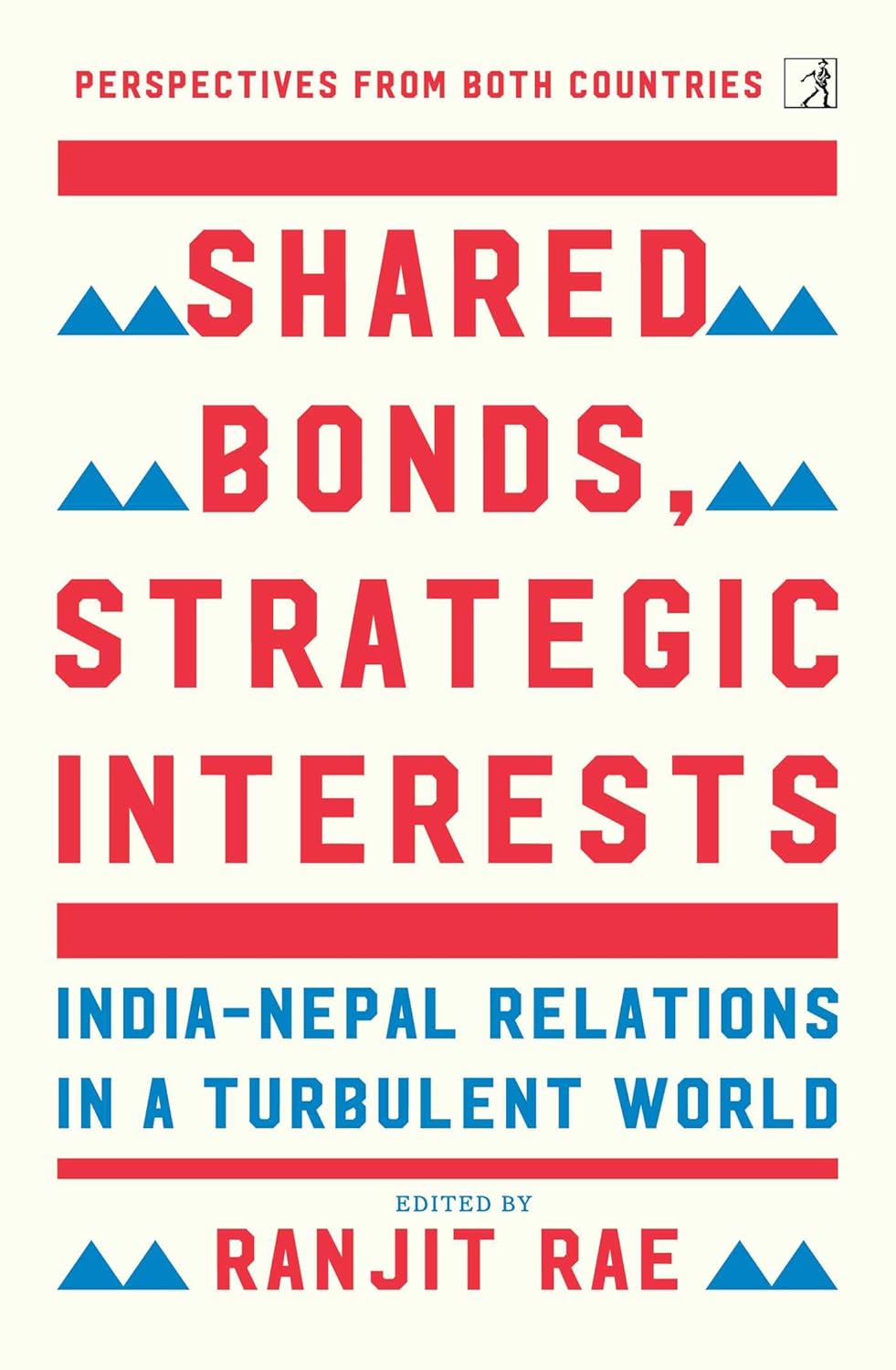
Shared Bonds, Strategic Interests
Editor: Ranjit Rae
Publisher: S&S IndiaYear: 2025
What was the original idea behind this book, and why did you feel this volume was needed now?
From India’s perspective, the country has global ambitions—whether to become a major power, to seek permanent membership of the UN Security Council, or to pursue the vision of ‘Viksit Bharat’. Achieving these goals requires investment and economic growth, but it also depends on a regional and global environment that is conducive to them.
In this context, the neighbourhood becomes extremely important. If India’s neighbourhood is unstable or in turmoil, the country’s attention will inevitably shift to security concerns and crisis management, as we are seeing in parts of the region today. A peaceful and stable neighbourhood is therefore essential, not only for India’s internal focus but also for how other countries perceive it.
Nepal, in particular, is one of India’s closest partners, culturally and in terms of development cooperation and security. Bilateral economic initiatives, including hydropower projects, are progressing steadily, which is a positive sign. India cannot afford to divert its focus from the neighbourhood, even as it engages with broader global challenges.
Do you think the emotional and cultural ties between the two countries are diminishing, and does the book address this?
The first chapter of the book focuses on borderlands, highlighting the importance of people-to-people ties between Nepal and India. Traditionally, discussions of roti-beti relations have centred on the Tarai–Madhesh region, but similar social, cultural, and familial connections also exist along Nepal’s eastern, western, and southern borders.
The open border between the two countries remains a major asset in sustaining these ties. However, it is also vulnerable to misuse, prompting increased security measures. When borders become overly securitised, traditional forms of interaction—such as marriages, shopping, and daily movement—are often affected. There are indications that cross-border marriages along Nepal’s southern border have declined, as crossing has become less easy than it once was.
Rather than relying on strict border controls, the emphasis should be on smart border management through better intelligence sharing and coordination between security agencies. This would help prevent misuse while preserving long-standing social exchanges. The open border between Nepal and India is unique in the region and has existed for centuries, even before modern boundaries were drawn. It plays a central role in sustaining cultural and emotional ties and should be protected.
Efforts such as twin-city initiatives, improved road and railway connectivity, and other cross-border projects are helping to strengthen these connections. While cultural ties may be weakening in some respects, there is still significant scope to reinforce them. Security concerns must not come at the cost of deep-rooted cultural interactions, particularly along the open border.
_________________
Ranjit Rae’s five book recommendations
India and the Persianate Age
Author: Richard M Eaton
Publisher: University of California Press
Year: 2019
In the book, Eaton views history not merely through the lens of conquest or violence, but through its cultural impact.
The Golden Road
Author: William Dalrymple
Publisher: Bloomsbury
Year: 2024
‘The Golden Road’ explores how ancient India shaped the cultural and spiritual life of Asia and the wider world.
In the Margins of Empires
Author: Akhilesh Upadhyay
Publisher: Penguin Random House
Year: 2025
In his latest book, Upadhyay examines territories on the peripheries of empires and their interactions.
Shattered Lands
Author: Sam Dalrymple
Publisher: Fourth Estate India
Year: 2025
Dalrymple traces the historical evolution of modern Asia and the changes in borders following several partitions.
Nalanda
Author: Abhay K
Publisher: Vintage Books
Year: 2025
Abhay K brings Nalanda back to life, a meeting place of cultures that attracted scholars from across the world.
Anish Ghimire
Ghimire is the Culture and Lifestyle Editor at the Post. He is also the author of 'A Walk Away From Home' and 'The Stardust In Us'.



Editor's Picks

Constitutional Bench caught in seniority, ‘pick and choose’ dispute

A Dom boy’s long road to becoming a doctor

From blankets to handmade dolls, two foreign women bring comfort to flood survivors

News Analysis: When institutional defence exposes institutional fault lines

It’s a bird … it’s a plane … it’s the Indian ambassador’s farewell tweets
E-PAPER | October 16, 2026

×